
Conditions We Treat
Standard Care vs. Regenerative Medicine for Joint Pain in Chicago for Knee Osteoarthritis

When persistent knee discomfort begins to interfere with daily mobility, whether walking or navigating a morning commute, the choice between traditional interventions and emerging biological therapies becomes a central focus for many patients. The landscape of regenerative medicine for joint pain in Chicago has shifted significantly in recent years, moving the conversation away from simple symptom management toward a deeper understanding of the joint’s internal environment. While standard care focuses on mechanical and inflammatory suppression, regenerative research investigates how cellular signaling might address the biological stasis that often prevents damaged cartilage and connective tissue from resolving on its own.
The Conventional Approach to Knee Osteoarthritis
For much of modern medicine, treating knee osteoarthritis has meant following a well-worn, stepwise path. The journey usually starts conservatively: physical therapy to strengthen the muscles surrounding the joint, and weight management to ease the load placed on deteriorating cartilage. When lifestyle modifications prove insufficient, physicians reach for pharmacological tools. NSAIDs (Non-Steroidal Anti-Inflammatory Drugs) are a common first choice for controlling day-to-day pain, though their prolonged use raises concerns, gastrointestinal complications, and cardiovascular risk, making them a less viable long-term solution for many patients.
When oral medications fall short, injectable therapies come into play. Corticosteroids have long been a go-to option, and for good reason; they act swiftly and powerfully against acute inflammation, offering patients meaningful short-term relief. Yet this benefit carries a hidden cost. Corticosteroids are catabolic in nature, meaning that even as they quiet inflammation, they may quietly accelerate the very cartilage breakdown they are meant to address.
Hyaluronic acid injections take a different approach, working mechanically rather than biologically by restoring some of the joint’s lost lubrication. They can ease discomfort, but they do little to alter the disease’s underlying course. Caught in this cycle of diminishing returns, a significant number of patients eventually arrive at total knee arthroplasty. The procedure is frequently effective, but it is no minor undertaking; recovery is lengthy, and the risks of surgery, including infection and the complications of anesthesia, are real and not trivial.
Biological Signaling and the Regenerative Perspective
In contrast to the suppressive nature of standard care, regenerative medicine explores the potential for “pro-tissue” signaling. The joints of the lower extremity, particularly the knee, are under constant mechanical load. When cartilage begins to wear down, the body’s natural repair mechanisms often stall due to a limited blood supply and a “pro-inflammatory” environment that prevents healing. Research in this field focuses on shifting the environment from degradation to homeostasis.
Our current research interests focus on several key modalities:
- Stem Cell Therapy: Investigating how mesenchymal stem cells (MSCs) use paracrine signaling to release growth factors and cytokines into the joint space.
- Exosome Therapy: Utilizing extracellular vesicles to carry proteins and microRNAs that may regulate cellular communication and reduce chronic inflammation.
- Peptide Therapy: Studying short amino acid chains for their potential role in supporting angiogenesis and extracellular matrix remodeling.
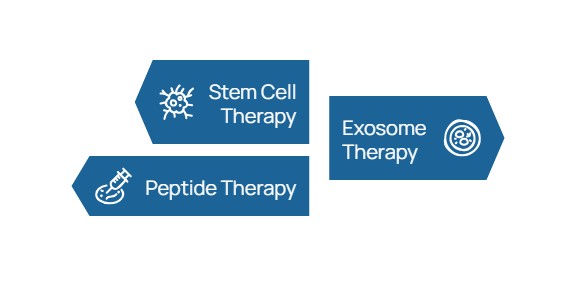
These approaches are not designed to fix the knee overnight. Instead, the focus is on the “paracrine effect”: the idea that these biological agents act as conductors, signaling the body’s local cells to modulate inflammation and support the integrity of the existing tissue. Unlike surgery, these are typically minimally invasive, outpatient procedures that allow patients to maintain their daily routines without the months of rehabilitation required after a joint replacement.
Comparative Analysis of Recovery and Outcomes
A primary distinction between standard care and regenerative approaches lies in the treatment timeline and the treatment goal. Standard care often aims for an immediate reduction in pain. A cortisone shot may work within 48 hours, but the effect typically wanes within weeks or months. Regenerative approaches generally have a delayed onset, as the biological signaling pathways take time to influence the joint environment. Patients may not notice a change for several weeks, but the goal is a more sustained improvement in functional scores.
Furthermore, the “risk-reward” profile of these treatments is a major point of discussion in Chicago’s medical community. Surgery addresses structural abnormalities directly but involves a permanent alteration of the anatomy. Regenerative medicine is being investigated as a middle-ground intervention; a way to potentially delay or avoid the need for surgery by addressing the joint’s biology before the damage becomes “bone-on-bone.”
Selecting the appropriate path requires a nuanced understanding of how these different treatments interact with the complex mechanics of the lower extremity. By moving beyond simple symptom suppression and exploring the potential of cellular signaling, patients can make more informed decisions about managing their joint health. Whether the goal is to return to a favorite sport or simply to walk without pain, integrating clinical evidence and personalized care remains the most effective strategy for long-term mobility.
Next step
Have a question for RLE Institute?
A national institute of physician specialists (DPM) advancing non-surgical regenerative medicine for the foot, ankle and lower leg — stem cell therapy, exosome therapy, peptide therapy and combination treatments — to help people move better and live with less pain. Locations in Ohio, Chicago, Puerto Rico, South Carolina, South Dakota and California.
Get in touch