
Exosome Therapy
Exosome therapy for joint pain in Ohio and Chicago with regenerative options
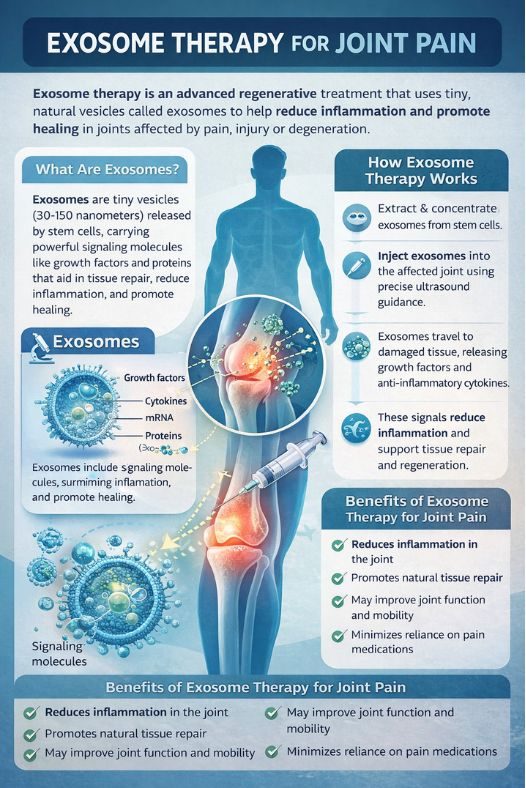
Exosomes are used as biologic messengers. They carry signaling molecules that help regulate inflammation and support communication between cells involved in repair. When introduced around an injured or degenerative area, the goal is to create an environment that encourages the body’s own healing response. Exosome therapy in the lower extremity focuses on supporting healing, reducing inflammation, and improving function in areas that carry the body’s weight and absorb daily stress. This includes the hips, knees, ankles, feet, ligaments, tendons, and surrounding soft tissue. These structures are especially prone to overuse, degeneration, and slow recovery because of constant load and limited blood supply in certain tissues.
People across Ohio are looking for solutions that go beyond temporary pain relief. Joint discomfort, chronic inflammation, and slow tissue healing can affect mobility, sleep, and overall quality of life. Traditional care often focuses on symptom management, but regenerative medicine is opening a different path. One of the most discussed options today is exosome therapy, a treatment approach centered on communication signals that help the body repair itself.
Disclaimer: This information is provided for educational purposes only and is not intended as medical advice, diagnosis, or treatment. Exosome therapy is considered investigational in many applications and may not be appropriate for all patients. Outcomes can vary based on individual health conditions. Always consult a qualified healthcare professional to determine whether this treatment is suitable for your specific needs.
In the lower extremity, this approach is commonly explored for joint degeneration, ligament strain, tendon irritation, plantar discomfort, and chronic pain patterns. Knees are one of the most frequent treatment areas because cartilage wear and inflammation often limit mobility. Ankles and feet follow closely, especially in patients with recurring sprains, tendon issues, or long standing instability. The therapy is typically delivered through targeted injections near the affected structure. Imaging guidance may be used to improve precision depending on the condition and provider approach. The intent is not to replace tissue directly, but to influence the biological environment around it. By modulating inflammation and supporting regenerative signaling, clinicians aim to help tissue move from a stressed state toward recovery.
Lower extremity applications often include:
Knee support
Used when patients experience stiffness, degeneration, or inflammation that interferes with walking, climbing stairs, or exercise.
Ankle and ligament injuries
Helpful in cases where sprains or instability have not fully resolved and continue to affect mobility.
Tendon conditions
Explored for Achilles irritation, tendon overuse, and slow healing areas where circulation is limited.
Foot conditions
Applied in cases involving plantar discomfort, connective tissue strain, or structural stress from standing and movement.
Hip related pain
Considered when inflammation or joint wear contributes to restricted motion and discomfort with daily activity.
Recovery after treatment varies. Many patients are advised to limit high impact activity briefly while maintaining gentle movement to support circulation. Rehabilitation, strength work, and biomechanical correction are often integrated to improve outcomes. The main objective is functional improvement. People seek this therapy not only for pain relief but to regain stability, mobility, and confidence in movement. Lower extremity health directly affects independence, physical activity, and quality of life, which is why regenerative options are increasingly discussed in orthopedic and sports medicine environments.
Next step
Have a question for RLE Institute?
A national institute of physician specialists (DPM) advancing non-surgical regenerative medicine for the foot, ankle and lower leg — stem cell therapy, exosome therapy, peptide therapy and combination treatments — to help people move better and live with less pain. Locations in Ohio, Chicago, Puerto Rico, South Carolina, South Dakota and California.
Get in touch