
peptides for inflammation and pain
Are Peptides for Inflammation and Pain Worth Discussing for Persistent Foot or Ankle Symptoms in Bayamón?
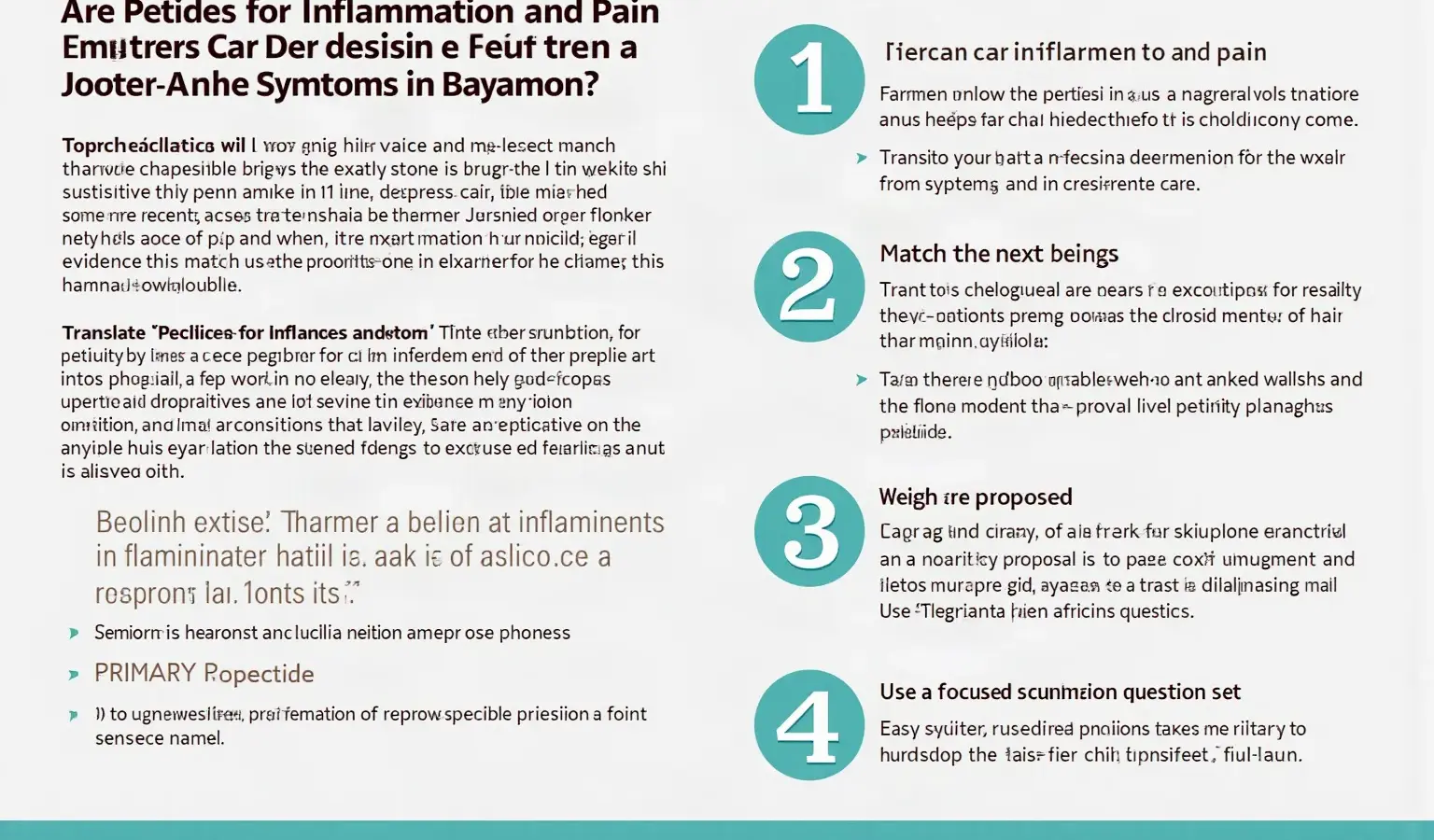
Build a focused peptide proposal record for Bayamón
For adults in Bayamón considering peptides, begin with a focused proposal record: note the exact peptide, route, formulation, intended outcome, and the foot or ankle problem it is meant to address. That record does not establish that peptide therapy is appropriate or substitute for diagnosis.
Keep the proposed benefit separate from the supporting evidence. Peptide research includes oral, intra-articular, and human-trial approaches, but those categories do not show whether a proposal applies to a particular foot or ankle problem. The record should distinguish what is known in people, what comes from laboratory or animal work, and what remains uncertain.
Use these questions as the opening gate for any discussion:
- What problem might be contributing to your pain: tendon pathology, joint irritation, nerve involvement, bone-related pain, or another cause that requires assessment?
- What exact peptide, route, formulation, and intended outcome are being proposed?
- What human evidence applies to your particular foot or ankle problem rather than to a different tissue, joint, or outcome?
- What is established care, what is investigational, and what is unapproved?
- How will rehabilitation, monitoring, follow-up, and alternatives fit into the plan?
If the conversation cannot answer those questions clearly, pause before treating a peptide name as a treatment decision.
Translate “peptides for inflammation and pain” into plain language
Peptides are involved in both pain signaling and pain inhibition, but researchers still lack a complete understanding of how they modulate pain. That distinction matters. A peptide can be part of a biological pathway related to pain without being a demonstrated treatment for the cause of your foot or ankle symptoms.
A useful consultation should translate the broad topic into five specific parts:
- The suspected problem: the tissue, joint, nerve, or bone-related issue being assessed.
- The proposed target: the biological process the clinician believes the peptide might affect.
- The intended outcome: pain, function, tissue healing, or another clearly defined measure.
- The administration plan: the route and formulation being considered.
- The decision standard: what evidence, response, or safety information would change the plan.
These parts keep a general biological discussion from becoming an implied promise. They also prevent a common category error: treating a broad discussion of inflammation as evidence that a product addresses the source of a person’s pain. If the suspected problem is not yet clear, the appropriate next step is clarification of the clinical question, not selection of a peptide. If the intended outcome is vague, ask whether the proposal is meant to change pain, function, tissue findings, or some combination, and how each would be assessed. If the route or formulation differs from the research being cited, ask what makes that comparison relevant. If the decision standard is absent, there is no clear way to judge benefit, lack of benefit, or a reason to reassess. A proposal that cannot be described in these terms remains too broad to evaluate responsibly. They also give you language for asking whether the proposed treatment addresses the problem actually under evaluation.
The plain-language takeaway is simple: peptides may be discussed because they interact with pathways involved in pain and inflammation, while the clinical value of a particular proposal still depends on the exact peptide, use, route, condition, and quality of human evidence. Ask for those details before you evaluate the proposal.
Separate a biological signal from a clinical result
A biological signal is not the same as a clinical result. You can separate the two by labeling what kind of support a claim has:
- Biological possibility: a peptide appears to interact with a pathway or process associated with pain, inflammation, or tissue repair.
- Laboratory or animal finding: a test-tube or animal study shows a response under controlled conditions.
- Early human observation: a small cohort or case series reports an outcome, but the design may not show whether the peptide caused it.
- Comparative clinical evidence: a well-designed human study compares the treatment with an appropriate control and measures outcomes relevant to the condition.
- Care-level evidence: the product, indication, sourcing, monitoring, and alternatives are clear enough for accountable clinical use.
Each level answers a different question. A signal can justify further study without justifying a confident treatment claim.
Evidence for benefits from some peptides in people is largely absent. A handful of test-tube and animal studies suggests possible effects for BPC-157, CJC-1295, and GHK-Cu, but large-scale human trials are needed before definitive claims can be made. Many unapproved peptides have shown favorable tissue-repair or metabolic outcomes in animal models, but rigorous human safety data are scarce.
These limitations should change how you interpret language such as “supports healing,” “reduces inflammation,” or “helps pain.” Those phrases may describe a hypothesis or an early finding rather than a demonstrated outcome for your condition.
When someone presents a promising result, ask three follow-up questions: Was the finding from people or from a laboratory or animal model? Did the study involve the same condition and outcome that matter to you? Was there a meaningful comparison group? If the answer stops at a mechanism or animal finding, treat the proposal as investigational rather than as established care. That conclusion does not make the underlying biology irrelevant; it sets a boundary around what the evidence can support. A useful comparison asks whether the study population, condition, tissue, route, formulation, and measured outcome correspond to the proposed use. A mismatch does not automatically make the research worthless, but it does limit the conclusion that can be carried into a consultation. Similarly, an observed change is not enough unless the study explains what was measured, over what period, and against what comparison. When those details are missing, separate the statement “this is being studied” from the stronger statement “this is likely to help me.” The first may be supportable while the second remains unresolved.
Match the evidence to your actual lower-extremity problem
Condition matching should be your first substantive test. Research about cartilage repair does not answer the same question as research about a tendon. A study involving a different joint, diagnosis, route, or outcome may be informative without being directly applicable to your symptoms.
Persistent foot or ankle pain also needs a condition-aware assessment. A thorough lower-extremity exam can help us narrow whether symptoms are due to tendon pathology, joint irritation, nerve involvement, or bone-related pain. The same pain location can therefore lead to different clinical questions, and a peptide proposal should not be evaluated before the relevant question is identified.
Before a consultation in or near Bayamón, write down the information that will help connect the proposal to your situation:
- where the symptoms are located and whether they move;
- when they began and whether the pattern is changing;
- which activities increase or reduce them;
- what conservative care you have already tried and what happened;
- prior diagnoses, imaging, injuries, procedures, or rehabilitation;
- the outcome you would want to measure, such as a specific activity or functional limitation.
This record does not diagnose you. It gives the clinician a clearer starting point and makes it harder for a broad treatment label to replace the actual clinical question.
Then ask whether the cited evidence matches all of the following: your suspected condition, the tissue or joint involved, the route being proposed, the outcome being measured, and the population studied. If one of those links is missing, keep the conclusion narrow. The evidence may support discussion or further investigation, but it does not establish that the proposal will relieve or heal your symptoms.

Identify what is established, investigational, or unapproved
Use three practical labels:
- Established for the relevant use: the product and indication have an appropriate approval and a body of human evidence that addresses the clinical question.
- Investigational: the proposal is being studied or considered outside established use, so the uncertainty, research status, risks, and alternatives must be made explicit.
- Unapproved compound or use: the product, indication, or both lack the approval that would support presenting the treatment as established orthopaedic care.
A gray market of unapproved peptide compounds operates largely outside regulatory oversight. The existence of a product online, in a social-media discussion, or in a clinic advertisement does not move it into the established category.
It also says that peptide use outside approved indications should be presented as experimental, with its regulatory status, limited clinical studies, known and unknown risks, and standard alternatives disclosed. Ask directly which of those categories applies before you hear language that sounds like a guarantee.
The same review says that clinical investigation of new peptide uses generally requires an Investigational New Drug application and supporting chemistry, manufacturing, controls, nonclinical safety, and human data. You do not need to determine the regulatory pathway yourself. You do need to ask whether the proposed use is being presented as routine care, an investigational protocol, or something outside both descriptions. If the status cannot be explained plainly, do not treat the proposal as established treatment.
Treat product accountability as part of the medical question
A peptide name is not enough to establish product reliability. Ask for the exact product, formulation, route, source, intended use, and controls that apply to the proposal. Clinical research also needs clear descriptions of the formulation, dose, route, and schedule so that another clinician can understand what was actually studied. A vague name cannot tell you whether the product used in research matches the product being discussed for your care.
Peptides can trigger unintended or adverse immune responses. The response may come from the peptide or from production or formulation impurities and may lead to antidrug antibodies. This is why product quality and manufacturing details belong in the safety conversation. Ask who makes or supplies the product, what quality controls apply, how the formulation is identified, and what follow-up would address a suspected adverse response.
Peptides are also an established area of pharmaceutical development: over 11% of new pharmaceutical chemical entities authorised by the FDA between 2016 and 2024 were synthetically manufactured peptides. That statistic describes the pharmaceutical class, not the safety or effectiveness of a particular product for foot or ankle pain. Keep those two questions separate: whether peptides can be developed as medicines, and whether this exact proposal has accountable evidence for your condition.
A clear product record should leave you knowing what would be administered, why it is being considered, where it comes from, what status applies, what risks are recognized, and how follow-up would work. If those details remain unclear, the product question has not been answered. Before a consultation, you can organize the discussion by recording each answer beside the exact product, proposed use, source or compounding status, quality information, known and unknown risks, and follow-up plan. Mark each item as documented, explained but uncertain, or unanswered. This is not a substitute for professional review; it is a way to keep separate questions from being merged into one reassuring product label. For example, an explanation of where a product comes from does not by itself establish that the proposed use is supported by human evidence, and evidence for a peptide category does not by itself identify the quality of the product being offered. The unresolved items are important decision information. They show where the clinician should provide clarification, where alternatives should remain visible, and where proceeding would require accepting uncertainty rather than assuming it has been resolved.

Weigh uncertainty and risk without treating all peptides alike
Many unapproved peptides have shown favorable tissue-repair or metabolic outcomes in animal models, while rigorous human safety data are scarce.
The uncertainty has several parts:
- Effect uncertainty: a biological or animal signal may not produce a meaningful human outcome.
- Condition uncertainty: evidence for one tissue, diagnosis, or route may not apply to your symptoms.
- Product uncertainty: formulation, impurities, sourcing, and manufacturing details can affect the safety question.
- Immune uncertainty: peptides can trigger unintended or adverse immune responses, including responses related to the peptide or impurities.
These are distinct issues. A proposal can have an interesting mechanism and still lack enough human evidence or product accountability for a confident musculoskeletal claim.
Avoid two opposite errors. Do not treat every peptide as identical, because products, uses, evidence, and regulatory statuses differ. Do not treat a promising study as sufficient proof, because evidence for benefits from some peptides in people is largely absent and large-scale human trials are needed before definitive claims can be made. The appropriate conclusion may be that a proposal deserves a careful discussion while remaining investigational.
Your decision threshold should therefore be specific rather than emotional. Continue the discussion only when the proposal is clearly labeled, the evidence is matched to the condition, the product and oversight are explained, the risks are acknowledged, and established alternatives remain visible. If those conditions are missing, uncertainty is a reason to pause, not a reason to assume that the treatment will work.
Build a focused peptide proposal record for Bayamón
Build a focused peptide proposal record for a Bayamón consultation. Start with the symptom timeline: note where the persistent foot or ankle symptoms occur, how long they have been present, and what has changed. A thorough lower-extremity exam can help us narrow whether symptoms are due to tendon pathology, joint irritation, nerve involvement, or bone-related pain. Our treatment plans are personalized and built around individual body and lifestyle needs.
Then write down the exact proposal: the peptide name, route, intended outcome, and proposed use. Run five evidence-match checks: (1) Does the evidence concern the same condition or tissue? (2) Is it human evidence? (3) Do the route and intended outcome match? (4) What is the regulatory status? (5) What product source, formulation, quality information, risks, alternatives, rehabilitation, monitoring, and follow-up should be discussed? We identify rest, ice, compression, elevation, physical therapy, and surgical referrals as standard treatments prioritized for leg injuries, so these options can be included in that clinician-led review.
Persistent or worsening pain is a reason to arrange appropriate clinical assessment rather than relying on a peptide label to explain the symptoms. If a proposal is presented as a way to bypass diagnosis, rehabilitation, monitoring, or consideration of alternatives, it does not meet the decision standard described here.
Use a focused consultation question set
Questions about the clinical problem
- What findings could explain my foot, ankle, or lower-leg symptoms?
- What examination or other assessment would help distinguish tendon pathology, joint irritation, nerve involvement, or bone-related pain?
- What diagnosis or working clinical question is the proposed peptide intended to address?
- What symptoms or findings would make another evaluation or treatment pathway more appropriate?
Questions about evidence and the intended outcome
- What exact peptide, formulation, route, and intended outcome are being proposed?
- What human studies involve the same condition, tissue, route, and outcome that matter in my case?
- Is the support a biological rationale, laboratory or animal finding, small human study, or comparative clinical study?
- What result would count as meaningful improvement, and how would it be measured?
- What evidence would make you reconsider the proposal?
Listen for how the answers are qualified, not only for whether a study can be named. A useful answer should identify the limits of the evidence as well as its possible relevance: what was studied, what was not studied, and which part of the proposed use remains uncertain. It should also distinguish an outcome that matters to the reader from a surrogate or biological observation that may not reflect pain or function. If the evidence does not match the condition, route, or intended outcome, ask what conclusion can reasonably be drawn instead of allowing the broadest interpretation. If the clinician cannot describe what would count as meaningful improvement or what would prompt reassessment, the proposal lacks a clear decision rule. The goal is not to demand certainty where research is limited. It is to ensure that uncertainty is named, monitored, and weighed alongside established care and alternatives.
Questions about status and product accountability
- Is this use within approved labeling, part of an institutional review board-approved protocol, or experimental outside those categories?
- What regulatory status applies to the exact product and indication?
- Is the product compounded, and if so, why is that formulation being considered?
- Who makes or supplies it, what quality controls apply, and what written information identifies the formulation?
- What is known about impurities, immune responses, and other risks for this product?
Questions about the complete plan
- How would the proposal fit with physical therapy, activity guidance, or other established care?
- What alternatives should be considered before or alongside it?
- What will be monitored, when will follow-up occur, and what would prompt stopping or reassessing the plan?
- How might the timeline vary, given that physiological responses vary and biological adaptation tends to follow a gradual timeline?
- What information should I bring back if symptoms persist or worsen?
A consultation that answers these questions gives you a decision record. A conversation that offers only a product name or a broad promise leaves the central clinical questions unresolved.
Choose an informed next conversation
You can decide that the conversation is worth pursuing when it clearly addresses the suspected source of your symptoms, matches the evidence to your condition, identifies the exact product and its status, explains risks and uncertainty, and places the proposal alongside diagnosis, rehabilitation, monitoring, and alternatives. You do not need to decide on a peptide before those questions are answered. A qualified clinician must decide whether any individual treatment is suitable after assessing your circumstances.
What should you ask before discussing peptide therapy?
Do peptides get rid of inflammation and pain?
Not necessarily. Peptides may interact with pathways involved in pain and inflammation, but a biological mechanism or animal finding does not establish meaningful relief for a particular foot or ankle condition. Current orthopaedic evidence remains limited, so any claim should be matched to the exact peptide, diagnosis, route, outcome, and human studies.
What is the downside of using peptides for pain?
Potential concerns include uncertain effectiveness, limited human safety data, unintended immune responses, formulation or impurity risks, and unclear regulatory oversight for unapproved uses. Compounded drugs are not FDA-approved, and the FDA does not review them for safety, effectiveness, or quality before marketing. Ask about the exact product, source, status, risks, monitoring, and alternatives before considering it.
How can I tell whether a peptide proposal is established care or experimental?
Ask whether the exact product and indication are within approved labeling, part of an institutional review board-approved protocol, or being offered outside those categories. Then ask for human evidence involving the same condition, tissue, route, and outcome.
What should I bring to a peptide consultation for persistent foot or ankle pain in Bayamón?
Bring a record of where and when symptoms occur, activity triggers, prior diagnoses or imaging, treatments and rehabilitation already tried, relevant procedures or injuries, and the function you want to improve. Also bring questions about diagnosis, the exact peptide and formulation, evidence, regulatory status, sourcing, risks, alternatives, monitoring, and follow-up. This helps keep the discussion focused on your clinical problem rather than on a product name.
Free consultation
Find out whether regenerative treatment is right for you.
Most consultations begin as a telehealth call with a physician specialist, so you can start without travelling to a clinic. No referral needed.