
heel bursitis home treatment
Heel Bursitis Home Treatment: A Safe Step-by-Step Approach
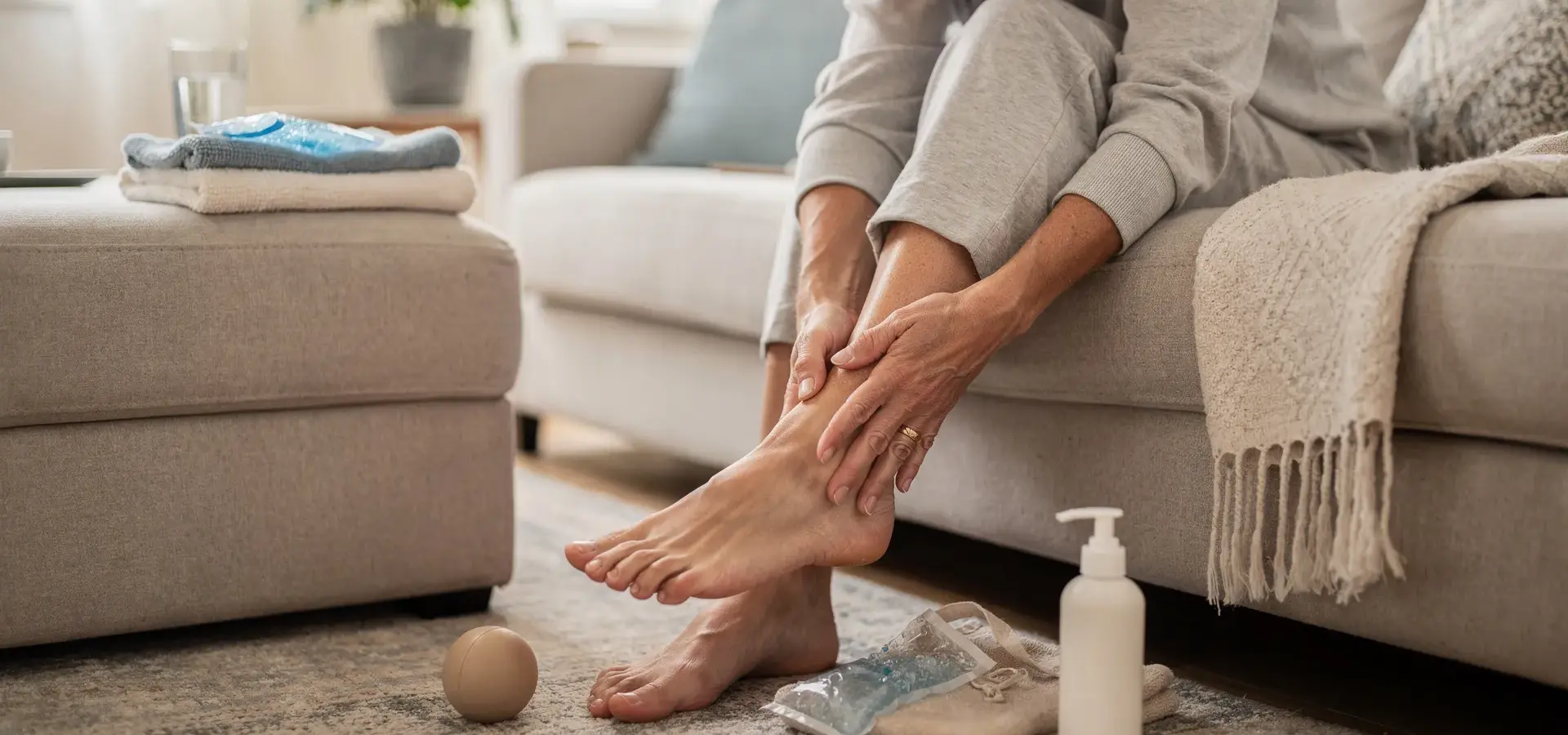
Start with the back-of-heel pattern, not a label
Possible heel-bursa irritation can cause pain, tenderness, stiffness, swelling, or redness. Heel bursitis is inflammation of a small, fluid-filled sac that cushions moving tissues near the heel. When the retrocalcaneal bursa is involved, the irritated sac sits between the Achilles tendon and the heel bone, so discomfort may be concentrated at the back of your heel.
That location can give you a useful starting point, but it cannot confirm the cause. Pay attention to where the pain is, what activity preceded it, whether the skin looks swollen or red, and whether the back of your heel is tender. Treat those details as information to record, not as a self-diagnosis.
Heel pain has several possible sources, including plantar fasciitis and Achilles tendon injuries, and different conditions require different treatments. Symptoms that resemble heel bursitis do not prove that bursitis is the cause. An examination may be needed to identify the source of your heel pain.
For mild symptoms that began recently, conservative home care may be reasonable while you watch how the pattern changes. The purpose is to reduce irritation without committing you to a diagnosis. If the pain is severe from the beginning, function is limited, or the pattern is unclear, move toward qualified evaluation instead of repeatedly testing the heel at home.
Remove the pressure that keeps symptoms active
Repeated heel pressure can keep a bursa irritated. Heel bursitis can develop when a bursa near the heel is repeatedly compressed or irritated; described causes include friction, pressure, repetitive motion, trauma, inflammation, or infection. A sudden increase in walking, running, or jumping can also contribute, especially when your ankles have not been conditioned for that load.
Start by identifying the activity that reliably reproduces the pain. Then reduce that load rather than testing it over and over. For the next phase of home care, use this short sequence:
- Pause running, jumping, uphill walking, or another specific trigger that increases your symptoms.
- Keep movement that remains comfortable, rather than treating rest as complete inactivity.
- Stop or scale back an activity when symptoms increase instead of pushing through worsening pain.
- If a lower-impact activity such as cycling or swimming feels comfortable and is medically appropriate for you, it may replace a high-impact workout temporarily.
A mild, recently started heel problem may settle when you reduce pressure and allow irritated tissue to calm. That does not mean you need to stay completely still or prove that the bursa is involved. It means removing the repeated compression that makes each step, hill, jump, or workout a fresh aggravation.
Use your symptom response as the boundary. Comfortable movement can remain part of your day; an activity that makes the heel hurt more should be shortened, changed, or paused. If ordinary walking is difficult or the pain is severe from the start, skip prolonged self-testing and arrange qualified evaluation.

Cool the heel conservatively
Cooling the back of the heel may calm discomfort for some people when used safely. Put a cold pack or a bag of frozen peas inside a cloth barrier rather than placing frozen material directly against your skin.
Ice timing varies by the condition and protocol. A general bursitis approach uses an ice pack or wrapped frozen peas for around 10 minutes at a time, repeated every few hours during the day. A retrocalcaneal-bursitis protocol describes 15-20 minutes on the back of the heel and ankle several times a day during the acute period. If you are unsure which approach fits your symptoms, ask a qualified clinician rather than treating a timing rule as proof of the diagnosis.
Persistent heel pain needs more than repeated cooling if the underlying source remains uncertain. Cooling can offer limited comfort, but it cannot identify whether the pain comes from a bursa, the Achilles tendon, or another condition.
Use cooling as a limited comfort measure while you monitor the pattern. Do not use temporary relief to justify returning immediately to the activity that caused the pain, and do not delay evaluation when warning signs or persistent symptoms change the decision.
Change the footwear that presses on the heel
Footwear that presses, rubs, or digs into the back of your heel can add irritation with every step. Shoes that dig into the back of the heel are described as a primary cause of calcaneal bursitis, and poorly fitting or too-tight footwear can irritate and inflame the retrocalcaneal bursa.
Inspect the shoes you wore when the pain began or worsened. Look for these possible contributors:
- A rigid heel counter that presses directly on the tender area.
- A worn-out sole or reduced cushioning.
- A recent shoe change that altered pressure on the heel.
- Activity-specific footwear that feels tight or rubs during movement.
- A fit that leaves the back of your heel compressed rather than comfortably supported.
Supportive footwear can reduce the pressure you place on the heel while symptoms settle. Choose shoes with suitable cushioning and support, including a cushioned sole and appropriate arch support. Those features can help reduce heel pressure and further irritation, but they do not establish whether bursitis is the source of your pain.
For now, favor the pair that does not reproduce the symptoms over the pair that looks most suitable for your sport or routine. If every shoe remains painful, if the heel becomes increasingly swollen, or if walking becomes difficult, footwear changes are no longer enough to guide the next step.
Avoid forceful attempts to walk it off
Forceful self-treatment can keep an irritated heel under repeated stress. Avoid aggressive stretching, deep massage, or trying to walk off heel pain when those actions increase discomfort. Repeated friction and pressure can maintain irritation, and stretches can sometimes further irritate the area.
A useful boundary is simple: an activity or technique that makes the heel hurt more is not a home-care success. Stop it, return to comfortable movement, and reduce the load that triggered the response. Do not turn a tolerable symptom into a worsening one by repeatedly checking whether the heel is ready for running, jumping, long standing, or a demanding workout.
Keep exercises and corrective treatment guided
Guided exercise, physical therapy, orthotics, and corrective treatment require a clearer understanding of what is causing your heel pain. Conservative treatment may include guided stretching and strengthening, properly fitting supportive shoes, custom orthotics, and physical therapy. A physical therapist’s individualized program is likely to involve strengthening exercises, while stretching can sometimes further irritate the area.
That distinction matters because the same back-of-heel pain can reflect different conditions. General home care can reduce pressure, modify activity, and provide limited comfort. It should not become a universal exercise prescription. Do not begin forceful calf or Achilles stretching, select an orthotic to correct an assumed alignment problem, or follow an intensive strengthening plan simply because the pain is near the heel.
Professional assessment can connect the exercise or footwear plan to your findings rather than to the word bursitis alone. Bursitis usually responds well to conservative management, but the appropriate conservative plan depends on the individual assessment. A qualified clinician may guide strengthening, stretching, physical therapy, or orthotic decisions after considering the location and behavior of your pain.
Until that assessment, keep your actions low-force and symptom-guided. If a prescribed or self-selected exercise makes your heel more painful, stop the exercise and seek guidance instead of increasing the effort to overcome the pain.
Change course when symptoms persist or warning signs appear
Persistent heel pain changes the question from “What can I try at home?” to “What is causing this, and what care fits it?” Arrange qualified evaluation if your heel pain is severe from the start or is not improving after a week or two of thoughtful home care. Seek medical evaluation if symptoms have not improved or are worsening after 1 to 2 weeks of self-care.
Symptoms can return when you resume running, prolonged standing, or footwear that presses on the heel. Recurrence deserves reassessment rather than another automatic round of the same self-care. The source may need clarification, especially when the pattern does not improve as expected.
Warning signs require prompt medical assessment rather than continued home treatment. Seek care promptly for any of these changes:
- A hot, red, rapidly worsening, swollen heel, especially with fever or feeling unwell.
- Skin at the back of the heel that feels particularly hot; this may indicate septic bursitis, which is uncommon but serious.
- A high temperature, feeling hot, cold, or shivery.
- Inability to move the affected joint.
- Very severe, sharp, or shooting pain.
- A sudden pop followed by new weakness or difficulty walking, which raises concern for a significant tendon injury.
Do not wait for a full home-care trial when these signs appear. Move from symptom management to qualified medical assessment.
A separate prospective study illustrates why persistent symptoms should not be used to predict your personal timeline. The nonoperative program in that study lasted an average of 163 days. Of the 103 participants who completed the program, 88% had improved symptoms and deferred surgery; the 88% figure represents those 103 study completers, and the study had no control group. Before the treatment protocol, the participants had experienced symptoms for an average of 15 months.
These figures describe specific study groups and do not establish that you need 163 days of treatment, that your symptoms have lasted 15 months, or that you have a tendon tear. Persistent or unclear heel pain needs an examination that addresses your own pattern.
Those study details are background, not a home-care schedule. They do not tell you how long to cool your heel, when to resume running, whether an orthotic is appropriate, or whether surgery can be deferred in your case. Because the study had no control group, its figures do not establish that the program itself caused improvement or show how it compares with another approach. If symptoms are mild and recent, continue only the conservative measures described above that do not increase pain. A return of pain with running, prolonged standing, or footwear pressing on the heel is a reason to reassess rather than repeat the same routine. The purpose of that evaluation is to clarify the source and match care to findings, not to confirm a label chosen at home.
Use the study only to understand why an unchanged or recurring pattern deserves attention. It is not evidence that home treatment has failed at a particular point, that an ultrasound is always needed, or that a procedure is required. A clinician can decide whether examination, imaging, therapy, footwear changes, or another conservative measure is appropriate after considering the symptoms and functional limits. Until then, comfortable movement and reduced irritation remain the general boundaries of home care; forceful stretching, deep massage, and pushing through worsening pain do not fit those boundaries.

Arrange the next conversation
Write down when the heel pain began, where it is located, which activity or shoe increases it, what happens after activity modification and cooling, and whether you have noticed swelling, redness, unusual warmth, weakness, or difficulty walking. Bring the pattern rather than a self-assigned label.
If cautious home care has not helped after 1 to 2 weeks, if symptoms keep returning, if the pain is severe, or if the cause remains uncertain, arrange qualified evaluation instead of extending self-treatment indefinitely. A qualified professional can decide which assessment and treatment options fit your individual findings.
Questions about safe home care and heel evaluation
Can heel bursitis home treatment confirm what is causing my heel pain?
No. Home care may reduce pressure and discomfort, but symptoms can overlap with plantar fasciitis, Achilles tendon injuries, and other conditions. An examination may be needed to identify the source, especially when pain is severe, persistent, recurrent, or difficult to localize.
Is walking bad for possible heel bursitis?
Not necessarily. Comfortable movement may be appropriate, but reduce or stop walking that increases symptoms, particularly uphill walking or prolonged activity. Do not try to walk off worsening pain; use the symptom response to guide activity while avoiding running, jumping, or another clear trigger.
What information should I bring to a foot-and-ankle evaluation?
Record when the pain began, where it is located, which activities or shoes increase it, and what happened after reducing activity or using cooling. Also note swelling, redness, unusual warmth, weakness, difficulty walking, recurrence, or any sudden pop. Bring these observations rather than assuming the cause is bursitis.
Free consultation
Find out whether regenerative treatment is right for you.
Most consultations begin as a telehealth call with a physician specialist, so you can start without travelling to a clinic. No referral needed.