
ankles pain
Ankle Pain: Use Symptom Patterns and Duration to Choose Your Next Step

Start with the action question, not a diagnosis
Ankle pain deserves an action decision before it deserves a label. The useful first question is not “Which condition do I have?” but “What should I do next based on how this pain started, where it is located, how long it has lasted, and whether any warning signs are present?”
Ankle pain can follow a sprain, strain, fracture, arthritis, tendon problem, overuse, or nerve problem. A sudden injury may produce sharp pain, swelling, a popping or snapping sound, difficulty walking, or an ankle that appears to sit at an unusual angle. Those features can occur with a broken ankle. Nerve problems can cause ankle pain with tingling or numbness. Arthritis can affect the ankle and cause inflammation and pain. These patterns help you decide what information to bring forward; they do not establish the cause by themselves.
Use the guide in three passes:
- Screen the timing. Decide whether the pain began after an injury, followed increased activity, or appeared without a clear event.
- Map the pattern. Note the exact location, swelling, stiffness, instability, altered sensation, and whether one or both ankles are involved.
- Set the next level of care. Separate urgent warning signs from a pattern that can be monitored briefly and from pain that has persisted or returned enough to merit an evaluation.
The goal is a clearer clinical conversation, not certainty at home. A symptom record can help you describe what is happening even when the pattern remains mixed or changes from day to day.
What the pattern can and cannot establish
An ankle-pain pattern can organize your next question, but it cannot identify a diagnosis without a clinical assessment. Location and timing are useful because different tissues and conditions can produce different combinations of pain, swelling, altered sensation, or loss of function.
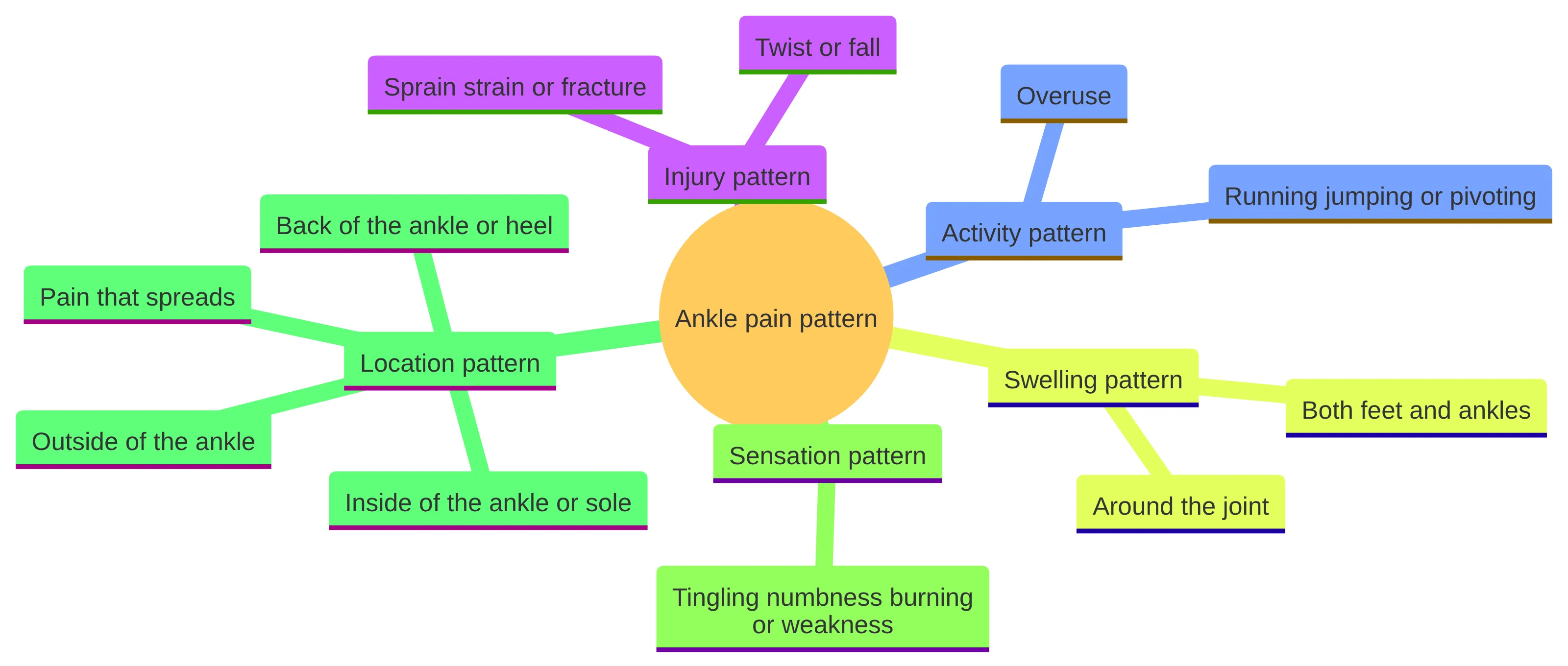
A practical pattern map looks like this:
- Pain after a twist, fall, impact, or sudden misstep: Sprains, strains, and fractures are possible injury categories. A sprain occurs when ankle ligaments are stretched or torn. Sudden sharp pain, swelling, a popping or snapping sound, difficulty walking, or an ankle at an abnormal angle raises the need for prompt assessment.
- Pain after repeated running, jumping, pivoting, or another increase in activity: Overuse can cause ankle pain or discomfort, particularly in people who perform those activities. The activity link is a clue about load, not proof that overuse is the only cause.
- Pain with swelling around the joint: Arthritis, an injury, a local tendon problem, or another condition may need consideration. Arthritis, including osteoarthritis, rheumatoid arthritis, and gout, can affect the ankle joint and cause inflammation and pain.
- Pain with tingling, numbness, burning, or weakness: Nerve problems can produce this combination. A change in sensation or power deserves clinical attention, especially when it progresses.
- Pain on the outside of the ankle: Peroneal tendinitis can affect tendons along the outer ankle and side of the foot. Sinus tarsi syndrome can cause pain and swelling along the outside lower edge of the ankle, sometimes spreading to other areas.
- Swelling in both feet and ankles: Swelling affecting both sides can be associated with systemic conditions, including cardiac or renal problems. Localized swelling is more likely to reflect a local problem, but that distinction still requires clinical context.
These categories overlap. An ankle can hurt after an injury and later feel unstable; arthritis can coexist with an old sprain; nerve symptoms can occur alongside a local foot or ankle problem. Treat the pattern as a way to choose the next conversation, not as a way to rule conditions in or out.
When pain follows injury or increased activity
Ankle pain after an injury or activity increase should be organized around the event, the immediate symptoms, and what you can do now. A sprain, strain, fracture, or overuse problem can begin with a similar complaint, so the mechanism and functional change matter more than the word you choose for it.
Write down the event in plain language:
- What happened: twist, fall, direct impact, misstep, or no single event.
- What you heard or felt: a pop, snap, sudden pull, or gradual soreness.
- What changed immediately: swelling, bruising, pain with movement, inability to walk normally, or a visible change in shape.
- What changed afterward: improving symptoms, persistent limitation, repeated giving-way, or worsening pain.
Sudden sharp pain with swelling, a popping or snapping sound, difficulty walking, or an ankle at an abnormal angle can be warning signs of a broken ankle. Seek medical assessment for that pattern rather than testing the ankle repeatedly at home.
That guidance is limited to initial management of a sprain; it does not tell you that every painful ankle is sprained or that home measures are enough.
A review of ankle-injury evidence found support for functional support and nonsteroidal anti-inflammatory drugs after ankle sprain. The same review found that exercise may reduce recurrent sprains and help chronic ankle instability, while also describing limits and judgment around how care is applied. Do not turn that review into a personal medication or exercise plan. Bring your injury history, current medicines, health conditions, and functional limits to a clinician who can decide what applies to you.
Increased activity deserves the same careful separation. Running, jumping, and pivoting can place repeated demands on the ankle, and overuse can cause pain or discomfort. Reduce the activity that clearly aggravates your symptoms while you arrange care, but do not use the activity link as proof that a tendon, ligament, joint, or bone is involved. Persistent or worsening pain changes the question from “How do I settle this?” to “What needs to be assessed?”
When location narrows the conversation
Ankle-pain location can narrow the conversation by showing which area needs closer attention, but location alone cannot identify the cause. Describe the spot with one hand: outside, inside, front, back near the Achilles tendon, around the joint, or extending into the heel and foot.
Outside ankle pain can occur with peroneal tendinitis, which affects tendons along the outer ankle bone and side of the foot. Sinus tarsi syndrome can also cause pain and swelling along the outside lower edge of the ankle, with symptoms sometimes spreading to other areas of the ankle. Ask whether the pain is superficial or deep, whether the area is swollen, and whether uneven ground or turning makes it worse.
Back-of-ankle or heel-area pain may involve the Achilles region. Achilles tendonitis is one possible cause of ankle pain because tendonitis involves inflammation of the tendons. Pain in this area deserves a description of whether it occurs with walking, standing on tiptoes, or activity, without assuming that the tendon is the source.
Inside-ankle or sole-of-foot symptoms can occur with a nerve problem. Tarsal tunnel syndrome affects the foot and ankle when the tibial nerve is damaged, and nerve problems can cause pain with tingling, numbness, burning, or weakness. The combination of location and altered sensation is more useful to report than a self-assigned label.
Pain that spreads needs a broader description. Note whether it travels up the leg, moves into the foot, or remains at one point. Pain and swelling from sinus tarsi syndrome may spread to other ankle areas, while plantar fasciitis can cause heel pain that radiates up the leg. A spreading symptom does not automatically mean the condition is more serious, but it gives a clinician another feature to assess.
Use a simple location sentence at an appointment: “The pain is on the outside of my right ankle, began after increased walking, swells by evening, and does not cause numbness.” That description is more actionable than “My ankle hurts.”
When stiffness, swelling, or both ankles are involved
Ankle stiffness and swelling become more useful when you describe their timing, distribution, and associated symptoms. Stiffness by itself does not establish arthritis, and swelling by itself does not establish an injury. Both details should be placed alongside duration, activity, pain location, and your general health context.
Record the swelling pattern:
- Is the swelling around one small area, the ankle joint, the whole foot, or the entire lower leg?
- Does it affect one side or both sides?
- Did it start suddenly or build over time?
- Is the area hot, red, or very painful?
- Does swelling appear after activity, remain throughout the day, or occur without an obvious trigger?
Swelling around the ankle joint may relate to degenerative changes or inflammatory joint disease, while localized swelling can reflect a local problem. Swelling of both feet and ankles can be associated with systemic conditions, including cardiac or renal problems. These are reasons to describe the distribution carefully rather than treating all ankle swelling as a routine sprain.
Osteoarthritis, rheumatoid arthritis, and gout are among the forms identified in the accepted medical guidance. If stiffness, swelling, or pain recurs, ask a clinician whether the pattern needs evaluation for a joint condition rather than relying on a symptom label.
Swelling changes the timing when it is unexplained, severe, sudden, worsening, red, hot, or accompanied by feeling feverish or shivery. NHS guidance also advises urgent medical help for swelling in one ankle, foot, or leg without a known cause and for swollen feet, ankles, or legs in a person with diabetes. Seek urgent medical help for those combinations instead of waiting to see whether ordinary rest settles them.
Stiffness can be described by function: how long it lasts after rest, whether it limits the first steps, and whether movement becomes easier or harder as the day continues. Do not force a painful joint to test it. The purpose of the record is to give the clinician a pattern to examine, not to create a home test.
When pain feels neurologic or affects stability
Nerve symptoms and ankle instability change the questions you should bring to an evaluation. Pain with tingling, numbness, burning, or weakness can reflect a nerve problem, while repeated giving-way can follow an ankle injury or involve the structures that stabilize the joint.
Describe altered sensation precisely:
- Where does the numbness or tingling begin, and where does it end?
- Does it stay in one area or travel into the foot or lower leg?
- Is it present at rest, during walking, or after a particular position?
- Does it occur with burning, weakness, tripping, or difficulty lifting the foot?
- Is the pattern new, recurring, or progressively more noticeable?
Nerve problems can cause ankle pain with tingling, numbness, burning, or weakness. Tarsal tunnel syndrome affects the foot and ankle when the tibial nerve is damaged; treatment may include nonsurgical care, steroid injections, custom orthotics, or surgery in severe cases. Those categories describe possibilities for a clinical discussion, not a recommendation for your symptoms.
Instability deserves its own description. Record whether the ankle gives way, whether the problem began after a sprain, whether uneven ground triggers it, and whether you have fallen or stopped activities because you do not trust the ankle. A prior injury can be part of the history even when current pain is mild.
Ankle surgery can include procedures intended to repair cartilage, remove bone spurs, or tighten ligaments to stabilize the ankle. The cited clinical guidance describes arthroscopic surgery in the context of smaller cartilage problems and mild arthritis conditions. That does not mean instability or pain automatically calls for surgery. It means a clinician may need to distinguish a structural problem from symptoms that can be managed through another category of care.
Changes in sensation, loss of power, frequent tripping, or a change in foot shape are reasons to contact a health professional. Do not wait for a complete loss of function before reporting a progressive neurologic or stability pattern.
The warning signs that change the timing
Ankle-pain warning signs change the timing from routine monitoring to prompt or urgent medical assessment. Use the following lanes as a safety screen, not as a diagnosis.
Seek urgent medical help for unexplained swelling in one ankle, foot, or leg; severe or sudden swelling; a red or hot swollen area; feverish or shivery symptoms; or swollen feet, ankles, or legs when you have diabetes. NHS guidance identifies these combinations as reasons for urgent help.
Arrange prompt professional assessment for pain that lasts more than three months, progressively worsens, or is not easing; unexplained swelling; a hot swollen joint; changes in sensation; weakness; a change in foot shape; or a rash, skin discoloration, ulceration, or possible infection. Pain that wakes you or keeps you from sleeping, fever, night sweats, and unexplained weight loss also warrant professional assessment.
Seek assessment after a sudden injury when sharp pain is accompanied by swelling, a popping or snapping sound, difficulty walking, or an ankle at an abnormal angle. Those symptoms can occur with a broken ankle.
Do not use improvement in one symptom to cancel another warning sign. For example, less pain does not explain unexplained one-sided swelling, and a familiar history of sprains does not explain new weakness or a change in foot shape. A mixed pattern still needs to be described accurately.
Persistent pain deserves attention even when it is not urgent. One selected source advises contacting a health professional for pain lasting more than three months or pain that is progressive and not eased. Other guidance emphasizes additional warning features such as sleep disruption or systemic symptoms. These points are not competing instructions: persistent or worsening pain is a reason to arrange assessment, while the added features increase the need for prompt attention.
If you are unsure whether a symptom fits an urgent category, describe the exact change, its timing, and any associated swelling, heat, feverish feeling, weakness, or altered sensation when seeking medical advice. Avoid waiting for a perfect label.
What may be reasonable while arranging care
General measures while arranging care should stay within the limits of the pattern you have observed. They can help you avoid repeatedly aggravating an ankle, but they cannot determine what is injured or replace an evaluation when warning signs are present.
Use that statement as general information about initial sprain guidance, not as an individualized plan for an unexplained, severe, swollen, or neurologic ankle problem.
A sensible short-term record can include:
- The activity or movement that increases pain.
- Whether ordinary walking is becoming easier, harder, or unchanged.
- The location and size of swelling.
- Any bruising, warmth, redness, numbness, tingling, burning, weakness, or instability.
- The date symptoms began and whether they are improving, stable, recurring, or worsening.
Avoid turning symptom relief into a clearance test. If a measure reduces discomfort temporarily, that does not show that the underlying problem has resolved or that the ankle is ready for a return to full activity. If a measure increases pain, stop using it and include that response in your clinical history.
General information does not supply a personal medication choice, dose, or exercise program. Medication decisions can depend on your health history and other medicines, and exercise decisions can depend on what structure is affected and how stable the ankle is.
Self-care has reached its limit when pain is persistent, progressive, recurrent, or accompanied by unexplained swelling, altered sensation, weakness, feverish symptoms, skin changes, or difficulty walking. It has also reached its limit when you cannot tell whether the original event was a sprain, fracture, or another injury. Arrange care rather than extending an informal trial indefinitely.
Why duration and recurrence matter
Ankle-pain duration and recurrence add meaning that a single symptom snapshot cannot provide. Note the start date, the first trigger, the longest symptom-free interval, and what happens when the pain returns.
A pattern that improves after a clear minor strain and does not return raises a different clinical question from pain that persists for more than three months, progressively worsens, or repeatedly returns after activity. Guidance advises contacting a health professional for pain lasting more than three months, progressive pain that is not eased, or symptoms that worsen rather than improve within the expected period for self-management.
Recurrence can be described without deciding why it happens:
- “The pain returns every time I increase walking.”
- “The ankle gives way twice a month.”
- “Swelling appears after activity and is gone by morning.”
- “The pain never fully stopped after the original sprain.”
- “Both ankles became uncomfortable over the same period.”
A review of ankle-injury evidence found that exercise may reduce recurrent sprains and help chronic ankle instability. That finding gives recurrence a place in the clinical discussion, but it does not tell you which exercise, level of activity, or treatment category is appropriate for your ankle.
Duration also affects how you frame treatment questions. A short-lived symptom after a known injury may lead to questions about protection, support, and follow-up. Persistent pain may lead to questions about whether the diagnosis, contributing structure, or treatment category needs clarification. Recurrent pain may lead to questions about stability, load, nerve symptoms, or an underlying joint problem.
Do not let a long duration automatically prove that surgery or regenerative care is necessary. Duration is a reason to arrange assessment and improve the quality of the discussion. It is not a substitute for an examination, a diagnosis, or a conversation about your goals.
What an evaluation can clarify
A clinical evaluation can turn a symptom pattern into a more specific set of questions about the joint, tendons, ligaments, nerves, bones, and surrounding tissues. The evaluation can also place your duration, functional limits, prior treatment, and goals into the same discussion.
Bring these details:
- How the pain began and whether there was an injury or activity change.
- The exact location and whether symptoms spread.
- Swelling, bruising, stiffness, instability, altered sensation, weakness, or skin changes.
- What walking, stairs, uneven ground, standing, or exercise feels like.
- What you have already tried and what changed afterward.
- Your relevant medical history, including diabetes or conditions that may affect swelling, sensation, healing, or activity.
A foot-and-ankle history and examination guide emphasizes details such as whether swelling is localized or generalized, whether it affects one or both sides, and whether it is associated with activity, frequency, and duration. The same clinical context treats numbness, weakness, and burning as neurologic symptoms that can relate to spinal problems or peripheral neuropathy. These details help a clinician decide what requires closer examination.
An evaluation can also separate treatment categories that sound similar in casual conversation. A smaller cartilage problem, mild arthritis, extensive arthritis, ankle instability, a nerve problem, and a suspected fracture do not create the same discussion. The cited guidance describes arthroscopy for smaller cartilage problems and mild arthritis conditions, total ankle replacement as a possible option for extensive ankle arthritis, and ankle fusion as an option for ankle arthritis that no longer responds to nonsurgical treatment.
We offer clinical evaluations for patients considering regenerative treatment options for foot and ankle conditions. Our treatment plans are personalized around individual body and lifestyle needs. A consultation can therefore begin with the pattern you have documented rather than with an assumption that one treatment applies to every ankle problem.
The useful result of an evaluation is a clearer next decision: what needs attention now, which options fit the condition being discussed, what limitations remain, and when the response should be reassessed. That decision can be made more useful by asking the clinician to connect each option to a specific finding rather than to pain alone. Ask whether the discussion is centered on a joint, tendon, ligament, nerve, bone, or surrounding tissue; what information supports that focus; and what remains uncertain. Then ask what the proposed option is meant to address—pain, function, stability, or another stated goal—and which alternatives are relevant to the same problem. This keeps a treatment conversation from becoming a list of procedures detached from the condition being evaluated.
It is also reasonable to ask how follow-up will work: what response will be monitored, when it will be reviewed, and what would prompt a different evaluation. These questions do not predict an outcome. They make the limits of the plan visible and help you compare an option with continued nonsurgical care, an injection, rehabilitation, or surgery when those categories are relevant. The answers should remain specific to the condition under discussion and to your goals, rather than treating ankle pain as one uniform problem.
Compare treatment categories by purpose and limits
Ankle-pain treatment categories should be compared by what they are intended to address, what the accepted information supports, and what remains uncertain. Pain duration alone does not establish which treatment category fits a person’s situation.
| Treatment category | Purpose or setting described in the available guidance | Limit to keep in view |
|---|---|---|
| Initial supportive care | For an ankle sprain, guidance includes initial rest, ice, elevation, and keeping the foot moving as much as possible. | This does not establish that an unexplained or severe ankle problem is a sprain. |
| Nonsurgical nerve-related care | For tarsal tunnel syndrome, treatment may include nonsurgical care, steroid injections, or custom orthotics. | Those options are described for a specific nerve condition, not for every form of ankle pain. |
| Arthroscopic surgery | Guidance describes arthroscopy in connection with repairing cartilage, removing bone spurs, or tightening ligaments, generally for smaller cartilage problems and mild arthritis conditions. | The procedure and its suitability depend on the structure and condition being assessed. |
| Total ankle replacement | For extensive ankle arthritis, total ankle replacement may be an option; damaged bone surfaces are replaced with metal components and a plastic articulating surface. | This is a surgical option for a particular arthritis context, not a general response to ankle pain. |
| Ankle fusion | Ankle fusion is described as an option for ankle arthritis that no longer responds to nonsurgical treatment. | The discussion belongs after the arthritis and response to nonsurgical care have been assessed. |
| Regenerative approaches | Regenerative care can be discussed in a clinical evaluation; PRP outcomes may differ among patients, and exosome therapy is being investigated for possible support of cell-to-cell communication during repair in tendon and ligament tissue. |
The comparison shows why “What treats ankle pain?” is too broad a question. Ask instead: “What is this category intended to address in my pattern, what evidence applies to my condition, what are its limits, and what would make us change course?” Keep injections, surgery, rehabilitation, and regenerative approaches downstream of the condition being evaluated. To make the comparison usable, apply the same five-part filter to each option:
- Problem: What condition or tissue is the discussion addressing?
- Purpose: Is the proposed goal to address pain, function, stability, tissue support, or another stated concern?
- Evidence: What information applies to this specific ankle problem, rather than to a different joint, tendon, or symptom pattern?
- Limits: What remains uncertain, and what does the option not establish or guarantee?
- Next decision: What response would be reviewed, and what would lead to continued care, reassessment, or discussion of another category?
Writing the answers in the same format makes differences easier to see without turning the comparison into a promise of benefit. It also keeps a treatment name from becoming the starting point of the decision. The starting point remains the condition being evaluated, the reader’s goals, and the limits of the available information.
Where regenerative care belongs in the discussion
Regenerative care belongs in a clinician-led discussion after your ankle pattern, condition, goals, and alternatives have been considered. It is not a universal answer to ankle pain, and it should not be presented as a way to avoid surgery.
We describe regenerative medicine for lower-leg conditions as an area of growing scientific interest for stubborn Achilles tendon pain. We also explain that exosome therapy is being investigated for its potential to support cell-to-cell communication during repair, particularly in tendon and ligament tissue. “Being investigated” is a meaningful boundary: it identifies an area of scientific interest without promising that a treatment will repair tissue or relieve your pain.
We explain that PRP outcomes may differ among patients and may be influenced by age, overall health, and metabolic function. That variability belongs in the consultation, especially when you are comparing an injection or regenerative approach with continued nonsurgical care, another injection, or surgery.
Use these questions to keep the discussion concrete:
- What condition are we trying to address, and what findings support that understanding?
- Is the proposed approach intended for pain management, tissue support, functional recovery, or another purpose?
- What evidence applies to this specific ankle problem rather than to a different tendon, joint, or body area?
- How might my age, health, metabolic function, prior treatments, and activity goals affect the discussion?
- What alternatives should I compare, including continued nonsurgical care, an injection, rehabilitation, or surgery when relevant?
- What would count as an adequate response, and when would the plan be reassessed?
- What symptoms or findings would make this approach unsuitable or require a different evaluation?
We offer clinical evaluations for patients considering regenerative treatment options for foot and ankle conditions, and our treatment plans are personalized around individual body and lifestyle needs. That means the appropriate next conversation starts with your condition and goals, not with an assumption that every person with ankle pain should receive the same therapy.
Questions to take to a clinician
Clinician questions work best when they connect your symptom pattern to a decision. Take a short list rather than trying to cover every possible diagnosis.
Questions about the pattern
- What structures or conditions could fit the location, timing, swelling, stiffness, instability, or nerve symptoms I described?
- What findings would distinguish an injury, arthritis, tendon problem, nerve problem, or another cause?
- Does the involvement of one ankle or both ankles change what needs to be considered?
- Do my duration and recurrence pattern change the timing or type of evaluation?
Questions about the next step
- What should I do while the cause is being clarified?
- Which activities should I pause, modify, or discuss before resuming?
- What symptoms should make me seek earlier assessment?
- When should we review whether the current plan is helping?
Questions about treatment categories
- What is the purpose of each option for the condition you are evaluating?
- What evidence applies to this specific problem?
- How do nonsurgical care, injections, rehabilitation, surgery, and regenerative approaches compare for my situation?
- What are the material limits, risks, and alternatives of each option?
- If regenerative care is being discussed, how might age, overall health, metabolic function, and prior treatment affect the conversation?
- What would make you recommend reassessment or a different category of care?
The goal is not to leave with the longest list of treatments. The goal is to understand which question each option is meant to answer and what information would change the plan. That approach is especially useful when pain has continued after rest, braces, injections, or medication, because treatment history can show what changed, what did not, and what still needs clarification.
Prepare a concise symptom record
A concise ankle-pain record should capture the details that change clinical timing and treatment discussion. Keep it factual, dated, and short enough to use during an appointment.
Include these headings:
- Start: date symptoms began, whether the onset was sudden or gradual, and any injury or activity change.
- Location: outside, inside, front, back, joint, heel, foot, or pain that spreads.
- Function: walking, stairs, standing, uneven ground, exercise, sleep, and any giving-way or difficulty bearing weight.
- Visible changes: swelling, bruising, redness, warmth, skin changes, or a change in foot shape.
- Nerve features: numbness, tingling, burning, weakness, or frequent tripping.
- Distribution: one ankle, both ankles, one foot, or swelling that involves a larger area.
- Course: improving, unchanged, worsening, recurring, or lasting more than three months.
- Prior care: rest, support, injections, medication, rehabilitation, or other measures and the response to each.
- Goals: walking comfortably, returning to a specific activity, improving stability, or understanding available categories of care.
The immediate use of this record is simple: read it before the visit, bring it with you, and use it to answer questions consistently. It can also help you notice a change that should alter the timing, such as new weakness, unexplained swelling, feverish symptoms, or pain that begins disrupting sleep. Clinical guidance identifies those features as reasons for professional assessment.
A symptom record is not a home diagnostic tool. Its value is that it separates observations from assumptions, so the clinical conversation can begin with what happened and how the pattern has changed.
Choose the next step without overcalling the cause
Your next step for ankle pain should follow the pattern and its timing, not a diagnosis guessed at home. Seek urgent medical help for sudden or severe swelling, a red or hot swollen area, feverish or shivery symptoms, unexplained one-sided swelling, or swelling in the feet and ankles when you have diabetes. Arrange professional assessment for persistent, progressive, recurrent, or unexplained pain, altered sensation, weakness, a change in foot shape, sleep-disrupting pain, or systemic symptoms.
When no warning sign is present, use the symptom record to describe what started the pain, where it occurs, what changes it, how long it has lasted, and what you have already tried. A clinician can then discuss conservative care, injections, surgery, or regenerative approaches in relation to the condition being evaluated. We offer clinical evaluations for patients considering regenerative treatment options for foot and ankle conditions, with treatment plans personalized around individual body and lifestyle needs.
A qualified clinician must decide whether an individual treatment is suitable for you. Use the pattern-to-action guide to choose the appropriate timing for that conversation, then bring your questions and symptom record with you.
What should I bring to an ankle-pain evaluation?
What are common causes of ankle pain?
Common causes of ankle pain include injuries such as sprains and fractures, arthritis, tendonitis (like Achilles tendonitis), nerve damage, overuse, and infections.
What initial self-care measures can I take for ankle pain?
Initial self-care measures for ankle pain may include resting the ankle, applying ice, elevating the foot, and keeping it moving as much as possible, especially after a sprain.
How can I prepare for a consultation about my ankle pain?
Prepare for a consultation by documenting the onset of pain, its location, any swelling or changes in sensation, previous treatments, and how the pain affects your daily activities.
What role do regenerative therapies play in treating ankle pain?
Regenerative therapies, such as stem cell and exosome treatments, are being investigated as adjunctive options to support healing and may be discussed in the context of your specific condition and treatment goals.
Free consultation
Find out whether regenerative treatment is right for you.
Most consultations begin as a telehealth call with a physician specialist, so you can start without travelling to a clinic. No referral needed.