
sesamoiditis treatment
Sesamoiditis Treatment: A Decision Guide for Safer Next Steps
The safest treatment decision starts before choosing a treatment
Care for suspected sesamoiditis should begin with a decision about certainty, not a rush toward a procedure. When trauma is involved, sesamoid bone abnormalities can include an acute fracture, stress fracture, or dislocation. Sesamoiditis is diagnosed only after other causes of sesamoid pain have been considered and excluded. That boundary matters because the same location can lead to different next steps.
A practical sequence is:
- Reduce the loading that repeatedly presses on the forefoot.
- Watch whether symptoms settle as that load changes, without treating improvement or persistence as a diagnosis.
- Arrange an assessment when pain continues, the cause is uncertain, or bearing weight is difficult.
- Discuss regenerative options only after the clinical question has been clarified.
Conservative-management guidance is not standardized. A systematic review published in 2025 analyzed published individual-level data available through December 2024 and reported that no standardized guidelines exist for conservative management of sesamoiditis. That finding does not make basic care pointless; it means your plan should match the suspected problem and your response rather than follow a universal script.
The immediate goal is modest and useful: lower pressure, collect better information, and choose the next step that fits what is known. A treatment label should come after that process, not replace it.
Understand what the painful area can—and cannot—tell you
Pain beneath the big toe identifies a region under stress, but it does not establish sesamoiditis. Sesamoiditis is a painful condition affecting the sesamoid bones and can occur with or without trauma. Sesamoiditis is a painful condition affecting these bones and can occur with or without trauma. Similar pain can arise from a fracture, stress fracture, dislocation, altered position, or another source.
Your symptom pattern can help you describe the problem without turning your description into a home diagnosis. Sesamoiditis may involve:
- Pain under the big toe or in the adjacent forefoot.
- Swelling around the painful area.
- Difficulty bearing weight on the affected foot.
- Symptoms that become more noticeable during repeated push-off or other activities that load the forefoot.
Those observations give a clinician a starting point. They are not enough to tell you whether the pain comes from inflammation around the sesamoids, a bone injury, altered position, or another source.
Activities such as running, dancing, and wearing high heels can increase pressure on the forefoot, so their timing and effect are useful details to report during an evaluation. That association does not prove that one activity caused your pain. It also does not rule out an injury that needs a different form of protection or assessment.
Write down where the pain sits, when it began, whether an injury preceded it, and which movements make it worse. Note whether swelling or difficulty bearing weight follows activity. Bring that account to an appointment if symptoms do not settle. The location starts the question; it does not answer it.
Start by lowering pressure on the sesamoids
Reducing forefoot loading is a reasonable first conservative step when pain is concentrated beneath the big toe and no clinician has told you that a different approach is required. Medical literature describes decreasing activity, choosing low-heeled footwear, and using custom-made insoles to offload the sesamoids as conservative measures.
You can organize that first step around three changes:
- Reduce the provoking load. Pause or scale back activities that repeatedly force the forefoot to push off, such as running, dancing, or other movements that clearly increase symptoms. Repetitive stress and increased pressure are recognized contributors to sesamoiditis.
- Choose lower-pressure footwear. Low-heeled shoes are described as a way to reduce pressure on the sesamoids. The immediate purpose is to change the load while you observe the response, not to treat a particular shoe as a cure.
- Discuss offloading support. Custom-made insoles are among the conservative measures described in the medical literature. A foot-care professional can determine whether that type of support fits your foot and symptoms.
Change one part of the load pattern at a time when practical. Record whether pain changes during ordinary walking, whether symptoms return after activity, and whether weight-bearing becomes easier. A simple record makes your next decision more concrete than a general impression that the foot is “better” or “worse.”
A change in symptoms can guide the next conversation, but it cannot identify the underlying condition. Persistent pain still needs assessment because sesamoiditis is a diagnosis made after other causes have been considered.
Do not use improved pain as permission to resume the same high-load activity immediately, and do not use continued pain as proof that a procedure is necessary. Use the response to decide whether the current level of self-care has reached its limit.
Treat activity as a source of information, not proof of the cause
Activity response can show how your forefoot reacts to load, but activity response cannot prove why the pain exists. Running, dancing, high heels, and repeated push-off movements can increase forefoot pressure and may contribute to sesamoiditis; the same pattern can also occur when a fracture or another condition is present.
Use a short activity record rather than guessing at the diagnosis. Note:
- The activity, footwear, and surface involved.
- How long you performed it before symptoms appeared.
- Whether pain occurred during the activity, afterward, or both.
- Whether swelling or difficulty bearing weight followed.
- What changed after you reduced the load.
- Whether symptoms returned when you tried a lower level of activity.
This record separates the trigger from the conclusion. For example, repeated push-off may be the activity that reveals pain, but that observation does not distinguish irritation from a bone injury. The record also gives a foot and ankle specialist concrete information to examine alongside your history and physical findings.
A podiatrist focus-group study reported that assessment may examine biomechanical factors that contribute to sesamoiditis and that clinicians may refer patients for advanced imaging when appropriate. The study was conducted in Aotearoa New Zealand, so it describes reported clinical practice in that setting rather than a universal rule for every United States appointment.
Use activity changes as an information-gathering tool. If symptoms steadily ease as pressure falls, record that pattern. If symptoms remain, return quickly with ordinary walking, or make weight-bearing difficult, move from observation toward professional assessment instead of trying to name the condition yourself.
Persistent pain changes the decision from self-care to assessment
Persistent forefoot pain changes the useful question from “Which treatment should I try?” to “What is causing this pain, and what needs to be ruled out?” Sesamoiditis is a diagnosis of exclusion, while a sesamoid fracture or stress fracture can produce pain in the same area.
Arrange professional assessment when any of these situations applies:
- Pain continues after you reduce the activity and pressure that appear to aggravate it.
- The cause remains uncertain because the pain began after trauma or a sudden change in activity.
- Swelling or difficulty bearing weight accompanies the pain.
- Initial imaging or a previous label has not explained why symptoms continue.
- The pain is worsening rather than responding to reduced loading.
These are decision points, not a diagnosis. They indicate that self-care alone has not answered the question well enough to choose a more specific treatment. Symptoms associated with sesamoiditis can include pain, swelling, and difficulty bearing weight, but those symptoms do not belong exclusively to sesamoiditis.
An assessment may include questions about your symptoms, examination of motion and tenderness, and imaging such as X-rays. Clinicians can use that information to consider whether the pain fits sesamoiditis or whether another cause needs attention.
If you cannot bear weight comfortably, do not use the absence of a confirmed diagnosis as a reason to keep testing the foot through painful activity. Reduce the provoking load and arrange an evaluation. That action protects the decision process: you are seeking clarification before choosing care that depends on the cause.
Evaluation is what separates sesamoiditis from a fracture or another problem
Clinical evaluation separates suspected sesamoiditis from a fracture or another cause by combining your history, examination, and appropriate imaging rather than relying on pain location alone. Sesamoid abnormalities after trauma can include acute fracture, stress fracture, and dislocation. Imaging findings may help distinguish a fractured sesamoid from a naturally bipartite sesamoid.
A foot and ankle evaluation may address four questions:
- What happened before the pain began? Trauma, repeated activity, or no clear event can change the possibilities under consideration.
- Where is the tenderness, and how does the joint move? History, range-of-motion assessment, and palpation are described parts of an evaluation for suspected sesamoiditis.
- What does initial imaging show? X-rays may be part of the assessment, although a normal or unclear result does not automatically settle the cause.
- What remains unexplained? Continued symptoms after conservative care can lead a clinician to consider whether additional assessment or imaging is appropriate.
A fractured sesamoid may show features such as a sharp, non-corticated line, fragments that fit together, displacement, soft-tissue swelling, or bone-marrow edema on appropriate imaging. A naturally bipartite sesamoid may have two corticated components that do not fit together in the same way. These are imaging considerations for a clinician, not findings you can reliably confirm at home.
Bring the timeline, activity changes, weight-bearing difficulty, swelling, and prior imaging to a clinician who can decide what the findings mean together. Do not select a treatment because the painful spot resembles a description online.
MRI belongs to the unresolved-question stage, not every first visit
MRI is generally a follow-up question rather than an automatic first step for every episode of pain beneath the big toe. OrthoInfo states that MRI is usually not needed to diagnose sesamoiditis or a sesamoid fracture; if X-rays do not diagnose the problem and conservative treatment has not improved symptoms, a clinician might order MRI. MRI can show inflammation around the sesamoids or a subtle stress fracture that X-rays do not show.
The decision can be understood in stages:
- Initial question: What do your history and examination suggest, and can X-rays help clarify the problem?
- Unresolved question: Do symptoms continue despite conservative care, or does the first assessment leave a meaningful concern about inflammation, stress injury, or another problem?
- Additional-imaging question: Would MRI answer something that would change the next clinical decision?
A podiatrist focus-group study reported that clinicians may refer patients for advanced imaging when appropriate, while also noting that the reliability and validity of lower-limb assessments vary and have not been specifically studied in people with sesamoiditis. That finding supports individualized imaging decisions rather than a blanket rule.
You do not need to decide on MRI before speaking with a clinician. Instead, ask what question the scan would answer, what the initial findings suggest, and whether the result would change the treatment discussion. If X-rays are unclear and conservative care has not helped, MRI may become relevant; if the clinical picture is improving and no unresolved concern remains, a clinician may not consider it necessary.
Conservative care has a reasonable role but no standardized script
Conservative care has a reasonable role in suspected sesamoiditis, but conservative care does not follow one standardized script. The medical literature describes reducing activity, choosing low-heeled footwear, and using custom-made insoles to offload the sesamoids.
A systematic review published in 2025 reported that conservative-management guidelines for sesamoiditis are not standardized and analyzed published individual-level data available through December 2024. The review included case reports and case series involving people aged 16 and older who had clinically or radiologically diagnosed sesamoiditis.
You can use the supported measures as a preparation framework:
- Load: identify the activity and movement that repeatedly increase forefoot pressure, then reduce that load.
- Footwear: choose lower-heeled footwear while symptoms are being assessed.
- Offloading: ask whether a custom-made insole is appropriate for your foot and the suspected cause.
- Response: record what changes, what does not, and whether weight-bearing remains difficult.
- Review: bring the pattern to a clinician if symptoms persist or the cause is uncertain.
This framework is a record of actions and responses. These measures may not resolve the pain, and they do not replace evaluation when a fracture, stress fracture, or another cause remains possible.
A lack of improvement should change the next question, not force you to keep repeating the same measure. Ask whether the diagnosis needs clarification, whether imaging should be reconsidered, or whether another conservative approach fits the findings.
Because there is no standardized conservative script, the response record should help organize a conversation rather than function as a scorecard. Compare the load that preceded symptoms with the load used after the change, and record whether the effect was immediate, delayed, partial, or absent. Keep separate the facts you observed from conclusions about the cause. For example, “pain returned after activity” is an observation; “the activity caused sesamoiditis” is a conclusion the record cannot establish. If a measure is uncomfortable, ineffective, or difficult to use, note that limitation instead of treating it as a test of willpower. A clinician can then decide whether the current approach should continue, be modified, or be replaced after considering the diagnosis and examination. That approach keeps conservative care proportional: it neither dismisses persistent symptoms nor treats one response as proof of a specific condition. One way to keep this process proportionate is to give each measure a stated purpose. A footwear change is being used to reduce forefoot pressure; a custom-made insole is being considered to offload the sesamoids; and an activity change is being used to observe whether symptoms respond when loading falls. The purpose does not prove the diagnosis. At the review point, ask which observation was expected, whether it occurred, and what uncertainty remains. If the answer is unclear, the next conversation can focus on assessment rather than adding another untested measure.
This also helps distinguish a temporary response from a durable change. Record whether relief lasts through ordinary walking, returns after a specific activity, or changes only while forefoot loading is reduced. Those distinctions do not establish the cause, but they make the report more precise. They can also prevent an early improvement from being mistaken for confirmation that the original label was correct. The aim of conservative care is therefore not to accumulate interventions. It is to reduce avoidable loading while preserving enough information for a clinician to decide whether the working explanation still fits.
Regenerative options come after diagnostic clarification
Regenerative options should enter the conversation after the painful structure and likely cause have been assessed. Published support for orthobiologic treatment of sesamoid injuries remains limited..
PRP is one option that may be discussed in regenerative care. PRP uses a concentration of growth factors taken from your own blood. PRP outcomes may differ among patients and may be influenced by age, overall health, and metabolic function. Those factors make a clinical review more useful than a general promise about what PRP will do.
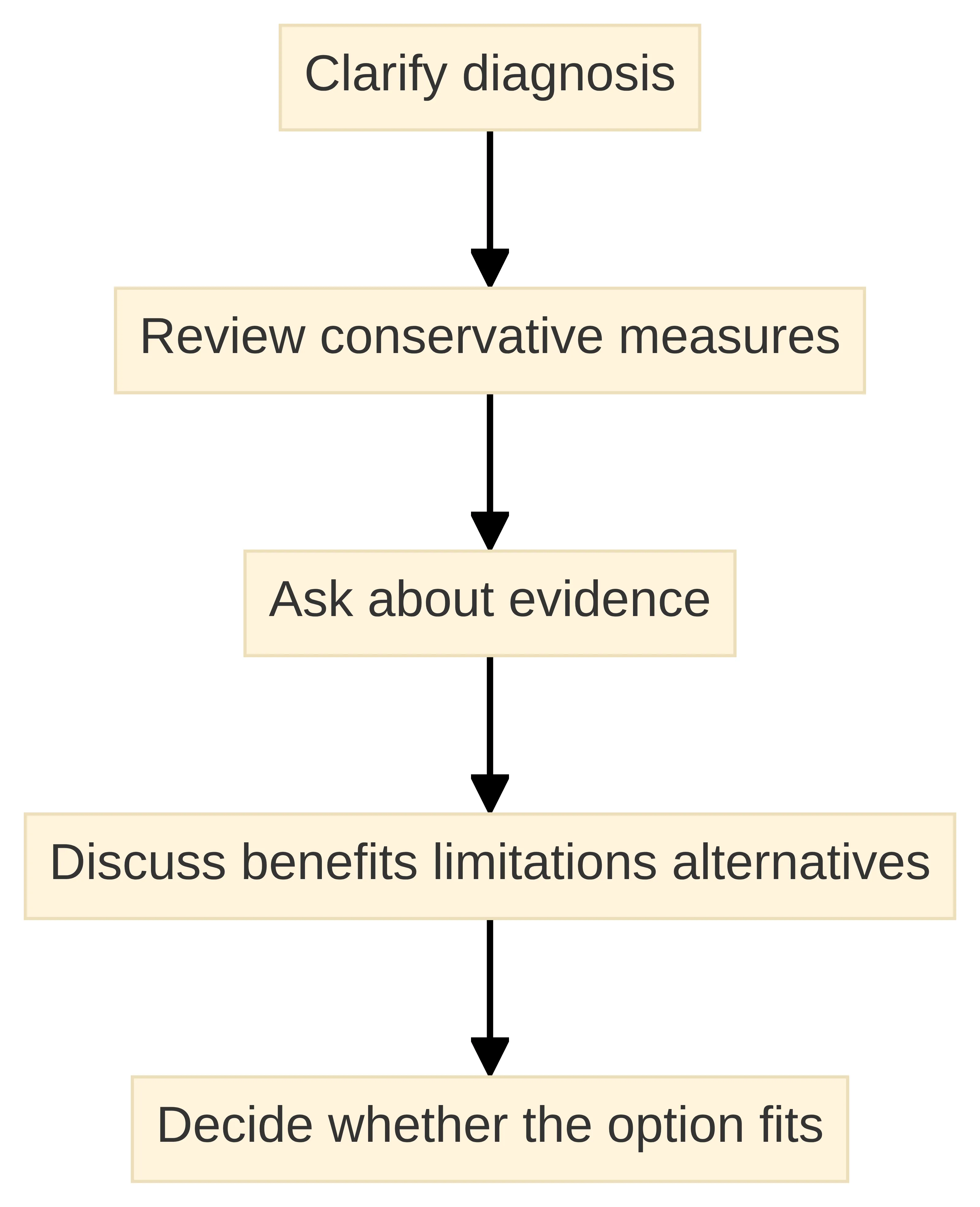
The appropriate sequence for a regenerative discussion is:
- Clarify the diagnosis or the leading clinical question.
- Identify what conservative measures you have tried and how your symptoms responded.
- Ask whether the proposed option has evidence for the specific condition being considered.
- Discuss possible benefits, limitations, alternatives, and what would count as an unsuccessful result.
- Decide whether the option fits your goals and clinical findings.
We offer clinical evaluations for people considering regenerative treatment options for foot and ankle conditions. An evaluation is a place to discuss whether a non-surgical option is relevant to the identified problem; it is not a guarantee that a regenerative treatment will be recommended or that it will prevent surgery.
Keep the distinction clear: the ability to evaluate a foot and ankle condition does not establish that a particular orthobiologic treatment will heal sesamoiditis. The condition, available support, and your individual findings must remain connected throughout the discussion. Because a regenerative discussion can sound more definitive than the evidence warrants, ask for the proposal in condition-specific terms. What tissue or finding is the treatment intended to address? Is the supporting evidence about sesamoiditis, osteonecrosis, fracture, or a broader foot and ankle condition? What outcome is being monitored, and over what follow-up period? These questions do not assume that a treatment is appropriate; they test whether its rationale matches the clinical question.
The decision should also account for what has already been tried and the goals being considered, such as reducing pain or improving function, without treating either goal as a promised result. A clinician can explain how diagnosis, tissue health, overall health, metabolic function, and prior response affect the discussion. If the proposal is individualized, ask which part is based on your findings and which part reflects general practice or limited evidence. If the evidence does not answer the question, that uncertainty should remain visible rather than being filled with a success expectation.
A non-surgical label also does not remove the need to discuss alternatives, activity guidance, rehabilitation, follow-up, and what would happen if symptoms persist. Those topics help define the full plan rather than focusing only on the injection or procedure.
The available orthobiologic evidence is too limited for a promise
Orthobiologic evidence for sesamoid injuries is too limited to support a promise about PRP or another regenerative option. A case report published in 2025 described one 28-year-old dancer with sesamoid osteonecrosis who received a leukocyte-rich PRP injection, reported less pain at 2 months, and returned to regular auditions at 3 months; her symptoms returned to baseline at 2 years.
That report can inform a discussion, but it cannot establish that PRP will work for every person with sesamoiditis. The reported patient had sesamoid osteonecrosis, which is not the same as ordinary, undifferentiated sesamoiditis. The report also involved one patient, so its outcome cannot provide a general success rate or a personal forecast.
Use four evidence questions before treating a case report as a reason to proceed:
- Condition: Does the study concern your diagnosed condition, or a different sesamoid problem?
- Treatment: Does the proposed preparation and technique match what was studied?
- Outcome: Did the study measure pain, function, imaging, return to activity, or another result?
- Durability: How long did the reported improvement last, and what happened afterward?
The 2025 report matters because both improvement and later symptom return belong in the same conversation. PRP outcomes may also differ among patients and may be influenced by age, overall health, and metabolic function.
A responsible discussion therefore sounds conditional: this option may be considered after evaluation, the evidence for sesamoid injuries is limited, and individual outcomes vary. It should not sound like a guarantee, a substitute for diagnosis, or proof that surgery can always be avoided.
Questions to take to a foot and ankle specialist
Questions for a foot and ankle specialist should connect your symptoms, the suspected cause, and the treatment decision. Evaluation may include symptom history, motion, tenderness, and imaging such as X-rays, while advanced imaging may be considered when the clinical question remains unresolved.
Take these questions to the appointment:
- What findings make sesamoiditis more likely in my case?
- What other causes of pain beneath the big toe need to be considered, including a fracture or stress fracture?
- What did the examination and any X-rays clarify, and what remains uncertain?
- If symptoms continue, what specific question would MRI answer?
- Which activity or footwear changes should I make while the cause is being assessed?
- Is offloading with a custom-made insole relevant to my findings?
- What change would show that conservative care is helping, and when should we reassess?
- If we discuss PRP or another orthobiologic option, what support applies to my diagnosed condition rather than to a different injury?
- What did the available study measure, how durable were its reported results, and how closely does it resemble my situation?
- What alternatives should I compare before deciding on a procedure?
Bring a short record of when the pain began, any trauma or change in activity, the exact location, swelling, weight-bearing difficulty, footwear, prior treatments, and the response to reduced loading. A focused history helps the appointment address the unresolved question instead of repeating a general description.
The purpose of these questions is not to arrive with a preferred procedure. The purpose is to learn what has been established, what remains uncertain, and which next action follows from those findings. That distinction is especially important when the orthobiologic literature is limited and a single case report cannot predict your outcome.
After the appointment, sort the answers into four parts. First, record what is established: the working diagnosis, examination findings, and what any imaging clarified. Second, record what remains unresolved, including whether the clinician still needs to distinguish among sesamoiditis, a fracture, stress injury, or another source of pain. Third, list the options that follow from those findings, such as continued conservative care, additional assessment, or a discussion of regenerative treatment. Fourth, record the boundaries of the discussion: the strength of the supporting evidence, alternatives, activity guidance, rehabilitation, and the point at which symptoms or lack of improvement should prompt review.
This summary can keep the next decision tied to evidence rather than to the most appealing treatment name. It also makes it easier to notice when a proposed option addresses a different condition from the one being evaluated. If the answers do not clarify the diagnosis or the reason for a proposed treatment, that lack of clarity is itself useful information to raise before proceeding.
Choose the next step that matches your current level of certainty
Your next step for pain beneath the big toe should match both your symptoms and your level of certainty. If the pain is mild and changing as you reduce forefoot loading, continue to record the activity, footwear, and weight-bearing response while using the conservative measures described in the medical literature.
If pain persists, follows trauma, makes weight-bearing difficult, or remains unexplained after initial care, move toward clinical assessment. Sesamoiditis is diagnosed only after other causes have been considered and excluded, and MRI may become relevant when X-rays do not clarify the problem and conservative care has not helped.
If an evaluation identifies a condition for which a regenerative option is being considered, ask how closely the available support matches that condition, what the limitations are, and what alternatives remain. Published support for orthobiologic treatment of sesamoid injuries remains limited, so a qualified foot and ankle professional must decide whether an option is suitable for your findings, health, and goals.
We offer clinical evaluations for patients considering regenerative treatment options for foot and ankle conditions.
What should I ask before pursuing regenerative treatment for sesamoid pain?
What are the initial steps to take for suspected sesamoiditis?
Begin by reducing the load on the forefoot, which may involve pausing or scaling back activities that increase symptoms, choosing low-heeled footwear, and considering custom-made insoles to offload the sesamoids.
When should I seek professional evaluation for sesamoiditis?
Arrange for a professional assessment if pain persists after reducing activity, if the cause of pain is uncertain, if swelling or difficulty bearing weight occurs, or if symptoms worsen despite conservative care.
What symptoms are associated with sesamoiditis?
Symptoms may include pain beneath the big toe, swelling around the affected area, and difficulty bearing weight on the foot, especially during activities that load the forefoot.
How is sesamoiditis diagnosed?
Diagnosis typically involves a clinical evaluation that includes a history of symptoms, range-of-motion assessment, palpation, and possibly imaging such as X-rays to rule out other causes of pain.
What conservative treatments are available for sesamoiditis?
Conservative treatments may include reducing activity, wearing low-heeled shoes, and using custom-made insoles to alleviate pressure on the sesamoids.
What role do regenerative therapies play in treating sesamoiditis?
Regenerative therapies, such as PRP, may be discussed after a diagnosis is clarified, but evidence supporting their effectiveness for sesamoiditis is limited and should be approached cautiously.
What questions should I ask a foot and ankle specialist regarding sesamoiditis?
Consider asking about the likelihood of sesamoiditis in your case, other potential causes of pain, findings from any imaging, and what changes to activity or footwear might be beneficial.
Free consultation
Find out whether regenerative treatment is right for you.
Most consultations begin as a telehealth call with a physician specialist, so you can start without travelling to a clinic. No referral needed.