
plantar fasciitis treatment
Plantar Fasciitis Treatment: Compare Your Options and Choose the Next Step

Choose treatment by fit, not by the most advanced-sounding option
Plantar fasciitis treatment decisions make more sense when you begin with fit rather than the name of a procedure. The useful questions are where your pain occurs, when it appears, how long it has lasted, what you have already tried, and whether the pattern still supports plantar fasciitis.
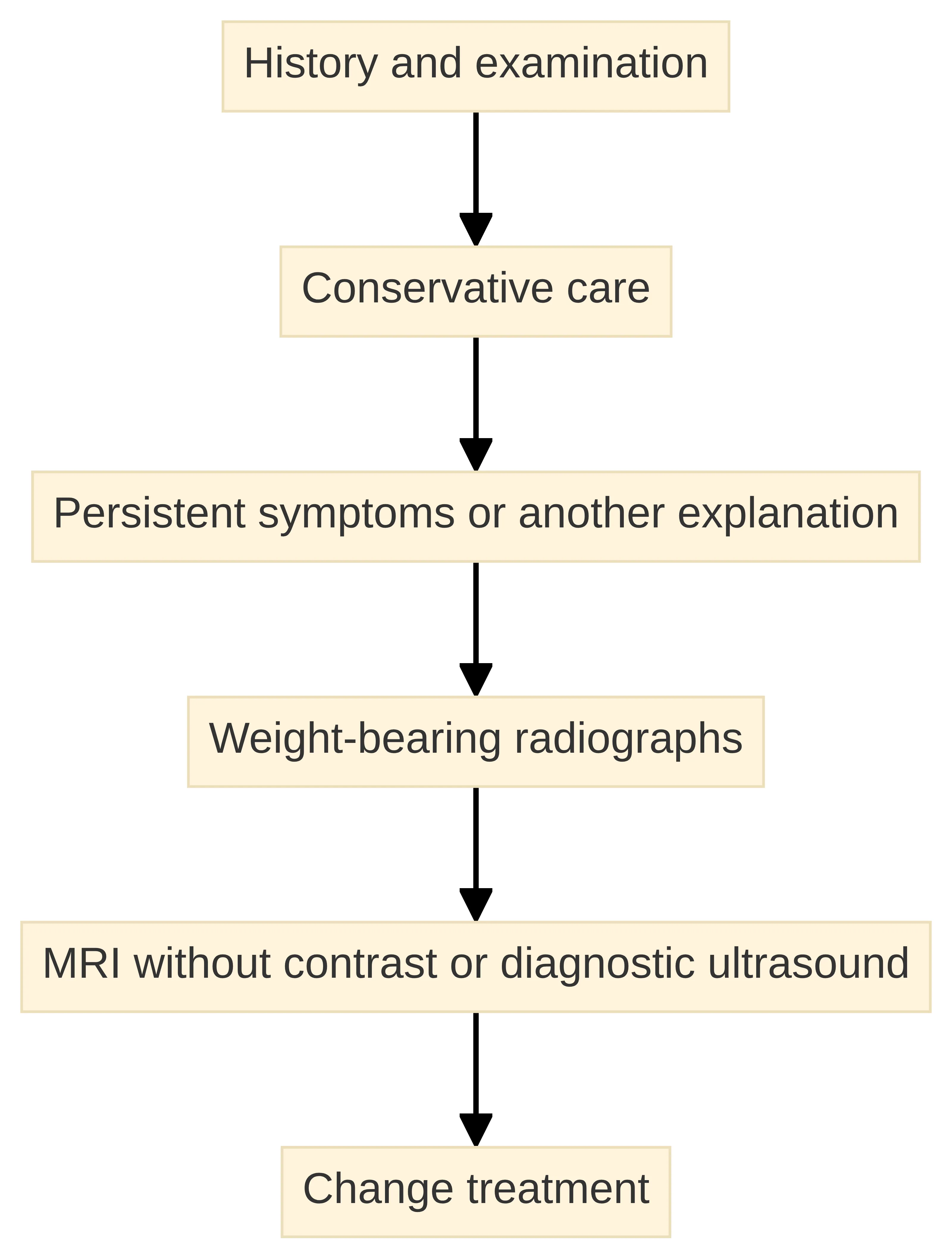
A procedure can sound more advanced than stretching, activity modification, or rehabilitation, but a more complex option is not automatically a better match. Diagnosis usually starts with your history and physical examination, while conservative care remains part of the discussion even when symptoms have lasted for a long time. Reducing repetitive loading during treatment is recommended regardless of the approach selected.
Use this guide as a decision path:
- Match your symptoms to the usual plantar-fasciitis pattern.
- Separate a familiar pattern from signs that another cause may be involved.
- Review the duration and response to conservative care.
- Discuss imaging or an injection only when it answers a specific clinical question.
- Consider PRP or another regenerative option only after diagnosis, alternatives, risks, and follow-up have been discussed.
The goal is not to choose a treatment from a menu. The goal is to choose the next question that will make your care more appropriate.
Confirm that the symptom pattern is compatible with plantar fasciitis
Plantar fasciitis commonly causes pain along the medial heel, near the inside portion of the heel, with tenderness around the medial calcaneal tubercle. The discomfort is often most noticeable with the first weight-bearing steps after waking or after a period of rest. Runners can develop this pattern, but prolonged standing and other daily loading can also contribute, so you do not need to be an athlete for the symptoms to fit.
The name can also create confusion. A 2019 clinical review noted that the condition is not primarily inflammatory and that some clinicians use plantar fasciopathy as a more accurate term. You may still hear plantar fasciitis in ordinary clinical conversations and online searches. The terminology matters less than whether the location, timing, examination findings, and course fit the condition being discussed.
Your symptom pattern is useful information, not a home diagnosis. Note the following before an appointment:
- The exact location of the pain.
- Whether the first steps after sleep or rest are the most painful.
- Whether pain changes with walking, running, standing, or reduced activity.
- Whether tenderness is concentrated at the inner heel or occurs elsewhere.
- How long the symptoms have been present and whether they are changing.
Bring that pattern to a clinician rather than assuming that every heel pain is plantar fasciitis.
Limited ankle motion, higher body mass index, and prolonged standing are among factors associated with plantar fasciitis. These factors add context, but none of them proves that plantar fasciitis is the cause of your pain. A runner with morning heel pain and a person who stands for work may arrive at a similar symptom pattern through different loading histories.
That distinction affects the next step. If the pain location and timing are familiar, a clinician may be able to begin with examination and conservative care. If the location, timing, or associated symptoms do not fit, the priority shifts toward clarifying the diagnosis before choosing an intervention.
Use duration and prior response to decide whether conservative care is still appropriate
Symptom duration changes the treatment conversation, but elapsed time alone does not select a procedure. A 2019 clinical review reported that 80% of patients improved within 12 months with proper treatment. That figure describes a review-level observation, not a promise about your recovery or a reason to wait without assessment.
Your prior response is more useful when you describe it precisely. “It did not work” may mean that pain never changed, that walking improved but running did not, that relief lasted briefly, or that the plan was difficult to follow. Each version leads to a different discussion. Tell the clinician what you tried, for how long, how consistently, and what changed.
Use these questions to sort your current position:
- Have you tried plantar-fascia and calf stretching under clear instructions?
- Did you reduce the repetitive loading that provoked symptoms?
- Did footwear, an orthotic, or a night splint change your function or pain?
- Did the plan produce partial improvement that has now stalled?
- Did symptoms worsen, spread, or develop a different quality?
A familiar pattern with incomplete or inconsistent conservative care usually calls for a more structured review of that care. A persistent pattern after a well-conducted plan calls for clinical reassessment, not an automatic jump to the most invasive-sounding option.
Conservative care is not a single event that either succeeds or fails. It can include several coordinated measures, and activity modification remains relevant during treatment regardless of whether you later discuss an injection or regenerative therapy. If your symptoms have lasted for months, that history deserves attention, but chronicity does not establish which tissue is involved or which treatment will help.
Ask a clinician to review the diagnosis and the quality of the prior plan before treating duration as proof that you need a procedure. The next step should respond to the reason care has stalled.
Start with load reduction and structured conservative care
Structured conservative care addresses the daily demands placed on the plantar fascia while you monitor how symptoms respond. Accepted options include plantar-fascia-specific stretching, calf stretching, suitable orthotics, night dorsiflexion splinting, ice massage, activity modification, and nonsteroidal anti-inflammatory medication when appropriate.
These options do not all serve the same purpose, and you may not need every option. A clinician or physical therapist can help connect the intervention to your examination findings and activity demands.
A practical starting discussion can cover:
- Which activities are repeatedly loading the painful area.
- Whether your calf or ankle mobility needs attention.
- Whether an orthotic or night splint has a specific role for you.
- How to adjust running, walking, standing, or training without abandoning all movement.
- How to judge progress by function as well as pain.
Reducing load does not mean treating movement as harmful. It means changing the amount, frequency, or type of loading while the condition is being evaluated and treated. To make that adjustment useful, separate the goal from the tool. The goal is to reduce the repetitive loading associated with symptoms while preserving an activity level you can discuss with a clinician. The tool might be changing running, standing, walking, or training; which tool fits depends on your symptoms and daily demands. At follow-up, compare the change in pain with the change in function and with the activity you hoped to regain. That record can show whether the plan needs refinement without treating one difficult day as proof that the entire approach failed.
Likewise, an orthotic, splint, stretch, or medication should have a stated role rather than being added because it is commonly mentioned. Ask what problem it is intended to address, how it fits with the rest of the plan, and what result would justify continuing or revising it. This keeps conservative care structured and makes later decisions easier to explain. It also helps prevent a list of options from becoming a plan with no way to judge its progress.
Conservative care also has a boundary: it should not become an indefinite explanation for pain that does not follow the expected pattern. If a structured plan has not produced meaningful progress, bring the response back to the clinician who can reassess the diagnosis and decide whether another option or further evaluation is justified.
Do not judge a treatment solely by whether it removes pain immediately. Ask what change the treatment is intended to produce, when that change will be assessed, and what will happen if the intended change does not occur.
Treat daily activity as part of the treatment decision
Daily activity is part of the treatment decision because repetitive loading can maintain plantar fascia pain during the treatment phase. A clinical review recommended reducing that repetitive loading regardless of the treatment modality selected. Your work, training, commute, footwear, and time spent standing may therefore matter as much to the discussion as the pain score itself.
Track activity as information rather than as proof of a diagnosis. For one week, record:
- The activity that preceded a flare.
- How long you stood, walked, ran, or trained.
- Whether pain appeared during the activity or afterward.
- How the first steps after rest felt the next morning.
- Which change in activity made the symptom pattern better, worse, or unchanged.
This record can help you and a clinician distinguish a predictable loading response from a pattern that needs more investigation. It can also expose an uneven plan: reducing running may not help much if your job still requires prolonged standing, and resting all week may not prepare you for a sudden return to high training volume.
The decision is not simply “keep moving” or “stop moving.” The supported action is to reduce repetitive loading while treatment is underway and to discuss a gradual activity plan suited to your symptoms and goals.
Your activity goal changes what counts as useful progress. Walking through a workday, completing household tasks, returning to recreational running, and competing at a high level place different demands on the foot. State the activity you want to regain instead of describing improvement only as less pain.
A treatment conversation that includes your actual goal can address load, timing, rehabilitation, and follow-up together. That is more informative than choosing a procedure because it appears to promise a faster return.
Reassess the diagnosis when the pattern does not fit or care is not working
Persistent heel pain can have causes other than plantar fasciitis, including heel-fat-pad atrophy, a calcaneal stress fracture, or entrapment of a nerve. Referred pain and systemic conditions can also contribute to plantar heel pain. These possibilities do not mean that you have another condition; they explain why an unchanged or atypical pattern deserves clinical reassessment.
A clinician can use your history and physical examination to decide whether the working diagnosis still fits.
Bring a concise account:
- When the pain began and what changed around that time.
- Where the pain is located and whether it radiates.
- What happens with first steps, rest, standing, walking, and exercise.
- Which treatments or activity changes you tried and what each one changed.
- Any relevant injury, health condition, or medication history.
The action at this stage is diagnostic clarification. Do not use a failed treatment as proof that one particular alternative diagnosis is present. Seek assessment by a qualified clinician if heel pain is worsening, severe, or limiting function, even if the symptom location seems familiar. Those features do not identify the cause on their own, but they make self-directed escalation a poor substitute for examination. The purpose of assessment is to decide whether the working diagnosis and next step still fit.
A treatment response cannot identify the injured or painful structure by itself. Temporary relief may change symptoms without settling the cause, while no relief may reflect an incorrect diagnosis, an incomplete plan, or a condition that needs a different approach.
That is why a clinician should connect any next intervention to an examination finding or an unresolved question. If the pattern no longer looks typical, reassess before escalating.
Use imaging to answer an unresolved clinical question
Imaging is generally not needed at the beginning when your history and examination support plantar fasciitis and conservative care has not yet failed. Imaging becomes more useful when symptoms persist despite care or when the clinician is considering another explanation.
For chronic foot pain when imaging is indicated, the 2023 clinical practice guideline described weight-bearing radiographs as the usual first study. If radiographs are negative and the examination raises concern for a plantar fascia tear, tarsal tunnel syndrome, or Baxter’s neuropathy, MRI without contrast or diagnostic ultrasound may be considered next. Ultrasound and MRI can show related findings, but some findings associated with plantar fasciitis are nonspecific and can also appear in people without symptoms.
The useful question is not “Which scan should I request?” It is “What decision would this scan change?” Possible purposes include:
- Checking whether a bone problem should be considered.
- Examining soft tissue when the examination raises a specific concern.
- Investigating nerve-related symptoms.
- Clarifying a persistent pattern after conservative care.
Ask what the clinician is looking for, what the possible results would mean, and how each result would change treatment. An image should answer a clinical question rather than replace the history and examination.
A scan cannot decide whether an injection or regenerative procedure is appropriate on its own. Imaging findings need to be interpreted alongside your symptoms, examination, duration, and functional goals. Because some plantar-fascia findings can also appear in people without symptoms, a scan finding alone does not establish that the finding is causing your pain or determine which treatment is appropriate. The clinical pattern still has to carry the decision. If the scan does not explain the pain, the diagnostic question remains open and should not be forced into a treatment decision.
Compare injections by expected benefit and trade-offs
Injections should be compared by the question they are meant to answer, the time horizon of any expected benefit, and their risks—not by the fact that they are procedures. An injection is not an automatic next step after conservative care; whether it fits depends on the individual presentation and treatment history.
| Potential risks include plantar fascia rupture and heel-fat-pad atrophy; serious adverse events were rare in reviewed evidence but may have been under-reported. |
| Discuss uncertainty, candidacy, alternatives, cost, follow-up, and the expected time frame with a qualified clinician. |
The comparison is not a promise that one injection will work better for you. It is a reminder that short-term symptom relief, biological rationale, long-term benefit, and risk are separate questions. Ask which outcome the proposed injection is intended to address and how you will decide whether it helped.
A steroid injection and PRP should not be treated as interchangeable choices. For steroids, available evidence indicates brief potential relief without established long-term benefit and identifies potential risks including plantar fascia rupture and heel-fat-pad atrophy. For PRP, biologic components may influence treated tissue, but that rationale does not establish a promised outcome. The practical questions differ: for a steroid injection, ask how short-term relief fits the plan and how potential harm will be monitored; for PRP, ask why it is relevant to your presentation, what uncertainty remains, and how response will be assessed.
No injection removes the need to revisit the diagnosis or discuss rehabilitation and activity guidance. If a proposed procedure is presented without a working diagnosis, a stated goal, alternatives, risks, and follow-up, those are reasonable gaps to raise before deciding. A clear comparison can end with continued conservative care, another evaluation, or discussion of a procedure; the answer depends on the presentation and prior response. Before an appointment, you can organize the comparison without deciding in advance. For each option, write four entries: the problem it is intended to address, the outcome and time frame to discuss, the risks or burdens, and the next step if the outcome is not achieved. For conservative care, this keeps attention on loading, stretching, activity guidance, and follow-up. For a steroid injection, it keeps a possible short-term benefit separate from longer-term benefit and potential risks. For PRP, it keeps biologic rationale separate from the question of individualized relevance and uncertain response. This format also makes “no procedure yet” a visible option rather than an omission. A clinician can then explain which entries depend on your examination and history.
Corticosteroid injections deserve a particularly clear time-horizon discussion. Available evidence indicates that any benefit may not persist beyond about one month and does not establish long-term benefit. Potential risks include plantar fascia rupture and heel-fat-pad atrophy, while the reviewed evidence described serious adverse events as rare but could not rule out under-reporting.
If you are considering a steroid injection, ask why short-term relief is the objective, what alternatives remain, and how the clinician will limit or monitor potential harm. Do not treat a temporary decrease in pain as proof that the underlying problem has resolved.
Discuss PRP as an individualized option, not a promised cure
PRP is an individualized option to discuss when symptoms persist and the diagnosis, prior care, and goals have been reviewed. PRP has biologic components that may influence the treated tissue.
A useful PRP conversation should answer five questions:
- What finding makes PRP relevant to my presentation?
- What alternatives remain reasonable, including continued rehabilitation or another evaluation?
- What benefit is the treatment intended to produce, and over what time frame will it be assessed?
- What risks, restrictions, and follow-up are part of the plan?
- What will we do if the intended improvement does not occur?
Ask for an explanation in terms of your diagnosis and goals rather than accepting a general claim about regeneration. Your response to prior injections, medication, stretching, activity changes, or rehabilitation should be part of the decision.
PRP also does not remove the need to manage loading during treatment. Reducing repetitive loading was recommended regardless of the treatment modality selected, so a PRP plan that ignores activity and rehabilitation leaves an important part of the care discussion unanswered.
The practical boundary is simple: consider PRP only after a clinician has connected it to your presentation and has explained uncertainty, alternatives, risks, costs, and follow-up. Choose an evaluation before choosing an injection.
Keep regenerative treatment alongside clinical reasoning and rehabilitation
Regenerative treatment belongs inside a broader clinical plan, not outside it. The diagnosis still depends mainly on your history and examination, and reducing repetitive loading remains relevant regardless of the modality selected. A regenerative discussion should therefore include the working diagnosis, the rehabilitation plan, activity guidance, the follow-up point, and the alternative paths if progress is limited.
An integrated plan can help you distinguish three separate decisions:
- Whether the symptoms are compatible with plantar fasciitis.
- Whether conservative care has been structured and given an appropriate opportunity.
- Whether a procedure adds a reasonable option for your particular presentation.
Those decisions should not be collapsed into “I have had pain for a long time, so I need regenerative care.” Duration is a reason to reassess and discuss options; it is not proof of candidacy or expected success.
At Regenerative Lower Extremity Institute, we provide specialized treatments for plantar fasciitis and other lower-extremity conditions, and we offer clinical evaluations for people considering regenerative treatment options for foot and ankle conditions. We personalize treatment plans around each patient’s individual body and lifestyle needs.
Bring your symptom history, prior treatment response, activity goals, and questions about alternatives so the discussion can stay connected to your presentation.
Bring a focused question set to the evaluation
A focused question set can keep an evaluation practical when you have already tried several options or are weighing an injection. Write the questions down and bring a record of your symptoms and activity response.
Diagnosis
- What findings support plantar fasciitis in my case?
- What other causes of heel pain should be considered?
- Do I need imaging, and what specific question would it answer?
Prior care
- Was my stretching, activity modification, orthotic, splint, or medication plan structured enough to assess?
- What response would count as meaningful progress?
- Which activity should I reduce, and how will I return to it?
Procedure choice
- What is the intended benefit of this option, and when will we assess it?
- How does it compare with continued rehabilitation, a different injection, or no procedure?
- What risks or restrictions apply to me?
PRP or another regenerative option
- What feature of my presentation makes this option reasonable?
- What uncertainty remains about the expected response?
- What will the follow-up plan be if symptoms do not improve?
Practical planning
- What will the evaluation and treatment cost?
- How many follow-up visits are expected?
- What activity guidance applies after treatment?
The purpose of these questions is not to force a treatment decision. It is to make the reasoning, alternatives, costs, and follow-up clear before you consent to care.
Your symptom record should include the first-step pattern, pain location, activity triggers, duration, and response to prior care. Include any change in pain quality or distribution. That information helps the clinician decide whether the familiar pattern remains persuasive or whether another cause needs investigation.
Take medication and treatment details with you, including the approximate dates and the effect you noticed. Specific information is more useful than a general statement that you have tried everything. One simple way to organize it is as a treatment ledger: list each intervention, the reason it was tried, how consistently it was used, the change in pain or function, and any concern that made you stop. Add the activity you were trying to resume and whether the change lasted. This record does not determine candidacy, but it helps separate an option that was ineffective from one that was not completed or did not address the main activity demand. It also gives the clinician a clearer basis for discussing alternatives, follow-up, and costs. If several treatments overlapped, note that as well, since overlapping changes can make the response harder to interpret. The purpose is not to grade your adherence; it is to make the treatment history accurate enough to support the next decision.
Choose the next action that matches your current certainty
Your next step should match what you know and what remains uncertain. If your symptoms follow the familiar pattern and conservative care has not been structured, start with load reduction and a clear plan for stretching, activity guidance, and follow-up. If symptoms persist despite a reasonable plan, arrange a clinical reassessment. If you are considering an injection or PRP, discuss the diagnosis, intended benefit, alternatives, risks, time frame, costs, and follow-up with a qualified clinician.
A qualified clinician should determine individual suitability for imaging, injections, PRP, or another treatment.
We offer clinical evaluations for people considering regenerative treatment options for foot and ankle conditions, with treatment plans personalized around individual body and lifestyle needs.
Questions to ask before choosing a plantar fasciitis treatment
What are the common symptoms of plantar fasciitis?
Plantar fasciitis typically presents as stabbing pain along the medial heel, especially noticeable with the first steps after waking or after periods of rest. Tenderness is often felt around the medial calcaneal tubercle.
What initial treatments are recommended for plantar fasciitis?
Initial supportive treatments include plantar-fascia-specific stretching, calf stretching, appropriate orthotics, night dorsiflexion splinting, ice massage, activity modification, and nonsteroidal anti-inflammatory drugs when appropriate.
When should I consider imaging for plantar fasciitis?
Imaging is generally not needed initially if the clinical examination supports a diagnosis of plantar fasciitis. It may be considered if symptoms persist despite conservative care or if another condition is suspected.
What are the potential risks of corticosteroid injections for plantar fasciitis?
Corticosteroid injections may provide short-term relief but carry risks such as plantar fascia rupture and heel fat-pad atrophy. Serious adverse events are rare but cannot be ruled out.
How does PRP therapy work for plantar fasciitis?
Platelet-rich plasma (PRP) therapy contains growth factors and anti-inflammatory cytokines that may influence the healing of the treated tissue.
What factors should I discuss with my clinician before choosing a treatment option?
Before choosing a treatment, discuss your symptom pattern, prior treatment responses, the intended benefits of the proposed option, potential risks, alternatives, costs, and follow-up plans.
What should I do if my plantar fasciitis symptoms do not improve with conservative care?
If symptoms persist despite a structured conservative care plan, it is advisable to arrange a clinical reassessment to clarify the diagnosis and consider alternative treatment options.
Free consultation
Find out whether regenerative treatment is right for you.
Most consultations begin as a telehealth call with a physician specialist, so you can start without travelling to a clinic. No referral needed.