
ankles pain
Ankle Pain: Use Symptom Patterns to Choose the Right Next Step
Ankle pain is a pattern to clarify, not a diagnosis to make at home
Pain around your ankle can follow an injury, develop without a clear accident, or continue after an injury that seemed minor at first. Sprains and fractures are common ankle injuries, but ankle pain can also arise from structures inside or outside the joint. The same symptom—such as swelling, stiffness, or pain with walking—can therefore lead to more than one clinical question.
Your first task is not to name the condition. It is to describe the pattern accurately enough to decide whether you can continue observing it, arrange a routine appointment, or seek prompt assessment after an injury. A symptom list can organize your next conversation, but it cannot establish which tissue or disease process is responsible.
Start by recording five features: what happened before the pain began, whether walking changes it, whether swelling or stiffness is present, whether symptoms occur at rest, and whether one or both ankles are affected. Add how long the problem has lasted and whether it is improving, recurring, or gradually becoming more limiting.
That record gives a clinician a clearer starting point than a label such as “a bad ankle.” A detailed history and physical examination, followed by imaging chosen for the clinical question when indicated, are used to clarify chronic ankle pain and plan treatment. Until that evaluation occurs, treat your observations as clues rather than a diagnosis.
Overview
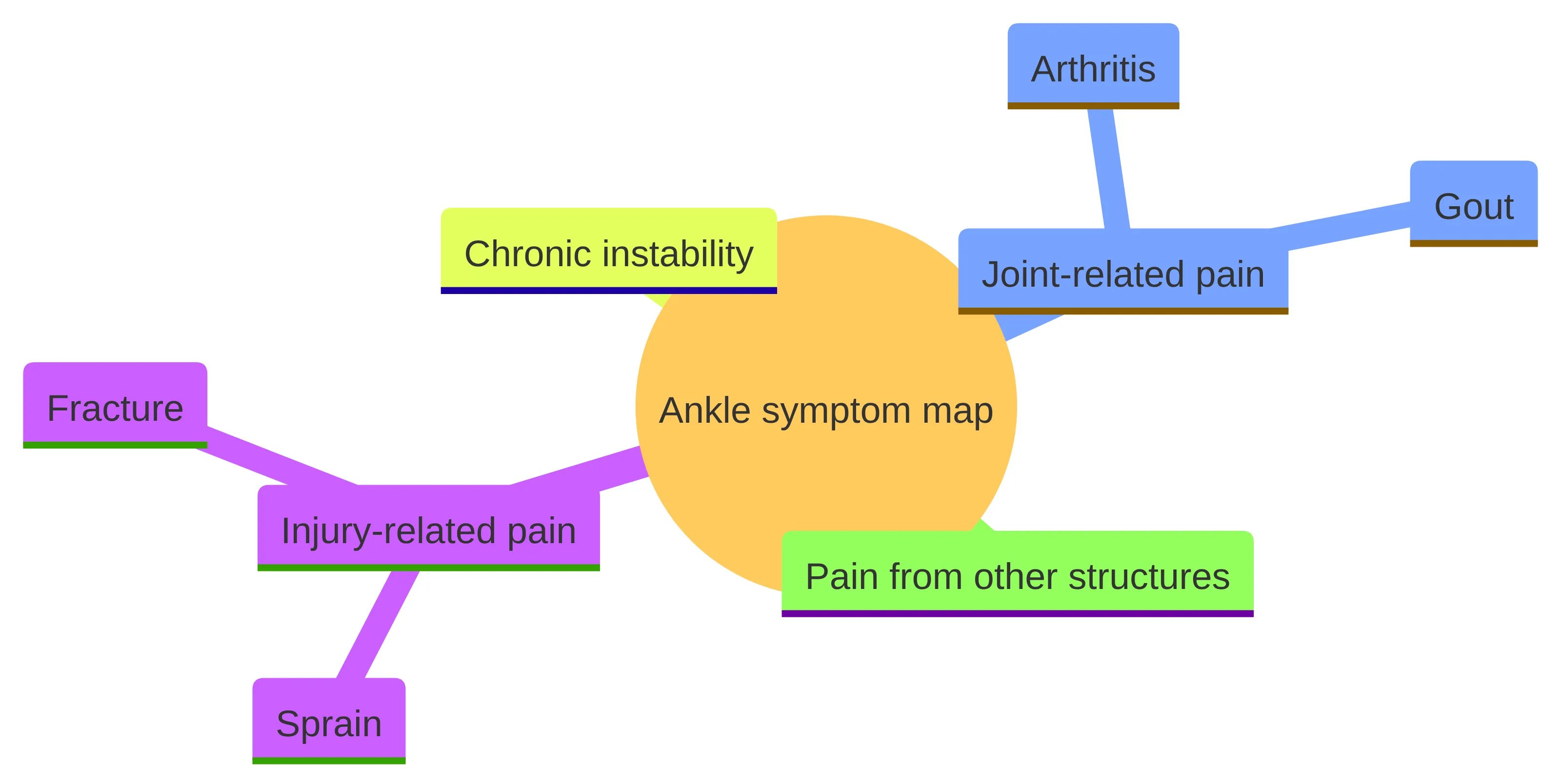
Ankle symptoms generally fit several broad categories, although those categories can overlap:
- Injury-related pain: A sprain stretches or tears the ligaments connecting the ankle bones. A fracture involves a break in one or more bones. Swelling, bruising, sharp pain, a popping or snapping sound, and difficulty walking can occur with an acute injury.
- Joint-related pain: Arthritis can be degenerative, rheumatoid, post-traumatic, or related to gout. Pain, swelling, stiffness, and reduced function may occur, but the pattern still needs clinical interpretation.
- Chronic instability: Repeated giving-way or pain after previous sprains can raise a question about lateral ankle instability. That question is different from the question of whether you have a new fracture or a simple acute sprain.
- Pain from other structures: Chronic symptoms may arise from structures inside or outside the ankle joint and may follow either a traumatic or nontraumatic event.
These categories are a map, not a home diagnostic tool. A lack of remembered trauma does not settle the cause, and a remembered sprain does not prove that every later symptom comes from the same injury.
The category that seems most familiar is not necessarily the category that explains your symptoms. For example, pain after activity may occur with more than one type of ankle problem, while swelling may reflect an acute injury or a joint-related condition. Use each observation to narrow the questions for an evaluation rather than to select a treatment on your own.
Use the map to organize the questions that matter next:
- Did the pain begin after a twist, fall, impact, change in training, or no identifiable event?
- Can you walk, and does walking make the symptom worse?
- Is there swelling, bruising, stiffness, warmth, or a visible change in shape?
- Does the discomfort occur only with activity, or also while resting?
- Is the pattern confined to one ankle, or does it affect both?
- Is the problem improving, staying the same, recurring, or becoming more limiting?
Your answers do not identify the cause by themselves. They determine which details deserve attention during evaluation and whether continuing to monitor the problem is sensible.
You can make the record more useful by separating what you observed from what you inferred. “The outside of my ankle swelled after I twisted it” records an event and a symptom. “I tore a ligament” is a conclusion that requires clinical assessment. This distinction keeps your account precise and gives the clinician room to consider alternatives.
Start with injury history and walking function
An injury history changes the first question. A twist, fall, collision, awkward landing, or sudden change in direction makes sprain and fracture part of the initial discussion. No clear injury does not rule out a meaningful problem, because chronic ankle pain can follow nontraumatic events as well.
Write down the event in plain language rather than deciding what it was. Note the direction of the twist, whether your foot was planted, whether you heard or felt a pop, and whether swelling appeared immediately or later. The timing does not diagnose the injury, but it gives the clinician information to combine with an examination.
Also record what happened in the hours after the event. Note whether you could continue walking, whether your gait changed, whether swelling increased, and whether the pain stayed in one location or spread around the ankle. These details can be more useful than trying to grade the injury yourself.
Walking function is a practical dividing line in your description. Record whether you can take a normal number of steps, whether you are avoiding weight on the foot, and whether the pain changes with a few steps, prolonged walking, stairs, or uneven ground.
Do not use your ability to walk as proof that no serious injury exists. Likewise, do not use pain with walking as proof that the problem is a sprain. Walking tells you how the ankle is functioning; it does not identify the structure involved.
Bring the sequence of events and the change in walking ability to that assessment. If the pain is persistent without a clear injury, record the same walking details and arrange an evaluation when the pattern does not settle or keeps returning.
Map swelling, stiffness, timing, and pain at rest
Swelling, stiffness, and timing add context, but none of them identifies a diagnosis alone. Sprains may produce pain, swelling, and bruising. Arthritis may produce swelling and pain, with stiffness that can become more noticeable after inactivity or activity depending on the pattern. Rheumatoid arthritis can include morning stiffness lasting more than an hour, while degenerative or post-traumatic arthritis can involve joint pain and reduced movement.
Describe the symptom rather than translating it into a condition. For example, write “the ankle is stiff for 45 minutes after I wake up” or “swelling increases after walking,” rather than “this must be arthritis.” That distinction keeps the observation useful without turning it into a conclusion.
Track when the discomfort appears:
- At rest: Note whether it occurs while sitting, lying down, or during the night, and whether a position changes it.
- With walking: Record how many minutes or steps pass before symptoms begin and whether they ease after stopping.
- After activity: Note whether soreness or swelling appears later rather than during the activity itself.
- In the morning: Record stiffness duration and whether the ankle loosens as you move.
- During a flare: Write down what changed beforehand, including activity, footwear, a new injury, or no obvious trigger.
These observations help establish a timeline. They do not, on their own, distinguish joint, ligament, bone, tendon, inflammatory, or other causes.
Record the pattern for several ordinary activities if the pain is recurring. Standing at work, walking on level ground, climbing stairs, exercising, and resting may produce different responses. You do not need a formal score; a short description of what you could do and what changed afterward is enough to start the conversation.
Pain at rest deserves a place in the history even when it is not the only symptom. Record its intensity in ordinary terms, its location, how long it lasts, and whether it is new or part of a recurring pattern. A clinician can then decide whether the history and examination call for imaging or another form of evaluation.
A symptom that improves temporarily after rest is not automatically harmless, and a symptom that persists at rest is not automatically a specific disease. Use timing to communicate the pattern, not to assign meaning that requires an examination.
Treat one-sided and two-sided pain as different questions
One-sided and two-sided symptoms give a clinician different starting questions. Pain confined to one ankle may be considered alongside a local injury, prior sprain, joint change, or problem affecting a nearby structure. Pain affecting both ankles may prompt a broader history that includes timing, other joint symptoms, known medical conditions, medications, activity changes, and whether both sides changed together.
This distinction does not identify a systemic condition, and it does not prove that one-sided symptoms are local or that two-sided symptoms share one cause. It tells you to preserve the distribution in your notes instead of describing every lower-extremity symptom as if it came from the same event.
Use a simple side-by-side record:
- Which ankle started first?
- Did both ankles become painful at the same time?
- Are swelling, stiffness, and walking limits equal on both sides?
- Does one side have an injury history that the other does not?
- Have symptoms spread, alternated, or remained in the same locations?
- What other joints or body areas changed during the same period?
Bring the record to a clinician rather than trying to explain the pattern with a single label. Distribution is useful context, not a diagnosis.
If both ankles changed together, include the timing of that change and any recent alteration in activity or routine. If one ankle became painful months before the other, record that sequence instead of grouping the symptoms under one date. The distinction may help organize the history even when it does not settle the cause.
Persistent or recurring pain needs more than symptom matching
Persistent or recurring pain changes the decision from “What does this symptom resemble?” to “What remains unclear, and what needs to be examined?” Chronic ankle pain has a broad differential. It may involve structures inside or outside the joint and may follow a traumatic or nontraumatic event. Many different patterns can therefore produce the same general complaint.
Repeated symptoms after a prior sprain may raise a question about chronic instability, but recurrence does not establish that diagnosis. Exercise may help manage chronic ankle instability and may reduce recurrent sprains, yet the appropriate plan depends on whether instability is actually present and what the examination shows.
A useful persistence record includes the number of flares, the time between them, the activity associated with each flare, and whether function returned between episodes. A problem that repeatedly interferes with walking deserves a different conversation from brief soreness that resolves and does not return. Both patterns should be described accurately rather than assigned the same label.
If you have already tried a brace, taping, exercises, rest, or another measure, record what happened rather than describing it as a success or failure in general terms:
- What was the original symptom and functional limit?
- Which measure did you use, and for how long?
- Did walking, balance, swelling, or pain change?
- Did symptoms return when activity increased?
- Did any brace or tape cause more pain?
For chronic lateral ankle instability, functional rehabilitation and bracing or taping are commonly used conservative approaches. A brace can be painful or unsuitable for a particular situation, and the type, restriction, duration, and use instead of immobilization require clinical judgment. If a brace causes pain, the cited review advises stopping it and pursuing a different approach.
The purpose is not to obtain a label from a symptom list. It is to combine your history and examination with imaging selected for the clinical question when indicated, then decide which treatment category fits the identified problem.
Choose evaluation before choosing a treatment category
Treatment choices make more sense after the problem has been characterized. A clinician generally combines your symptom history and physical examination with imaging selected for the clinical question when evaluating chronic ankle pain. That sequence matters because pain can arise from different structures and can follow different types of events.
An evaluation may focus on location, range of motion, stability, strength, walking, swelling, tenderness, and the history of injury or recurrence. The exact assessment depends on your presentation. Imaging is not a substitute for the history and examination; it is selected when it can answer a relevant clinical question. Use that question to make the result interpretable. Ask what the clinician is trying to confirm, exclude, or compare, and which history or examination finding makes the test relevant. If an imaging result is discussed, ask how it relates to the place of pain, walking limitation, swelling, or prior injury you described. A finding on an image should be considered alongside the rest of the evaluation rather than treated as an explanation by itself. If the proposed test will not change the next decision, ask what information it is expected to add. This keeps imaging connected to a clinical question and helps you understand why it was selected, without requiring you to interpret the images or decide whether a treatment is appropriate on your own. Because chronic ankle pain may come from structures inside or outside the joint, the same test may not answer every question. Ask whether the assessment is aimed at an injury, joint change, instability, or another suspected source; those are questions for the clinician to define from your history and examination, not labels to choose from a scan. The point is clarity, not more testing.
Before an appointment, write down what you want the evaluation to clarify. You might need to understand whether a previous injury remains relevant, whether the joint or a nearby structure is involved, or whether a treatment already tried was aimed at the right problem. A focused question helps keep the visit connected to function rather than to a preferred treatment name.
Keep these treatment categories separate until the problem is clearer:
- Supportive and activity-based care: This may include a discussion of exercise, functional rehabilitation, bracing, taping, or other measures suited to the identified problem.
- Medication-based care: Anti-inflammatory medication is included among options discussed for ankle sprain in the evidence cited here, but suitability is individual and should not be assumed from an article.
- Procedural or surgical care: These discussions depend on the injury, instability, joint or soft-tissue findings, symptoms, and response to prior care.
- Regenerative discussions: These belong after evaluation, when you know what condition is being addressed and can examine the evidence, regulation, alternatives, and limits of the proposed treatment.
The sequence prevents a treatment category from becoming a substitute for diagnosis. It also gives you a more useful basis for comparing options.
For a grade I ankle sprain, one review recommends functional rehabilitation and bracing as initial treatment, while also stating that an individual clinician should determine whether that classification applies. Do not assign yourself a grade from symptoms alone. If the injury has not been assessed, the practical next step is evaluation rather than selecting a grade-specific plan.
Use general safety considerations to decide how soon to seek care
The timing of evaluation should follow the pattern’s change in function and the circumstances of onset. Those features can occur with a fracture, and deciding that the injury is only a sprain at home can delay clarification.
A symptom that is mild and improving after a clearly understood minor event presents a different question from a symptom that is worsening, repeatedly returning, or limiting ordinary walking. Even when the immediate concern is lower, persistent or recurring pain warrants routine clinical evaluation because chronic ankle pain has multiple possible sources.
Use these broad lanes without treating them as a diagnosis:
These lanes are deliberately general. The appropriate timing can change with your overall health, the force of the injury, visible changes, and examination findings. If the pattern feels substantially different from your usual symptoms, choose clinical assessment rather than relying on a self-classification.
If you are unsure which lane fits, describe the most concerning feature rather than waiting to make a perfect classification. State whether you can walk, whether the symptoms are changing, and whether an injury occurred. A clinician can then help determine the appropriate level of assessment.
When you seek care, state the decision-relevant facts first: when the problem began, whether there was an injury, whether you can walk, where the pain is located, whether swelling or bruising appeared, and whether the symptoms are worsening or recurring. A short factual account is more useful than trying to prove that the problem is a particular condition.
Compare conservative care by purpose and evidence
Conservative care is not one intervention with one purpose. The option should match the clinical question, and the boundaries below matter:
| Option | Purpose or context | Evidence boundary | Practical decision point |
|---|---|---|---|
| Functional rehabilitation | Used for chronic lateral ankle instability and recommended with bracing for a grade I sprain | The recommendation depends on the injury classification and clinical findings | Ask whether instability or a particular sprain grade has been established |
| Exercise | May help manage chronic ankle instability and may reduce recurrent ankle sprains | It does not identify the reason for pain or establish that instability is present | Discuss which movement or rehabilitation goal fits the assessed problem |
| Bracing or taping | Commonly used with functional rehabilitation for chronic lateral ankle instability; considered with exercises during high-risk activities | Brace type, restriction, duration, and use instead of immobilization require clinical judgment | Ask what the support is meant to address and stop using it if it causes pain |
| Anti-inflammatory medication | Included among evidence-supported options for ankle sprain | Suitability depends on your health history and the clinical situation | Ask a qualified clinician or pharmacist whether it is appropriate for you |
| Manual therapy | May have short-term effects in the cited review | The evidence is described as weak | Treat it as a discussion point, not an automatic recommendation |
| Electro-physical agents | Not recommended in the cited review | This statement applies to the reviewed ankle-injury context | Ask what specific problem the proposed modality is intended to address |
The table compares purposes and limits; it is not an individualized treatment plan.
The comparison also shows why “conservative” does not mean “one-size-fits-all.” Support, exercise, medication, and other approaches have different purposes and different evidence boundaries. Ask what problem each option is intended to address, how response will be judged, and what would prompt reassessment.
Functional rehabilitation usually means more than waiting for pain to fade. In the review of chronic lateral ankle instability, it includes strengthening exercises and proprioception training. Exercise may reduce recurrent sprains and may help manage chronic ankle instability. Those findings support a conversation about rehabilitation when the clinical problem fits; they do not mean every ankle-pain pattern calls for the same exercises.
Bracing or taping can restrict motion and may support function in selected situations. Braces are reusable, while taping may feel less bulky, but these practical differences do not determine which option is appropriate for you. A clinician should consider the injury grade, examination findings, needs, and preferences. The cited review reports approximately 80% functional improvement for patients with chronic lateral ankle instability receiving functional rehabilitation and bracing or taping. That figure is specific to the population and approaches described in that review; it should not be transferred to every person with ankle pain, every type of brace, or every cause of symptoms. It also describes functional improvement, not proof that a particular tissue has healed or that recurrence is impossible. Ask what functional change the clinician is tracking—such as walking, balance, or activity tolerance—and when the plan should be reassessed.
The evidence also has clear limits. The appropriate duration for wearing an ankle brace remains uncertain, and clinicians are advised to reassess use according to clinical findings and individual needs. For acute ankle sprain, the umbrella review found insufficient evidence to recommend acupuncture. Return to sport depends on multiple factors, and no published algorithm provides a clear single pathway after a lateral ankle sprain.
That uncertainty is not a reason to abandon rehabilitation. It is a reason to connect the option to the actual injury, function, goals, and response rather than treating a general recommendation as a universal rule.
Keep regenerative discussions downstream of evaluation
Regenerative treatment should be discussed after the source of the ankle symptoms has been evaluated. Before considering any biologic or regenerative option, you need to know what problem is being addressed, whether the proposed treatment is intended for that problem, what alternatives exist, and what the evidence can and cannot establish.
A treatment discussion cannot replace a history, physical examination, or appropriately selected imaging. It also cannot turn an unexplained symptom into a confirmed condition. Keeping evaluation first protects the distinction between a mechanism that is being investigated and an outcome that has been demonstrated. A practical boundary is to ask how any proposed regenerative option fits with structured rehabilitation and the rest of the plan. Ask whether rehabilitation remains part of the plan, what alternatives would be considered if the response is limited, and what finding would prompt a change in direction. This keeps the discussion focused on the identified problem, the patient’s goals, and the evidence for the specific indication. It also distinguishes a gradual or variable biological response from evidence of effectiveness.
We describe exosome therapy as being investigated for its potential to support communication between cells during the body’s repair process, particularly in tendon and ligament tissue. That investigation is not proof that the treatment will improve ankle pain or repair a specific injury. Separate regulatory concerns also apply: reviews describe FDA safety and enforcement actions involving unapproved exosome preparations and concerns about manufacturing, sterility, potency testing, and unsupported safety or effectiveness claims.
This distinction should remain clear in any consultation. A proposed biological mechanism is not the same as clinical effectiveness, and a treatment name is not the same as approval for your condition.
Our treatment plans are personalized around individual body and lifestyle needs. We also explain that physiological responses to regenerative treatments vary and that biological adaptation tends to follow a gradual timeline.
Those points describe how we frame an evaluation; they do not promise a result or establish that a regenerative option is appropriate for your ankle. The useful question is whether a clinician can connect the proposed treatment to an identified problem and explain its limitations clearly.
Check evidence and regulation before discussing regenerative options
The same review describes FDA actions involving unapproved exosome preparations, including concerns about manufacturing standards, sterility and potency testing, and unsupported promotional claims.
The selected source also states that exosomes and many birth-tissue products are not FDA-approved for orthopedic conditions such as knee osteoarthritis or tendonitis. Approval status can differ by product and indication. That means you should not assume that a product approved, cleared, registered, or legally marketed for one purpose is approved for your ankle condition.
Before treating a regenerative proposal as an option, ask direct questions:
- What exact product is being proposed, and what is its source?
- What condition or tissue is the treatment intended to address?
- What approval or authorization applies to this product and this indication in the United States?
- What clinical evidence applies to this exact problem rather than to a different joint, tissue, or symptom?
- Which claims are established outcomes, and which describe a mechanism still under investigation?
- What alternatives should be considered first or alongside it?
- What uncertainties, costs, risks, and follow-up decisions should you understand before proceeding?
A clear answer should separate the product’s regulatory status, the evidence for the indication, and the clinician’s judgment about fit. Those are related questions, not interchangeable ones.
Be especially careful with absolute promises. The cited regulatory review reports that unsupported safety or effectiveness claims have been part of FDA enforcement concerns involving unapproved exosome preparations. A confident statement about “regeneration,” “repair,” or avoiding surgery does not establish that the treatment will produce that result for you.
A responsible discussion should identify the ankle problem first, state what is known for that indication, describe what remains uncertain, and keep the proposed treatment in the context of alternatives. If those parts cannot be explained separately, pause the decision and seek further clinical clarification.
Prepare a concise ankle-pain record for the visit
A concise record can make your visit more focused. Use one page or a phone note with these sections:
- Beginning: Write the date or approximate time symptoms began and whether an injury, activity change, illness, or no clear event came first.
- Location: Mark the painful area and note whether the discomfort is in front, behind, on either side, or deep in the joint.
- Function: Record how walking, stairs, standing, uneven ground, exercise, and rest affect the symptom.
- Visible changes: Note swelling, bruising, stiffness, or a change in shape, including when each appeared.
- Distribution: State whether one or both ankles are affected and whether the pattern has changed sides or spread.
- Course: Describe improvement, worsening, recurrence, flare-ups, and any return of symptoms after activity.
- Prior care: List braces, taping, exercises, medication, or other care, along with the response and any unwanted effect.
- Relevant context: Include previous ankle injuries, other joint symptoms, important health conditions, and medicines you take.
A history and physical examination remain central to evaluation, with imaging selected when it addresses a relevant clinical question. Your record supports that process; it does not replace it.
Keep the record factual and brief. “Swelling increased after 20 minutes of walking” is more useful than “my ankle is unstable” unless instability has already been established clinically. If you have photographs of visible swelling, note when they were taken and what activity preceded them, but do not use a photograph to determine the cause.
Bring a list of what you want clarified. The visit should leave you understanding the working problem, what has been examined, whether imaging is needed, which options match the findings, and when the plan should be reassessed.
You can update the note once a day rather than documenting every sensation. Include meaningful changes in walking, swelling, stiffness, rest pain, or activity tolerance. This keeps the record manageable and makes the progression easier to describe.
Questions that keep an ankle-pain consultation focused
Use questions that ask for reasoning rather than a quick label:
- What structures or categories could explain this pattern?
- Which details in my history and examination support those possibilities?
- What findings would make a sprain, fracture, arthritis, or chronic instability more or less likely?
- Is there a reason to obtain imaging, and what clinical question would it answer?
- Does the fact that my pain occurs at rest, with walking, or after activity change the evaluation?
- Does one-sided or two-sided involvement change what you need to ask or examine?
- What would count as improvement, and when should the plan be reassessed?
These questions keep the discussion connected to your actual symptoms. They also distinguish findings established by the evaluation from possibilities that still need clarification.
If conservative care is proposed, ask:
- What is this option intended to address?
- Why does it fit the identified problem?
- How should walking, exercise, bracing, or activity be adjusted while it is being considered?
- What response should lead to reassessment?
- If a brace is recommended, what type, restriction, and duration are intended, and what should you do if it causes pain?
- What alternatives exist if the response is limited?
For return to sport or higher-risk activity, ask which functional milestones matter rather than relying on a calendar alone. The evidence cited here notes that return to sport depends on multiple factors and does not provide a single published algorithm after lateral ankle sprain.
If regenerative treatment is raised, ask:
- What diagnosis is being treated, and how was it established?
- What product and procedure are being proposed?
- What regulatory status applies to that product for this indication in the United States?
- What evidence applies to this ankle problem specifically?
- What conservative, procedural, or surgical alternatives should be discussed?
- How will response and uncertainty be monitored over time?
A useful consultation does not require certainty about every option on the first visit. It does require a clear separation between the identified problem, the proposed treatment, the available evidence for that indication, and what remains uncertain.
Use the evaluation to decide what comes next
A qualified clinician must determine individual suitability for any treatment.
Bring your symptom record and use the visit to clarify the problem before deciding whether any treatment category fits.
Frequently asked questions about ankle pain and regenerative treatments
What are common causes of ankle pain?
Ankle pain can arise from various causes, including sprains, fractures, rheumatoid arthritis, and osteoarthritis. Symptoms may include pain, swelling, bruising, stiffness, and difficulty walking.
What conservative treatment options are available for ankle pain?
Conservative treatments may include functional rehabilitation, bracing, taping, anti-inflammatory medications, and exercise. The choice depends on the specific condition and clinical findings.
How does chronic ankle pain differ from acute ankle injuries?
Chronic ankle pain may arise from ongoing issues such as instability or arthritis, while acute injuries typically result from a specific event like a sprain or fracture. Chronic pain often requires a broader evaluation.
What should I prepare for my consultation about ankle pain?
Prepare a concise record detailing when symptoms began, their location, how they affect walking, any visible changes, and prior treatments. This information will help the clinician assess your condition.
What role do regenerative treatments play in managing ankle pain?
Regenerative treatments, such as stem cell or exosome therapy, are discussed after evaluating the specific ankle condition. Their effectiveness and appropriateness depend on the identified problem.
Free consultation
Find out whether regenerative treatment is right for you.
Most consultations begin as a telehealth call with a physician specialist, so you can start without travelling to a clinic. No referral needed.