
bottom of heel pain
Bottom of Heel Pain: How to Choose the Right Next Step
Bottom-of-heel pain: connect a possible cause to treatment questions
Pain on the bottom of your heel is a symptom, not a diagnosis. Several conditions can produce it, including plantar fasciitis, a heel-pad problem, a stress fracture, nerve involvement, referred nerve pain, or a systemic condition. A heel spur seen on an X-ray does not necessarily explain the pain, so treatment discussions are clearer when they begin with the condition being considered.
Once there is a working clinical explanation, compare a proposed option by what it is intended to address and when the plan should be reconsidered. For a possible plantar fasciitis presentation, one primary-care review recommends starting with plantar-fascia stretching, ice massage, and – when appropriate for the individual – nonsteroidal anti-inflammatory drugs. If pain continues beyond three months despite treatment, an ultrasound may be a reasonable diagnostic option to discuss with a clinician.
For chronic foot pain when conservative treatments are no longer effective, discussing whether a regenerative evaluation is appropriate with a qualified provider may be reasonable. Exosome therapy is being investigated for its potential to support natural cell-to-cell communication during repair, particularly in tendon and ligament tissue. Responses to regenerative treatments vary significantly, and biological adaptation tends to occur gradually.
After an injury, inability to bear weight or a new deformity warrants prompt evaluation. A clinical evaluation is needed to determine the diagnosis and whether a specific treatment is appropriate; this guide cannot make that determination for you.
The first useful clue is where and when the pain appears
The location and timing of plantar heel pain can make plantar fasciitis one possibility, especially when pain is concentrated on the inner underside of the heel. Plantar fasciitis often causes the most discomfort with the first weight-bearing steps after waking or after sitting or resting for a while. The pain may ease as you walk, then return with continued weight bearing.
That pattern is useful, but it is not proof. Several other conditions can produce plantar heel pain, and a clinician usually needs your history and a foot examination to distinguish among them. Pay attention to whether the pain is truly on the inner underside of the heel or whether it is centered elsewhere on the sole.
Use these observations to make the pattern more precise:
- Record whether the first steps after waking are the worst part of the day.
- Notice whether the pain returns after sitting, driving, or another period of rest.
- Identify whether walking initially loosens the discomfort or consistently makes it worse.
- Mark the most painful spot with a fingertip rather than describing the whole foot as painful.
- Note whether the pain is present only with weight bearing or also continues while you are resting.
A pattern that resembles plantar fasciitis can justify a discussion about that condition. It does not justify assuming that plantar fasciitis is the cause. If the timing is different, the pain is located elsewhere, or the symptoms are changing, describe those differences rather than trying to force them into a familiar label.
Prevalence supplies context but does not settle an individual case. One approved review reports that plantar fasciitis affects about 1 in 10 people over a lifetime. That makes it an important possibility to discuss, not a conclusion to apply from a single symptom. In practical terms, use the first-step pattern to decide whether plantar fasciitis belongs in the conversation, then use the exact location, pain quality, activity history, and timeline to decide what still needs clarification. This keeps a common explanation from crowding out other possible causes. A familiar pattern can guide the next question without answering it.
Pain quality can change the question
Pain quality can point toward a different clinical question than ordinary first-step heel pain. Burning, tingling, or numbness can occur with nerve involvement, while deep, bruise-like pain in the middle of the heel can occur with a heel-pad problem. Progressively worsening pain after an increase in activity or a change to a harder walking surface can occur with a calcaneal stress fracture.
These descriptions are clues, not home diagnoses. A burning sensation does not prove nerve entrapment, and a bruise-like feeling does not prove that the heel pad is involved. Still, the quality of your pain matters because it can change what a clinician needs to investigate.
Pain that travels beyond the heel or appears with symptoms elsewhere in your body also deserves a broader discussion. Plantar heel pain can have referred or systemic causes in addition to local foot problems. Describe those associated symptoms rather than focusing only on the spot that hurts most.
Bring specific language to an evaluation:
- “The pain feels sharp with my first steps after rest.”
- “The center of my heel feels deeply bruised.”
- “The pain burns and includes tingling.”
- “The pain began after I increased running or started walking on a harder surface.”
- “The pain spreads beyond the heel or occurs with another symptom.”
A clear description helps the clinical examination answer a more focused question. It also makes it easier to explain whether the problem is stable, worsening, or changing character.
A heel spur on an X-ray does not settle the cause
A heel spur seen on an X-ray does not necessarily explain pain on the bottom of your heel. Heel spurs are found in about half of people with plantar fasciitis, but they do not correlate well with symptoms and can also appear in people who do not have plantar fasciitis.
That means an imaging finding and your pain source are not automatically the same thing. A spur may be present while another structure accounts for your symptoms.
Use the result as one piece of the clinical picture. Ask what the examination, symptom timing, and activity history suggest, and ask which unresolved question the imaging is meant to answer. The useful question is not simply whether a spur appears on the image. It is whether the finding fits your symptoms and changes what should happen next.
A spur can be worth mentioning during an evaluation, but the finding should not decide your diagnosis or treatment by itself.
Activity history and personal context add clues without proving a cause
Your recent activity and personal context can add meaning to heel pain without proving its cause. Plantar fasciitis can affect runners and sedentary adults. Reported risk factors include limited ankle flexibility, a higher body mass index, and prolonged standing, but having one of these factors does not establish that plantar fasciitis is responsible for your symptoms.
A change in load deserves particular attention. A new running program, more jumping, longer shifts on your feet, or a harder walking surface can provide context for pain that worsens progressively. That history can also matter when a clinician considers a stress fracture or another problem related to increased load.
Write down the changes that occurred before the pain began:
- Distance, pace, hills, or surface changes in running and walking.
- New sports, work duties, footwear, or standing requirements.
- Whether the pain began suddenly or built over time.
- Whether both heels hurt or only one side is affected.
- Any previous episode and whether the current pattern feels different.
- Whether you have reduced activity and what happened afterward.
Context narrows the questions; it does not answer them. A runner can have plantar fasciitis, and someone who is not active in sports can have it too. A recent activity increase can matter without making a stress fracture the automatic explanation. Treat activity history as information to bring to an evaluation, not as proof of a diagnosis.
Safety signs override pattern matching
An injury with impaired walking function deserves attention before you try to match it to a familiar heel-pain pattern. Inability to bear weight after an injury warrants prompt medical evaluation, and a severe injury may require emergency care.
Seek prompt medical assessment for:
- Severe or worsening pain after an injury.
- Major swelling or bruising.
- A new deformity or concern that a bone is broken.
- Pain that remains significant even though you can still walk.
- An open wound, heavy bleeding, or bone visible through the skin.
Walking does not rule out a fracture. Some broken bones still allow weight bearing, so continued walking should not be used as proof that the injury is minor. The same applies when the pain is worsening: your ability to walk is only one observation, not a reliable safety test.
Open wounds, heavy bleeding, or bone visible through the skin require urgent attention. Severe bleeding or visible bone calls for emergency evaluation. Do not spend time comparing those symptoms with descriptions of plantar fasciitis before arranging care.
The practical boundary is simple: when a recent injury changes your ability to bear weight, causes major visible changes, or produces severe or worsening symptoms, the timing decision comes before home experimentation.
Some symptoms require prompt attention even without a clear injury
Spreading redness, warmth, drainage, or fever can signal infection and warrants prompt medical assessment even when you do not remember a specific injury. Those signs should not be explained away as ordinary plantar heel pain.
New numbness or tingling, pale or bluish toes, or unusual coldness after an injury needs prompt evaluation because the pattern may involve nerves or circulation. A new change in sensation or color is a reason to seek care rather than wait for a familiar first-step pattern.
Diabetes changes the threshold for action when a foot injury or wound is present. Reduced sensation and slower healing can increase risk, so prompt evaluation is appropriate even if the injury seems small or the pain is limited.
Use the warning-sign check before deciding that self-care is enough:
- Look for spreading redness, warmth, drainage, or fever.
- Note new numbness, tingling, unusual coldness, or a pale or bluish color after injury.
- Check whether a wound or injury is present if you have diabetes.
- Pay attention to whether a symptom is spreading, worsening, or appearing with a visible change.
Prompt evaluation does not require you to know the cause first. It is the appropriate response when the symptom pattern raises a concern that home observation cannot answer. If you are unsure whether a warning sign is present, describe exactly what you see and feel when seeking guidance.
Self-care is a short information-gathering phase, not a diagnosis
General self-care can be a reasonable short phase when you have no warning signs and the pattern is not rapidly worsening. A primary-care review recommends beginning plantar fasciitis care with plantar-fascia stretching and ice massage. The same review includes nonsteroidal anti-inflammatory drugs when they are appropriate for the individual, so do not assume that an anti-inflammatory medicine is suitable for you without considering your health history and medication risks.
Use this phase to observe the problem rather than to prove a diagnosis:
- Note which movements, surfaces, or periods of standing increase symptoms.
- Record whether stretching or ice massage changes the discomfort and for how long.
- Track whether the pain is improving, unchanged, recurring, or worsening.
- Keep the original location and pain quality in your notes instead of reducing everything to “heel pain.”
- Record whether ordinary walking becomes easier, stays the same, or becomes more difficult.
Activity modification should be specific enough to describe what you changed. For example, note whether you reduced running, shortened time spent standing, or avoided a harder walking surface. Do not treat a temporary reduction in discomfort as proof that you have identified the cause. A change during self-care can reflect a change in load without establishing which structure is involved.
The expected course also deserves caution. Plantar heel pain often appears to improve over time, but a Cochrane review describes the evidence supporting that course as low quality and identifies at least 20% of affected people as having slower progress or incomplete relief. Do not use an optimistic timeline to postpone evaluation when the pattern is persistent, recurring, or concerning.
Self-care has a clear limit: it is a way to observe symptoms while arranging the next decision, not a test that can confirm plantar fasciitis or exclude a stress fracture, nerve problem, heel-pad problem, or another cause.
One primary-care review reports that 80% of patients with plantar fasciitis improve within 12 months with proper treatment. That figure describes a reported course for a diagnosed condition; it is not a prediction for an undiagnosed heel symptom, a guarantee of relief, or a reason to wait through worsening symptoms. It also sits alongside lower-quality evidence about the general course of plantar heel pain. The useful takeaway is not to count down to a fixed deadline. Instead, use the direction of symptoms, their effect on walking, and any change in warning signs to decide whether observation remains reasonable or whether the working explanation needs professional review.
Persistence changes the decision from watching to evaluating
Persistent or recurring heel pain changes the question from “Can I watch this?” to “What needs to be clarified?” Arrange an evaluation when pain continues, returns after temporary improvement, interferes with ordinary walking, or does not respond as expected to general care.
Duration is useful information, not a diagnosis. If plantar heel pain continues beyond three months despite treatment, one primary-care review describes ultrasound as a reasonable diagnostic option to discuss with a clinician. That threshold does not mean you must wait three months when your symptoms are severe, worsening, associated with an injury, or accompanied by warning signs.
Clinicians usually begin with your history and a foot examination. Imaging or other tests may be considered when another cause, such as a stress fracture or nerve problem, needs investigation. Depending on the question, available evaluations can include imaging or other testing rather than a single automatic test for every case.
Arrange care sooner when the pattern keeps returning or when the symptoms do not fit the familiar first-step description. A different timing pattern, a different pain location, or a new neurologic symptom gives the evaluation a reason to look beyond plantar fasciitis.
Before arranging care, organize the timeline in a few sentences: when the pain began, what changed beforehand, how it behaves after rest, what you tried, and whether it is improving or worsening. That information helps distinguish a brief, stable episode from a problem that needs a more deliberate assessment.
Recurrence deserves its own interpretation. If pain repeatedly settles and then returns when ordinary activity resumes, the temporary improvement tells you that symptoms changed; it does not explain why they returned or establish that the original cause was harmless. Record what activity preceded each return, whether the location or quality changed, and whether walking became easier or harder. That comparison can show whether the current episode resembles the earlier one or has developed a new feature. A recurring pattern is therefore a reason to bring the record to a clinician, even when no single flare seems dramatic. The purpose of evaluation is not to turn every recurrence into a particular diagnosis, but to decide whether the working explanation still fits and whether further assessment is warranted.
Treatment discussions should follow clinical clarification
Treatment discussions should follow clarification of the likely pain source. Conservative care for a plantar-fasciitis pattern may begin with plantar-fascia stretching, ice massage, and medication only when appropriate for your circumstances. A general treatment category is not a personalized plan, and the same approach may not fit a stress fracture, nerve problem, heel-pad problem, or systemic condition.
Conservative care and regenerative care also differ in what they can establish. Stretching, ice massage, medication when appropriate, rehabilitation, and activity guidance may be discussed as ways to manage a plantar-fasciitis pattern while the response is observed. A change in symptoms during that period does not identify the injured or painful structure by itself. The plan still needs a point at which the response is reviewed, especially if pain persists, returns, or begins to interfere more with walking.
A regenerative option is likewise not defined by its label alone. The discussion should identify the condition or tissue problem it is intended to address, the findings that support considering it, and the other measures that remain relevant. Regenerative therapies are adjunctive non-surgical options, so they do not automatically replace surgery when a clinician determines that surgery is indicated. They may also be considered alongside structured rehabilitation and activity guidance rather than as a reason to stop those parts of care.
This distinction keeps a proposed biological mechanism separate from an individual treatment decision. An explanation about supporting repair or natural cell-to-cell communication does not establish that an option matches your pain source, will relieve symptoms, or should be used without further assessment. The appropriate discussion remains tied to the diagnosis under consideration, your health history, the goals of care, and the point at which the plan should be reconsidered.
The available evidence also argues against treating every common recommendation as automatically effective. The Cochrane review describes low-quality evidence for the general course of plantar heel pain and notes that at least 20% of affected people may have slower progress or incomplete relief. That uncertainty makes reassessment important when your symptoms are not following the expected direction.
A treatment conversation can be organized around four questions:
- What diagnosis or working explanation is the treatment intended to address?
- What finding from the examination supports that choice?
- What conservative measures, rehabilitation, or activity changes belong alongside it?
- What would count as insufficient progress and prompt reassessment?
Regenerative treatment is a separate discussion that belongs after clinical evaluation. At Regenerative Lower Extremity Institute, we provide full clinical evaluations for people seeking regenerative treatments for foot and ankle problems. For chronic foot pain, we suggest discussing whether a regenerative evaluation is an appropriate next step with a qualified provider, particularly when conservative treatments are no longer effective.
A proposed mechanism does not establish that exosome therapy is appropriate for your pain or that it will relieve symptoms. Responses to regenerative treatments vary significantly, and biological adaptation tends to occur gradually.
A non-surgical option is not a guaranteed replacement for every other treatment. The relevant question is whether a qualified provider can connect the proposed option to your diagnosis, tissue findings, goals, and alternatives. Keep that question separate from the broader decision about how urgently your symptoms need evaluation.
That separation also prevents a category error: a treatment can be non-surgical without being appropriate for every cause of plantar heel pain. Stretching and ice massage are described in the supplied review as starting measures for a plantar-fasciitis approach, while a regenerative evaluation is a business-supported discussion for chronic foot pain when conservative care is no longer effective. Neither description identifies the source of pain on its own. A reasonable comparison therefore asks whether the proposed option follows the working explanation, what care continues alongside it, and what finding or lack of progress would lead to reassessment. If those points cannot be explained, the next step is clarification rather than choosing an option because its label sounds more advanced.
A useful evaluation question is what remains unexplained
A useful evaluation question is: “What remains unexplained about my heel pain?” That question keeps the conversation focused on the gap between your symptoms and the current working explanation.
Bring a concise record that covers:
- The exact painful spot and whether the pain is on the inner underside, center, or another part of the heel.
- The time of day, first steps after rest, walking response, and activity triggers.
- The pain quality, including sharp, deep, burning, tingling, or numb sensations.
- The date or period when the pain began and whether it is improving, recurring, or worsening.
- Recent changes in running, work, standing, walking surfaces, footwear, or other activity.
- Any injury, wound, swelling, bruising, fever, color change, or sensation change.
- What you have tried and what happened afterward.
Ask whether the pattern is compatible with plantar fasciitis and what other causes need consideration. Ask what an examination can establish and whether imaging or another test would answer a specific unresolved question. History and physical examination are central to assessing plantar heel pain, while additional testing may be used when an alternative cause needs investigation.
You can also ask how the proposed next step fits the uncertainty. If a treatment is being discussed, ask what problem it is intended to address, what other options remain, and what would lead to a change in plan. If the cause is still unclear, clarification should come before treating an image or a familiar label.
This preparation does not diagnose you. It gives the evaluation enough detail to move beyond a broad label and toward the question that matters for your next step.
One way to keep that discussion precise is to separate three statements: what the symptoms suggest, what the examination has actually established, and what remains uncertain. For example, first-step pain may make plantar fasciitis worth discussing; it does not establish that the plantar fascia is the source. A heel spur may be visible; it does not establish that the spur explains the symptoms. Burning or numbness may make nerve involvement worth investigating; it does not establish entrapment. Keeping these statements separate helps you judge whether a proposed test or treatment answers the unresolved question rather than simply repeating the initial label. It also gives you a clear reason to revisit the plan if symptoms persist, recur, or change.
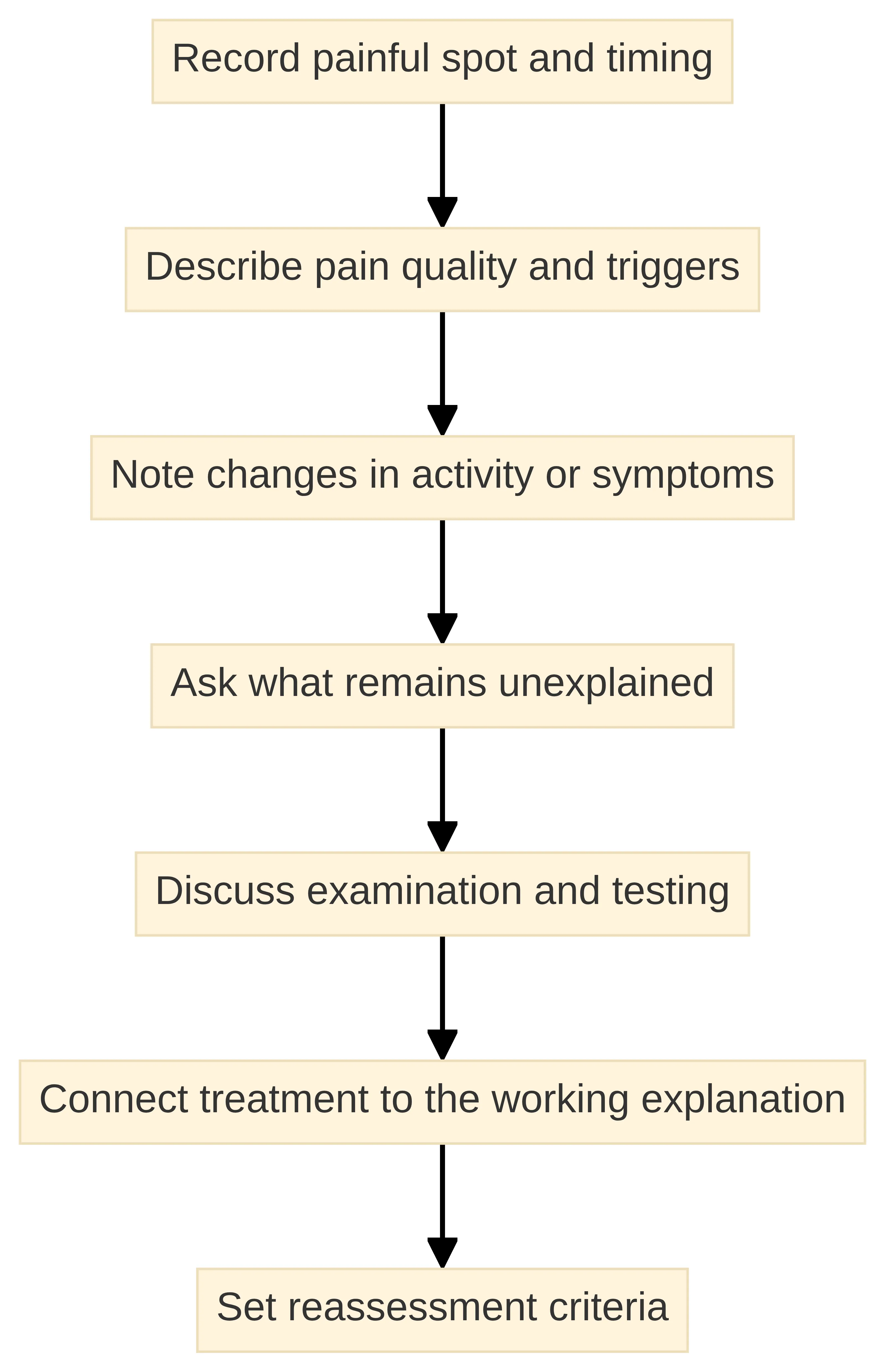
Use symptom contrasts to frame the clinical question
Bottom-of-heel pain is a symptom, so the useful comparison is between the pattern you notice and the question a clinician may need to investigate. Pain on the inner underside of the heel, especially with the first steps after waking or after rest, can occur with plantar fasciitis, but that pattern alone does not establish the diagnosis. Burning, tingling, or numbness can point toward nerve involvement; deep, bruise-like pain in the middle of the heel can occur with a heel-pad problem; and worsening pain after increased activity can occur with a calcaneal stress fracture.
An X-ray finding should be interpreted in context: a heel spur does not necessarily explain pain, because spurs are found in about half of people with plantar fasciitis and can also occur in people without the condition. At an evaluation, describe where the pain is, when it appears, what changed before it began, and whether it is worsening or accompanied by altered sensation. Clinicians usually begin with your history and a foot examination; imaging or other tests may be considered when another cause needs investigation.
Pattern comparison has limits. After an injury, inability to bear weight, severe or worsening pain, major swelling or bruising, a new deformity, or concern about a broken bone warrants prompt medical assessment. Spreading redness, warmth, drainage, or fever can signal infection and warrants prompt medical assessment. After an injury, new numbness or tingling, pale or bluish toes, or unusual coldness needs prompt evaluation. If you have diabetes, seek prompt evaluation for a foot injury or wound.
Conservative treatment discussions may include plantar-fascia stretching, ice massage, and—when appropriate for the individual—nonsteroidal anti-inflammatory drugs. If pain continues beyond three months despite treatment, an ultrasound may be a reasonable diagnostic option to discuss with a clinician. For chronic foot pain when conservative treatments are no longer effective, a regenerative evaluation may be a next step to discuss with a qualified provider; responses to regenerative treatments vary and biological adaptation tends to occur gradually. The Regenerative Lower Extremity Institute provides full clinical evaluations for people seeking regenerative treatments for foot and ankle problems.
What should I bring to a bottom-of-heel pain evaluation?
What are common causes of pain on the bottom of the heel?
Pain on the bottom of the heel can be caused by several conditions, including plantar fasciitis, heel fat-pad syndrome, calcaneal stress fractures, nerve entrapment, and systemic inflammatory diseases. Each condition may present with different symptoms and requires careful evaluation.
When should I seek medical evaluation for heel pain?
You should seek medical evaluation for heel pain if you experience severe or worsening pain, inability to bear weight, significant swelling or bruising, new deformities, or signs of infection such as spreading redness or warmth.
How can I determine if my heel pain is related to plantar fasciitis?
To determine if your heel pain is related to plantar fasciitis, note if the pain is worst with the first steps after waking or after sitting for a while, and if it eases with movement but returns with prolonged weight-bearing.
What role do regenerative treatments play in managing heel pain?
Regenerative treatments, such as stem cell therapy and exosome therapy, may be discussed as options for managing chronic heel pain, particularly when conservative treatments have not been effective. These treatments aim to support the body’s natural healing processes.
Free consultation
Find out whether regenerative treatment is right for you.
Most consultations begin as a telehealth call with a physician specialist, so you can start without travelling to a clinic. No referral needed.