
sudden foot pain without injury
Sudden Foot Pain Without Injury: How to Decide What to Do Next

Sudden foot pain is first a safety question, not a diagnosis
Unexpected foot pain without a known injury is not automatically minor, but it is not a diagnosis either. Several conditions can produce similar symptoms.
Your next step depends on four observations:
- How suddenly the pain began and whether it is getting worse.
- How severe the pain is and whether you can bear weight.
- Whether swelling, bruising, a wound, redness, warmth, drainage, fever, or a new deformity is present.
- Whether you notice numbness, tingling, unusual coldness, or pale or bluish toes.
A lack of injury history does not rule out a problem that needs assessment. Being able to walk does not rule out a fracture, and severe or worsening pain cannot reliably be separated from a bruise or sprain by symptoms alone.
The immediate decision is whether you need emergency care, prompt medical assessment, or careful observation while arranging professional advice. Severe injury signs, exposed bone, severe bleeding, or a new deformity raise the urgency. Infection-like changes, new nerve or circulation changes, and calf swelling with foot pain also need prompt attention. Calf pain or swelling cannot diagnose or rule out a blood clot by itself, so you should not use symptom matching as a substitute for assessment.
If none of those warning signs is present, keep the conclusion modest: the absence of a red flag does not identify the cause or guarantee that the problem will resolve. Record what you notice, avoid using walking ability as reassurance, and arrange clinical advice if pain persists, worsens, returns, or remains unexplained.
Possible causes range from mechanical problems to nerve, bone, and systemic contributors
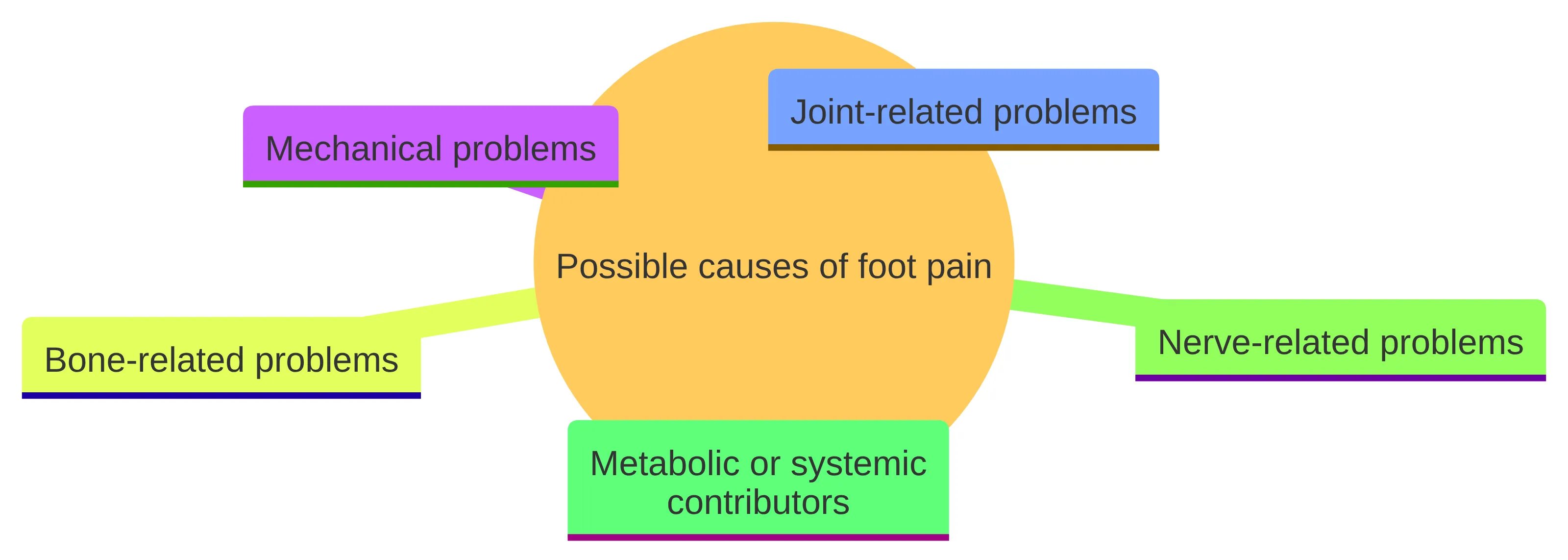
Unexpected foot pain can arise from several broad categories, and more than one problem may be involved. A symptom pattern can help organize the conversation, but it cannot establish which category applies to you.
- Plantar fasciitis: This is one possible cause of foot pain when you cannot identify a single injury.
- Joint-related problems: Arthritis is one possible contributor, while gout is another condition listed among possible causes.
- Bone-related problems: Stress fractures can occur among the possible explanations for pain without an obvious injury.
- Nerve-related problems: Peripheral neuropathy and nerve compression can contribute to painful feet.
- Metabolic or systemic contributors: Metabolic disorders and systemic illnesses are broader possibilities that require clinical evaluation rather than home diagnosis.
These categories overlap. For example, pain may feel located in the foot while the relevant issue involves nerve function, a joint, or bone. The location of pain is useful information, but it does not settle the source.
The pattern of your symptoms matters more than a single label. Note whether the pain is in the heel, arch, toes, midfoot, or ankle; whether it stays in one area or spreads; and whether it feels deep, burning, sharp, aching, or unusually sensitive. Those descriptions can help a clinician decide which possibilities deserve attention, but they do not prove that you have plantar fasciitis, gout, a stress fracture, arthritis, nerve compression, or a systemic condition.
A broad cause list should reduce false certainty, not increase fear. The practical point is that several explanations can look alike at first. Clinical history, examination, and—when appropriate—imaging are what separate plausible categories.
Foot-pain evaluation depends on the likely cause and the severity of your symptoms. A healthcare provider may ask when the pain began, examine the foot, and order foot X-rays when those findings make imaging useful. That process is more reliable than choosing a treatment from a list of possible causes.
Pain severity and walking ability change the level of concern
Pain severity and walking ability are two separate observations. Sudden, severe pain that prevents you from bearing weight warrants prompt medical evaluation, and diagnostic imaging may be needed. Difficulty walking is especially concerning when it appears with substantial swelling, bruising, or a rapid change in symptoms.
Being able to walk does not rule out a fracture. Some broken bones still allow weight-bearing, so walking should not be used as a home test for whether the foot is injured. Symptoms also cannot reliably distinguish a fracture from a bruise or sprain when pain is severe or worsening, swelling or bruising is substantial, or weight-bearing is difficult.
The combination of findings should guide your timing:
- Severe pain with inability to bear weight: Seek prompt medical evaluation; imaging may be needed.
- Pain that is worsening, persistent, or paired with substantial swelling or bruising: Arrange medical assessment rather than assuming a minor strain.
- Pain that is mild and stable without warning signs: Observe the pattern while arranging professional advice if it persists or remains unexplained. Do not treat stability as proof of a harmless cause.
Your timing should change if a new warning sign appears. A change in walking ability, pain intensity, swelling, skin color, temperature, sensation, or wound status deserves renewed attention.
Seek urgent attention for severe structural warning signs
A new deformity, suspected broken bone, or sudden severe pain with inability to bear weight can signal a structural problem that needs prompt attention. A severe injury may require emergency evaluation. Do not wait for a visible bruise before taking these signs seriously; some broken bones can still permit walking, and symptoms cannot reliably identify the exact injury.
Seek prompt medical attention when you notice:
- A new change in the shape or position of the foot.
- Sudden severe pain that prevents weight-bearing.
- Severe or worsening pain with substantial swelling or bruising.
- A suspected broken bone, even when the cause is not clear.
Emergency evaluation may be appropriate for a severe injury. The level of urgency depends on the full pattern, not on whether you can point to an accident.
An open wound, heavy bleeding, or exposed bone changes the decision immediately. An open wound or heavy bleeding needs urgent care, while severe bleeding or visible bone warrants emergency evaluation. Keep the focus on obtaining appropriate care rather than trying to identify the injury yourself.
A missing injury story does not make a wound or deformity less significant. If either appears, use the warning sign itself to determine your next step.
Do not ignore infection, nerve, circulation, or clot-related signals
Infection-like changes require prompt medical assessment even when you do not remember an injury. Spreading redness, warmth, drainage, or fever alongside foot pain can signal infection. An open wound adds another reason to seek urgent care, especially when the wound is changing or the surrounding skin is becoming more inflamed.
Use the combination of signs rather than waiting for every sign to appear. Foot pain with spreading redness or warmth, drainage, or fever is enough to change the timing of care.
New numbness, tingling, pale or bluish toes, or unusual coldness may signal a nerve or circulation problem and should be evaluated promptly. These changes are different from simply having pain; they suggest that sensation or blood flow may need clinical attention.
Do not dismiss a new color, temperature, or sensation change because you can still move the foot. Describe when the change began, whether it is spreading, and whether it affects one toe, several toes, or the whole foot.
Foot pain with calf swelling warrants urgent assessment, particularly after travel, surgery, or prolonged rest, so a possible blood clot can be evaluated. Calf pain and swelling can occur with deep-vein thrombosis, but those symptoms are not sufficiently specific to diagnose or exclude it by themselves.
The practical boundary is clear: do not try to rule out a clot through symptom comparison at home. If foot pain occurs with calf swelling, use the combination as a reason for urgent assessment and tell the clinician about recent travel, surgery, or prolonged rest.
Diabetes and nerve problems call for a lower threshold for evaluation
Diabetes changes how you should respond to a foot wound or injury. If you have diabetes and develop either one, seek prompt medical evaluation because reduced sensation and slower healing can increase risk.
Regular foot examinations can help assess your risk of foot ulcers. A provider may test sensation with a monofilament and check foot pulses. Those checks are different from trying to judge the foot only by how it feels at home.
Nerve damage can contribute to serious foot conditions even when the initial symptom pattern seems unclear. Charcot foot is a rare, disabling condition related to nerve damage in the foot, and peripheral neuropathy is a common cause. This possibility does not mean that your pain represents Charcot foot; it means that nerve-related symptoms and relevant health history belong in the clinical discussion.
Do not wait for severe pain to appear before taking a wound or injury seriously.
While arranging care, protect the foot and monitor changes
Monitoring unexpected foot pain should mean tracking changes, not trying to prove that the cause is harmless. While arranging care, write down:
- The date and approximate time the pain began.
- The exact location and whether the pain stays there or spreads.
- The intensity and whether it is improving, stable, or worsening.
- Whether you can bear weight and whether walking changes the pain.
- Any swelling, bruising, redness, warmth, drainage, fever, wound, deformity, numbness, tingling, unusual coldness, or color change.
- Recent travel, surgery, prolonged rest, or a history of diabetes or neuropathy when relevant.
This record gives you a concise account to share with a clinician. It does not diagnose a fracture, infection, nerve problem, circulation problem, or clot. Use the record to organize the changes that affect timing. The onset and progression describe whether the pain began suddenly and whether it is worsening. Location and quality help a clinician understand the complaint, but they do not identify the cause. Weight-bearing information matters because being able to walk does not rule out a fracture, while sudden severe pain that prevents weight-bearing warrants prompt evaluation. Skin, temperature, sensation, wound, swelling, and bruising changes should be recorded as observations rather than interpreted as a diagnosis.
Relevant context also belongs in the record. Note recent travel, surgery, prolonged rest, diabetes, or known neuropathy when applicable. Calf swelling with foot pain deserves urgent assessment, particularly after travel, surgery, or prolonged rest; the record supports that conversation but does not replace it. If you have diabetes and develop a foot wound or injury, seek prompt medical evaluation because reduced sensation and slower healing can increase risk. When no warning sign is present, the record can help show whether symptoms are settling or whether persistence and uncertainty justify contacting a clinician.
Protecting the foot while you decide what to do starts with avoiding false reassurance. Do not deliberately test the foot by repeatedly walking on it; the ability to bear weight does not rule out a fracture. If pain becomes severe, worsens, or makes weight-bearing difficult, move from observation to prompt assessment.
For mild, stable pain without the warning signs described above, avoid activities that aggravate the pain and unnecessary weight-bearing when weight-bearing is painful. Even then, persistent or unexplained pain deserves professional attention. Add any new symptom to your record and change your timing if the pattern changes.
Short-term observation cannot replace an examination when uncertainty remains. A healthcare provider can use your symptom history and a physical examination to decide whether foot X-rays or another form of assessment is appropriate. Your role while arranging care is to notice meaningful changes and communicate them clearly, not to assign yourself a diagnosis.
An evaluation can separate the plausible explanations
A professional evaluation can connect your symptoms with findings that cannot be established by pain location alone. A healthcare provider may ask about onset, severity, walking ability, associated changes, and relevant health history, then perform a physical examination. Foot X-rays may be used when the clinical question calls for them.
Imaging choice depends on the question. MRI provides high soft-tissue contrast and is especially useful for soft-tissue abnormalities and bone lesions in chronic or nonacute foot and ankle problems. The cited imaging review describes CT as having a greater role in acute settings. Neither statement means that you need a particular scan; the examination and clinical context guide that decision.
At Regenerative Lower Extremity Institute, we use a thorough lower-extremity examination to help narrow whether symptoms involve a tendon, joint, nerve, or bone. That examination helps organize the next discussion; it does not establish an individual treatment choice from symptoms alone.
The useful sequence is evaluation first, options second. Once the possible source and urgency are clearer, you can discuss appropriate care with a qualified clinician without assuming that a regenerative option, medication, procedure, or surgery belongs in your plan.
Bring a short set of questions to the appointment:
- What findings could explain the location and timing of my pain?
- Does my walking ability change the need for assessment or imaging?
- Which warning signs should make me seek faster care?
- Does my history of diabetes, neuropathy, travel, surgery, or prolonged rest change the evaluation?
- What remains uncertain after the examination, and what is the next way to clarify it?
These questions keep the conversation focused on cause, urgency, and the information needed before discussing treatment. Keep any later treatment discussion within that same boundary. Regenerative therapies are adjunctive, non-surgical options used alongside structured rehabilitation; they are not guaranteed substitutes for surgery. Their relevance depends on the diagnosis, tissue health, and treatment goals, so a symptom list is not evidence that a particular regenerative procedure is appropriate. A clinician must first clarify what structure or process may be involved and how urgent the problem is. An evaluation may show that another form of care or further assessment is more appropriate. This keeps the focus on ethical, outcomes-driven care rather than matching a sudden symptom to a named procedure. It also separates discussing options after assessment from treating a possibility in the cause list as a recommendation. No treatment outcome can be promised from the information in this article alone. That boundary is especially important when onset is sudden: safety and urgency come before selecting a non-urgent option. If a warning sign is present, obtain appropriate medical attention before focusing on treatment preferences.
Before contacting a clinician, organize the account so safety-relevant changes are easy to find. Start with when the pain began and whether it is worsening. Then report any change that affects urgency—such as inability to bear weight, a new deformity, a wound, fever with spreading redness, altered toe color or temperature, or calf swelling—before describing less urgent details. If you are unsure whether a change matters, report it rather than deciding that it is unimportant. Separate observations from interpretations: “my toes look pale” describes what you noticed, while “this is a circulation problem” is a conclusion. This distinction supports a clearer conversation without turning the appointment into a home diagnosis. Add relevant context, including diabetes, known neuropathy, recent travel, surgery, or prolonged rest, and say whether the overall pattern is improving, stable, or worsening. The goal is a complete account that helps the clinician decide what examination or assessment is appropriate.
Choose professional assessment when risk or uncertainty remains
If those signs are absent, persistent, worsening, or unexplained pain still deserves professional assessment rather than a home diagnosis.
Use the observations in this guide to describe what changed and how quickly, then choose care that matches the urgency of those findings.
If the cause remains uncertain or the pain is not settling, professional help can clarify what needs attention and how soon it should be addressed.
What should I record before requesting an evaluation?
What are common causes of sudden foot pain without an injury?
Sudden foot pain without an identifiable injury can be caused by conditions such as plantar fasciitis, gout, tarsal tunnel syndrome, stress fractures, and arthritis. Other potential contributors include mechanical problems, nerve compression, and systemic illnesses.
When should I seek medical attention for sudden foot pain?
You should seek prompt medical attention if you experience sudden severe pain that prevents you from bearing weight, if there is substantial swelling or bruising, or if you notice signs of infection such as spreading redness, warmth, or fever. Additionally, new numbness, tingling, or changes in skin color warrant evaluation.
How can I monitor my symptoms while deciding what to do about foot pain?
While monitoring your symptoms, keep track of when the pain began, its location, intensity, and whether it changes with activity. Note any swelling, bruising, or other symptoms like numbness or tingling. This information can be helpful for a healthcare provider.
What role does a professional evaluation play in addressing foot pain?
A professional evaluation can help identify the underlying cause of foot pain through a thorough examination and possibly imaging. This assessment is crucial for determining the appropriate treatment options.
What should I expect during a consultation for foot pain?
During a consultation, a healthcare provider will ask about your symptoms, perform a physical examination, and may order imaging tests like X-rays if necessary. They will discuss potential causes and treatment options based on their findings.
Free consultation
Find out whether regenerative treatment is right for you.
Most consultations begin as a telehealth call with a physician specialist, so you can start without travelling to a clinic. No referral needed.