
What is the best place for foot pain treatment in Chicago?
What is the best place for foot pain treatment in Chicago?
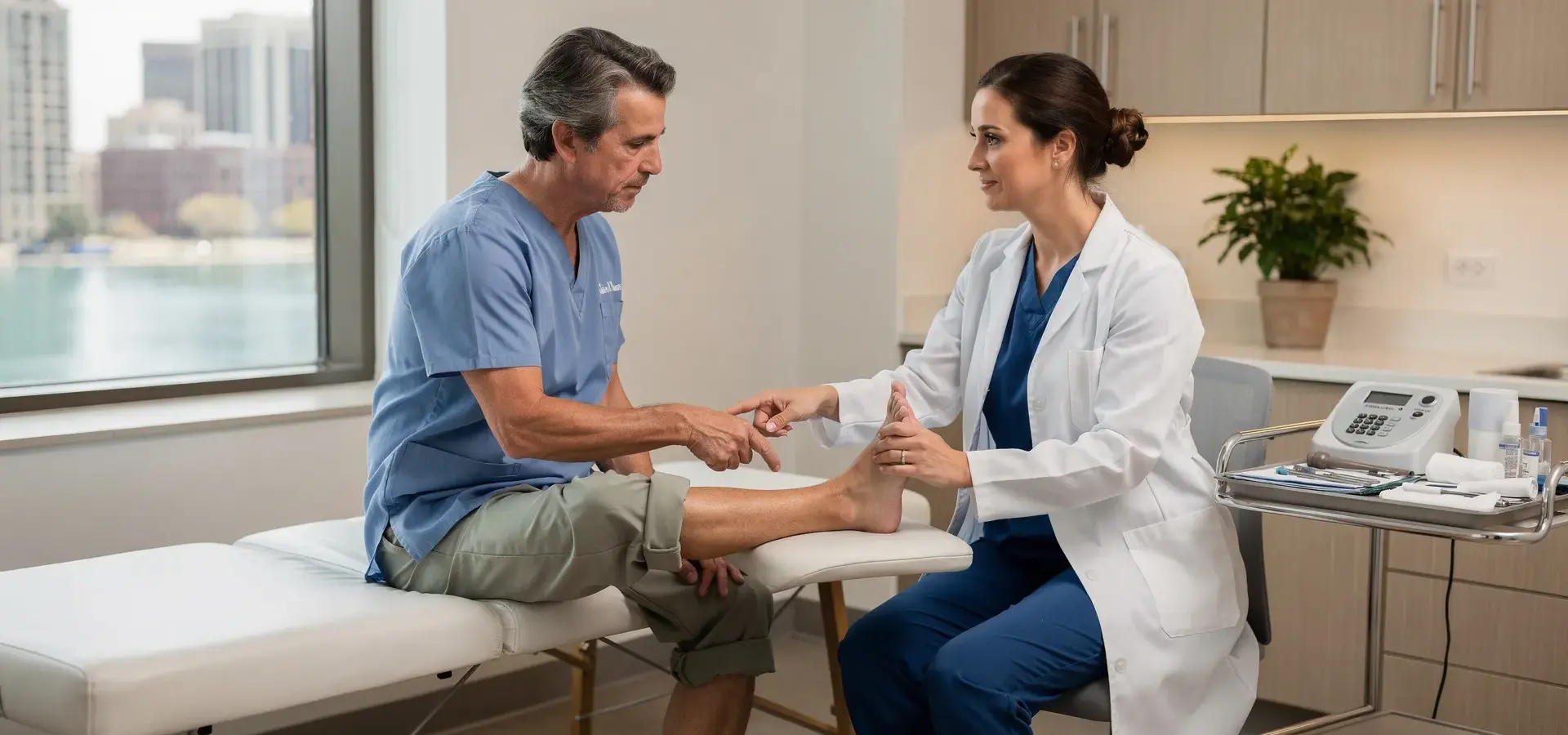
Turn “best place” into a decision you can test
The best place for foot pain treatment in Chicago cannot be identified responsibly from a ranking or a treatment promise alone. You need a provider that can explain what may be causing your pain, which reasonable pathways apply, what each option involves, how follow-up will work, and what the full cost may be.
Foot and ankle pain can result from injury, overuse, or conditions affecting bones, joints, tendons, or ligaments. That range of possible sources is why a familiar label such as “heel pain” or “ankle pain” is a starting point, not a treatment decision.
Use this guide to test a Chicago provider’s decision process. A useful shortlist should include a practice that can:
- connect your symptom pattern with a focused history and examination;
- explain when imaging could confirm or rule out a diagnosis;
- discuss established care, rehabilitation, regenerative options, and surgical referral in context;
- describe evidence and uncertainty for the specific condition being considered;
- explain product oversight, injection guidance, risks, reassessment, and follow-up; and
- give you a complete financial picture rather than only an advertised procedure price.
Use these criteria to compare Chicago providers by how they assess your pain, explain options, and plan follow-up before booking. It gives you a way to decide whether a consultation is worth booking and whether the conversation is about your condition rather than a predetermined procedure.
Provider comparison becomes more useful when you treat it as a sequence rather than a popularity contest. First ask whether the evaluation can explain the pain pattern. Then ask whether the proposed pathway includes established alternatives, meaningful limits, and a point at which the plan would be reassessed. Only after those questions are answered should a particular procedure or price become part of your decision.
The same standard applies whether you are an active adult trying to return to exercise, someone whose walking has become difficult, or someone who has already tried rest, braces, medication, or injections. A clear process matters more than a broad label.
Start with the provider’s assessment process
A Chicago foot pain assessment should begin with your history and a physical examination, then use imaging when the clinical question calls for it. A podiatrist may review your medical history, perform a physical examination, and order imaging such as X-rays to confirm or rule out certain diagnoses. A thorough history and objective physical examination are needed to differentiate plantar fasciitis, and plantar fasciitis is diagnosed in most cases through history and physical-examination findings.
The provider should also ask how long the problem has lasted. Choosing appropriate plantar-fasciitis treatment requires understanding the duration of your symptoms, not just the place where you feel pain.
A strong first visit should leave you with a working explanation and a plan for resolving uncertainty. Ask:
- What possible source of pain are you evaluating?
- What findings support that explanation?
- What other causes need to be considered?
- Would imaging change the decision, and if so, what question would it answer?
- Which parts of the plan address the cause, and which parts address symptoms?
- When will you reassess the plan if the pain does not change?
A provider does not need to order every available test to offer a useful evaluation. The better question is whether each examination step or image has a clear purpose. You should be able to understand what the provider knows, what remains uncertain, and what information would change the next step.
For a Chicago shortlist, prioritize relevant foot-and-ankle experience and an evaluation process that connects your symptoms, examination, and any appropriate imaging. Do not treat a clinic’s use of a broad treatment category as proof that the clinic has identified your pain source.
A useful working explanation should connect three parts of your visit: what you felt and when it began, what the examination showed, and what any imaging was intended to clarify. If those parts do not line up, ask what uncertainty remains instead of assuming that the most familiar diagnosis is correct.
Plantar fasciitis is a good example of why this matters. A thorough history and objective physical examination are needed to differentiate it, and the duration of symptoms affects treatment decisions. Ask the provider to explain how your symptom timeline supports or challenges that possibility before you discuss an intervention.

Match the evaluation to the pattern of pain
Different foot and ankle pain patterns can require different clinical questions. Ankle osteoarthritis most commonly arises from prior trauma and often affects younger, working-age individuals. It may be complicated by deformity, instability, prior surgery, and compromised bone or soft-tissue envelopes.
An ankle sprain also needs more than a generic “sprain” label: ankle sprains range in severity from grade I to grade III. Morton’s neuroma is a common foot condition in which the nerve between the bones of the toes becomes swollen, thickened, and inflamed. These examples do not diagnose your pain, but they show why location alone should not determine treatment.
Use the pattern of your symptoms to test the provider’s reasoning:
- If pain follows an injury, ask how the injury’s severity and stability affect the plan.
- If pain developed gradually, ask whether overuse, tendon, fascia, joint, or nerve-related causes are being considered.
- If you have had prior surgery, ask how the surgical history changes the examination and available pathways.
- If pain affects the toes or includes nerve-like features, ask what structure the provider is evaluating.
- If you have arthritis concerns, ask which joint findings matter and what nonsurgical and surgical alternatives exist.
A Chicago foot pain provider should explain why a proposed pathway fits the evaluated problem. A procedure that is appropriate for one condition is not automatically appropriate for another.
A Chicago foot clinic lists plantar fasciitis surgery at $3,500, including anesthesia. That listing is a price example from one clinic, not a universal Chicago price and not a recommendation for surgery.
Ask what diagnosis would make a surgical pathway relevant, which conservative options remain reasonable, and what would trigger referral. The point is to compare pathways after evaluation rather than to choose a procedure because its name or price appears first.
Your symptom pattern becomes more useful when you describe its change over time, not only its location. Note whether the pain followed an injury, appeared gradually, became sudden or severe, or changed after a new activity. Prior surgery, instability, and the effect on walking can also change the questions a provider needs to ask.
Bring those details to the evaluation and ask which parts of the pattern matter most. A provider should be able to explain why the working diagnosis fits the history and what would make another cause more likely.
Check whether established care remains part of the plan
Plantar fasciitis care should not begin with an injection simply because an injection is available. Conservative treatment should be the first-line treatment for plantar fasciitis, and it leads to good outcomes for most patients.
Evidence-supported conservative options for plantar fasciitis include:
- soft-tissue and joint mobilization;
- targeted calf and plantar fascia stretching;
- a night splint;
- a custom foot orthosis; and
- taping.
Clinicians may use prefabricated or custom-fabricated or fitted orthoses with other treatments to reduce pain and improve function in people with heel pain or plantar fasciitis. When consistent first-step pain in the morning is part of the pattern, the guideline says clinicians should prescribe a 1- to 3-month program of night splints.
Ask a provider which conservative measures fit your evaluated condition, how you would use them, and what finding would lead to a change in plan. A treatment discussion should include the practical work that supports recovery, not only an intervention performed in the clinic.
Progressive loading is described as the most evidence-supported approach for plantar fasciitis and Achilles tendinopathy. For plantar fasciitis and Achilles tendinopathy, treatment should focus on progressive loading rather than rest and anti-inflammatories alone.
A cited study found that patients with heel pain who received manual therapy had better functional outcomes at 4-week and 6-month follow-up. The study result does not establish that every person will have the same response. It does support asking how rehabilitation, activity guidance, and reassessment fit around any proposed treatment.
If a clinic presents a regenerative option without explaining how established care and rehabilitation fit into the plan, ask for that explanation before deciding.
A conservative plan should be specific enough for you to understand what happens between visits. Ask which measure is being recommended, how it relates to the evaluated condition, and what change would lead to reassessment. For plantar fasciitis, that conversation may include stretching, mobilization, orthoses, taping, or a night splint. For plantar fasciitis or Achilles tendinopathy, it may also address progressive loading rather than rest alone.
Do not interpret “conservative” as “do nothing.” It can be an organized treatment pathway with defined follow-up and a clear point for reconsidering the diagnosis or another option.

Compare pathways instead of choosing a procedure first
A useful consultation compares pathways before it names a procedure. Treatment options for ankle osteoarthritis include joint-preserving procedures, ankle arthrodesis, and total ankle arthroplasty. The relevant choice depends on the evaluated joint problem and the surrounding clinical factors, not on a generic promise of avoiding surgery.
Ankle sprains also illustrate why the decision needs context. Uncomplicated ankle sprains are treated without surgery, while complicated ankle sprains usually require surgical management. That distinction should come from an evaluation of the injury, not from an online symptom description.
Ask the provider to place each pathway beside the same criteria:
- What problem is the option intended to address?
- What established alternatives remain available?
- What are the material risks and limitations?
- What rehabilitation or activity guidance follows it?
- What reassessment would show that the plan should change?
- When would referral to another foot-and-ankle professional be appropriate?
This comparison keeps conservative care, regenerative care, and surgery in the same decision rather than making one option appear inevitable.
A second opinion can be helpful when surgery is elective, you are unsure about the plan, imaging is unclear, or you want to compare conservative and surgical options. A second opinion may confirm the original plan, suggest a different conservative path, recommend updated imaging, or explain why surgery may still be the appropriate option.
If you seek another evaluation, bring the original records, imaging, treatment history, and the specific decision you want clarified. Ask the second provider to explain both agreement and disagreement with the first plan.
A pathway comparison is most useful when every option has a boundary. Ask what would make continued conservative care reasonable, what finding would support a regenerative discussion, and what finding would make surgical referral more appropriate. The answer may differ for an ankle joint affected by osteoarthritis, a sprain with a particular severity, or pain that has not been explained.
If the provider cannot explain why an option fits your findings or what would happen if it fails, pause before committing. If surgery is elective or the plan remains unclear, a second opinion may help you compare the available routes.

Audit regenerative claims for evidence and fit
Regenerative treatment is not one uniform intervention. A proposal may involve platelet-rich plasma, bone marrow aspirate concentrate, stem-cell therapy, exosome therapy, peptide therapy, or a combination of approaches.
A biological explanation for a regenerative treatment is not the same as proof that it improves your particular foot or ankle condition. A review describes the evidence for regenerative applications in the foot and ankle as fragmented and calls for further research on efficacy and safety across specific conditions and technologies.
The practical test is specificity. Before considering a proposal, ask:
- What exact product or procedure is being proposed?
- Which foot or ankle condition is it intended to address?
- What evidence applies to that condition and this type of treatment?
- What benefit is being measured, and over what follow-up period?
- What alternatives would be reasonable if you did not choose it?
- What would count as insufficient improvement?
The answers should distinguish a biological theory from evidence about a clinical result.
For plantar fasciitis, the cited consensus describes PRP and other injection techniques as uncertain—neither appropriate nor inappropriate. That wording does not tell you to accept or reject every PRP proposal. It tells you to ask how the clinician applies the evidence to your condition and what other options remain.
Broader pricing summaries list advanced regenerative protocols at $5,000 to $30,000, with specialized cases reaching $50,000 or more. Those figures are broad pricing summaries, not a quote for your care. Treat them as a reason to request the treatment scope and inclusions in writing, not as a reason to select a procedure.
Evidence should be matched to the condition, not borrowed from a different joint or a general explanation of healing. Ask whether the discussion concerns your specific foot or ankle problem, the proposed technology, and the outcome being measured. For plantar fasciitis, the cited consensus leaves PRP and other listed injection techniques uncertain, so a responsible discussion should state that uncertainty plainly.
You should also hear what happens if you decline the regenerative option. A comparison with established care, rehabilitation, and referral gives you a decision rather than a sales pitch.
Put safety, oversight, and follow-up before enthusiasm
A regenerative consultation should explain the proposed treatment as carefully as it explains its possible benefit. A PRP consultation may include reviewing your medical history, symptoms, and relevant imaging, explaining the treatment, and determining whether PRP suits your needs.
Ask how the preparation is made, what is included in the procedure, whether imaging guidance is used, how risks will be discussed, and how improvement will be assessed. Lower-cost biologic procedures may use less concentrated preparations, and PRP quality can vary widely between clinics. Without ultrasound or fluoroscopy, an injection can be placed in the wrong area, potentially reducing effectiveness and preventing accurate assessment of improvement at follow-up.
If a product is described as regenerative, ask whether it is FDA-licensed or approved for the intended use. The FDA has received reports including blindness, tumor formation, and infections associated with unapproved regenerative medicine products. This question does not replace clinical advice; it gives you a direct way to ask about oversight before treatment.
Follow-up should be part of the initial discussion. We explain that physiological responses to regenerative treatments vary significantly and that biological adaptation tends to follow a gradual timeline.
Ask when the first reassessment would occur, what change would count as meaningful, what rehabilitation or activity guidance applies, and what happens if the expected change does not occur. Also ask whether another diagnosis, updated imaging, or referral would be considered if the plan is not working.
A provider that answers these questions gives you a way to judge the plan over time. A promise that skips product details, risks, or reassessment leaves you without a clear decision boundary.
A safety-focused discussion should leave you with concrete information, not only encouraging language. Before you agree to a proposed injection or biologic, ask who prepares it, what exactly will be used, whether imaging guidance is part of the procedure, and how the result will be assessed later. Ask what would prompt a change in plan if improvement is limited.
The preparation, guidance, follow-up, and evidence are separate questions. A low price does not answer them, and a biological explanation does not answer them either.
Prepare a symptom and treatment record
Your symptom record can make a Chicago foot pain consultation more focused. Note when your pain began, whether it developed gradually or became sudden or severe, and whether it is changing over time.
Record the practical effect as well. Write down how pain affects walking, work, exercise, sleep, or other activity, along with the measures you have tried, such as stretching, activity changes, footwear adjustments, cryotherapy, padding, strapping, or taping.
Bring a short record that includes:
- the location and pattern of pain;
- when symptoms started and how they have changed;
- activities that increase or reduce symptoms;
- injuries, surgeries, or relevant diagnoses;
- medicines, injections, braces, therapy, or home measures already tried; and
- the result of each measure, including little or no change.
This record is not a diagnosis. It is a practical way to give the evaluating clinician a clearer timeline and to avoid forgetting prior care during the appointment.
Your treatment record should separate what you tried from what happened afterward. For each measure, note when you started it, whether walking or activity changed, and whether the pain stayed the same, improved, or worsened. Include footwear changes, stretching, taping, padding, cryotherapy, injections, or other care you remember.
Bring relevant reports and images if you have them, but do not assume that an old image settles a new or changing problem. The purpose of the record is to help the clinician see the sequence and decide what needs to be examined next.
Compare the full financial pathway
One Illinois cost guide says most cash-pay PRP injections cost $750 to $2,000 per session and cell-based treatments typically cost $3,000 to $9,000 per treatment area; the same guide describes Illinois PRP at $750 to $2,000 per injection site. Consultation, imaging guidance, processing, follow-up, and additional treatment areas can raise the total.
A separate U.S. pricing summary for 2025 reported cash prices of $500 to $2,000 for a single PRP injection and said many offices offered a discounted series around $2,000 for three sessions. The final PRP quote depends on the clinic’s protocol and what is included.
The same 2025 U.S. summary placed most office-based biologic injections for joints, tendons, and ligaments at roughly $500 to $3,000 per session, with advanced or cell-based procedures higher. It said the price depends on the biologic used, imaging guidance, and whether you purchase a series.
These figures describe different populations, timeframes, units, and treatment categories. They should not be merged into one expected price or treated as a quote from Regenerative Lower Extremity Institute.
A complete cost comparison includes more than the first injection receipt. Comparing regenerative treatment costs may require considering repeat procedures, expected duration of relief, rehabilitation, downtime, and whether treatment may delay surgery—not just one injection’s price.
Request a written breakdown of:
- the consultation and examination;
- imaging and interpretation;
- the biologic or procedure being proposed;
- preparation and processing;
- imaging guidance;
- the number of treatment areas or sessions;
- follow-up visits and reassessment;
- rehabilitation or activity guidance; and
- possible referral or additional care if the plan changes.
Ask which amounts are estimates and which are fixed charges. Do not compare one clinic’s procedure-only price with another clinic’s full pathway price. The meaningful comparison is the care you may need from evaluation through reassessment.
A treatment budget should follow the pathway you are actually considering. For a PRP discussion, ask whether the quoted amount is per session or per injection site, whether a series is being proposed, and whether consultation, preparation, imaging guidance, and follow-up are included. For a cell-based discussion, ask whether the amount is per treatment area and what additional areas or visits would change the total.
The published ranges are not interchangeable: one Illinois guide describes most cash-pay PRP injections at $750 to $2,000 per session and cell-based treatments at $3,000 to $9,000 per treatment area, while a 2025 U.S. summary describes single PRP injections at $500 to $2,000. Ask which population, date, unit, and treatment category a quote represents before comparing it with another figure.

Use a consultation question list before booking
A consultation question list can help you distinguish a clinical discussion from a sales conversation. Take these questions with you:
- What is the most likely source of my pain, and what other causes are you considering?
- What did the history and examination show?
- Would imaging change the plan, and what would it clarify?
- Which conservative options and rehabilitation measures should I consider?
- If you are proposing regenerative treatment, what exact treatment is it and what evidence applies to my condition?
- What are the material risks, limitations, and alternatives?
- How will you assess improvement, and when will we reassess?
- What would lead to updated imaging, a second opinion, or referral?
- What is the total cost, including consultation, imaging, preparation, guidance, follow-up, repeat care, and additional treatment areas?
- What information or activity guidance should I follow while the plan is being evaluated?
If there has been little or no improvement after about six weeks, heel-pain guidance says to seek referral to a foot and ankle surgeon when specialist care is not already in place.
The purpose of the list is not to force a particular answer. It is to make the decision process visible before you commit to a treatment.
We provide specialized treatments for plantar fasciitis, Achilles tendonitis, arthritis in the foot and ankle, sports injuries, ligament sprains and tears, chronic pain conditions, and post-surgical recovery. Our treatment plans are personalized and built around your individual body and lifestyle needs.
A Chicago foot clinic lists a $150.00 office visit, a $350.00 visit plus injection, a $300.00 visit plus X-ray, and $500.00 for custom orthotics. That is one clinic’s published price list, not a universal Chicago rate and not our price.
Use price examples only to decide what you need clarified. Ask for the scope of your own proposed pathway rather than assuming that another clinic’s menu or a general online range applies to you.
A Chicago consultation can be more productive when you bring three things: your symptom timeline, your treatment history, and the questions that matter most to your decision. Ask the clinician to connect the proposed plan with your findings, goals, alternatives, and budget. Ask what would happen if the first plan did not produce enough improvement.
We offer clinical evaluations for people considering regenerative treatment options for foot and ankle conditions, and our treatment plans are personalized around individual body and lifestyle needs. That evaluation is a place to discuss fit; it is not a promise that a particular treatment will be selected.
Know when evaluation should take priority
If foot or ankle pain is severe, sudden, worsening, or accompanied by concerning symptoms, seek immediate qualified evaluation rather than waiting for a routine consultation. If you can do so without delaying care, note when the change began and how it affects walking or activity, and share that information with the evaluating professional. Heel-pain guidance specifically recommends referral to a foot and ankle surgeon when there has been little or no improvement after about six weeks and specialist care is not already in place.
A diabetic foot exam checks for signs of foot-health problems that can lead to serious infection and amputation if they are not found and treated early.
Do not use a regenerative label to postpone necessary evaluation. Do not treat a marketing claim, a familiar symptom name, or a single price as proof that a treatment fits your condition. If your symptoms are severe, changing, or not improving, make qualified assessment the next action rather than continuing to compare advertisements.
Decide whether to contact the Regenerative Lower Extremity Institute
The right Chicago foot pain consultation is the one that helps you understand the problem, compare reasonable pathways, and decide what should happen next. Bring your symptom and treatment record, ask the questions in this guide, and request clear explanations of evidence, risks, follow-up, and total cost.
A qualified professional must determine whether any treatment is suitable for your individual findings, medical history, goals, and alternatives. Use the consultation to understand those factors before choosing a pathway.
Bring the completed checklist, your symptom timeline, prior treatment information, and your cost questions to the conversation. Ask whether the proposed plan fits the findings and what alternatives or reassessment points should remain available. That gives you a concrete basis for deciding what to do next.
Free consultation
Find out whether regenerative treatment is right for you.
Most consultations begin as a telehealth call with a physician specialist, so you can start without travelling to a clinic. No referral needed.