
how to get rid of leg pain immediately
How to Relieve Leg Pain Safely and When to Seek Care
Leg pain calls for a first response, not an instant cure
Treat immediate relief from leg pain as a no-guessing comfort check. Stop or modify the activity that aggravates it and choose a less demanding position. Record where the pain is, when it began, how it feels, and whether swelling, a skin change, altered movement, or an injury is involved. If you are considering acetaminophen, check with a doctor or pharmacist about allergies, other medicines or supplements, and pregnancy or breastfeeding before using it. A change in comfort is an observation, not an explanation of the cause.
The word “immediately” needs a practical boundary. No home measure can establish the cause of leg pain or promise that it will disappear in minutes. Your first task is to avoid making a potentially serious problem worse, then choose between monitoring, arranging timely care, and seeking urgent attention based on the symptom pattern. Temporary relief can be useful, but it does not explain why the pain started.
A useful first question is not simply how much your leg hurts. Ask what changed, whether the pain is in one leg or both, whether swelling or skin changes are present, whether an injury came first, and whether you can move and bear weight as usual. Those details help separate a short-term activity response from a pattern that needs prompt assessment.
Build a no-guessing comfort record
Use the sequence as a comfort record:
- Change the trigger: Change the activity or position that increases the pain.
- Record the pattern: Note location, onset, quality, whether one or both legs are involved, swelling or skin changes, movement, and ability to bear weight.
- Check before medication: Before using acetaminophen, check with a doctor or pharmacist about allergies, other medicines or supplements, pregnancy, or breastfeeding.
- Choose the next step: Use the record and symptom changes to decide whether to monitor, arrange a timely evaluation, or seek urgent care. A comfort change alone does not identify the cause.
The pain pattern gives your next step more meaning than the word “leg” alone. An evaluation considers where the pain is, when it began, how it feels, related symptoms, swelling, possible injury, and relevant medical history. Before deciding to monitor symptoms, identify those details for yourself. A change in location, intensity, walking ability, or associated symptoms can change the timing of care.
Some symptoms take priority over comfort tracking. One-sided leg pain or tenderness with swelling, warmth, or red or discolored skin needs urgent assessment. Unexplained shortness of breath or fainting calls for emergency care; chest pain or coughing blood should be treated as an emergency as well. Do not use a change in comfort to delay care for these patterns.
A symptom pattern can guide urgency without proving a diagnosis. Do not use temporary improvement after rest, ice, elevation, or another comfort measure as proof that the underlying problem is minor. Relief and explanation are separate outcomes, so continue to watch how the symptom behaves after the immediate discomfort changes.
Start with the activity that is aggravating the pain
The first comfort step is mechanical rather than diagnostic. Change or stop the activity that clearly increases the pain and choose a less demanding position. Compare the symptom at rest with ordinary movement without deliberately reproducing it. A decrease after unloading may make the next hour more manageable, but it cannot show whether the source is a tendon, joint, nerve, bone, or another structure. To keep that observation interpretable, change one obvious aggravating factor at a time when you can do so safely: stop or modify the activity, then note the response before trying another comfort measure. This does not turn home observation into a diagnostic test. It simply prevents several simultaneous changes from making it unclear what happened. If the pain worsens, walking becomes harder, or a new associated sign appears, stop the observation approach and use the appropriate care pathway rather than adding another experiment. The record is most useful when it shows the sequence of activity, change, and response.
Keep the initial comfort check limited and observable when no warning pattern is present:
- Rest from the activity that provokes the pain rather than repeating the same movement.
- If you are considering acetaminophen, check with a doctor or pharmacist about allergies, other medicines or supplements, and pregnancy or breastfeeding before using it.
- Record what changed and how long the change lasted instead of layering several remedies together.
A brief decrease in pain is symptom management, not an explanation of the underlying cause.
The response to activity gives you useful information, but it does not identify the painful structure. Pain that settles when you stop loading the area may still involve a tendon, joint, nerve, bone, or another source. Compare what happens at rest with what happens during ordinary walking, stairs, or the activity that started the problem. Do not deliberately reproduce pain to obtain more information.
Your ability to bear weight is a safety observation, not a home diagnosis. If your pain is unexplained or your walking ability is changing, stop trying to solve the problem through repeated activity experiments and arrange an assessment.
A short symptom record can make the next decision clearer. Note the exact location, onset, duration, pain quality, activity that preceded it, swelling, changes in skin appearance, and any systemic symptoms. Add what happened after you stopped the aggravating activity. This record gives a clinician useful starting information without asking you to identify the injured tissue at home.
Activity modification has two purposes: it may reduce immediate aggravation, and it gives you a clearer observation to report. For an active person, the useful detail may be whether pain appears during a particular workout or sport-related movement and settles after stopping. For another reader, it may be whether ordinary walking, stairs, or standing changes the symptom. In either case, do not turn the pattern into a conclusion that the problem is only a muscle, tendon, joint, nerve, or bone issue. If the symptom returns as ordinary movement resumes, continues without a clear trigger, or begins to affect walking, treat that response as a reason to arrange evaluation rather than as a reason to test the area repeatedly. The goal is not to discover how much activity you can tolerate. The goal is to avoid adding aggravation while collecting accurate information about what changed.
Use medication caution instead of guessing
Medication choice is not a substitute for identifying why your leg hurts. If you are considering acetaminophen for temporary pain relief, check with a doctor or pharmacist first about allergies, other prescription or nonprescription medicines, vitamins, supplements, pregnancy, or breastfeeding. Do not guess that a familiar medicine is appropriate for you simply because the symptom is familiar.
Acetaminophen can also appear in combination products, so the products you already take matter when you ask about it. Use a product-by-product check rather than naming only the item you plan to take for temporary relief. Tell the doctor or pharmacist about each prescription, nonprescription medicine, vitamin, supplement, and relevant pregnancy or breastfeeding status. Ask whether acetaminophen is present in any combination product and whether the product fits your circumstances; this article does not provide a dose or schedule. That check keeps a medication decision separate from the unresolved cause of the leg pain. Give the doctor or pharmacist a complete list of medicines and supplements rather than naming only the pain medicine you are considering. This is a medication-safety check, not a diagnosis of the leg pain.
Separate the medication question from the cause question. A doctor or pharmacist can review whether acetaminophen is appropriate in light of your allergies, medicines, supplements, pregnancy, or breastfeeding status, but that review does not explain why the leg pain began. Likewise, a change in pain after taking a medicine does not establish that the underlying problem is minor. If the symptom pattern includes a warning sign, do not postpone appropriate medical care while waiting to see whether a medicine changes the discomfort. When there is no urgent pattern, provide the complete product list and describe the timing of the pain so the medication discussion and the clinical evaluation are based on the same account. This avoids two common errors: treating a familiar medicine as automatically suitable and treating temporary symptom improvement as proof that no assessment is needed.
Medication should never be used to mask a warning pattern while you wait to see whether it passes. Avoid dosing advice based on a general article; your medical history and current medicines affect what a pharmacist or doctor may recommend.
Keep a comfort record that supports the next decision
Keep four notes for the next decision:
- Trigger: Identify the activity or position that increased the pain and what changed after you stopped or modified it.
- Pattern: Record location, onset, quality, whether one or both legs are involved, swelling or skin changes, movement, and ability to bear weight.
- Medication checkpoint: Before using acetaminophen, ask a doctor or pharmacist about allergies, other medicines or supplements, pregnancy, or breastfeeding.
- Persistence: If pain persists, recurs, or remains unexplained, arrange a clinical evaluation rather than relying on a comfort change to explain it.
The immediate action is simple: use conservative comfort only when the pattern is free of urgent warning signs, seek emergency medical care for breathing or chest symptoms, seek urgent assessment for clot-like or serious injury patterns, and arrange a clinical evaluation for persistent, recurrent, or unexplained pain. The amount of pain matters, but the associated signs and change over time matter too.
A one-sided warning pattern ends the comfort sequence
The comfort sequence stops for this pattern: one-sided leg pain or tenderness with swelling, warmth, or red or discolored skin can be a warning pattern for a blood clot. Seek medical care immediately if you have signs or symptoms that could indicate a blood clot. These findings call for clinical assessment rather than a home experiment, but they do not establish a diagnosis.
Urgent assessment matters because clot-related symptoms can be nonspecific. Do not rely on the absence of a dramatic injury to decide that one-sided symptoms are harmless. When swelling, warmth, tenderness, or discoloration is concentrated in one extremity, stop trying to manage the symptom as ordinary activity soreness and seek immediate medical care.
The symptom pattern is a reason to seek care, not a reason to self-diagnose. Let medical assessment determine what the signs mean.
Breathing or chest symptoms end the comfort sequence
Breathing or chest symptoms also end the comfort sequence. Leg pain with unexplained shortness of breath, chest pain that worsens with breathing, coughing blood, or fainting is an emergency warning pattern. Seek emergency medical care immediately; do not wait to see whether a comfort step changes the leg pain.
Breathing and chest symptoms change the decision because they can occur with an acute pulmonary embolism, while signs of deep vein thrombosis in an extremity can include pain, tenderness, swelling, warmth, and skin discoloration. You do not need to determine which condition is present before seeking care. The correct boundary is immediate emergency attention.
The combination of leg symptoms and sudden breathing or chest symptoms should be treated as a care-timing problem, not a comfort problem. Stop reading and seek immediate medical care if this pattern is happening to you. Do not wait to complete a symptom diary or compare the pain with a prior episode.
Use injury or infection signs as stop points
The injury history helps set urgency. Record what happened, whether the pain began immediately or later, whether swelling appeared, and whether you can bear weight. Also note whether the joint feels unstable or whether movement is restricted. This information supports an evaluation, but it does not establish at home whether the problem involves a tendon, joint, bone, or another structure.
Context matters when applying these stop points. Inability to bear weight is specifically concerning after acute trauma, particularly when it occurs with severe pain, swelling, or instability; it should not be treated as an unqualified rule that identifies the cause of every leg symptom. Similarly, fever, swelling, redness, and limited movement are important as a combined pattern because infection is a possible concern, not because any single one of those findings proves infection. Describe which signs appeared together and in what order. A clinician can then consider the injury history, local findings, movement, and relevant medical history instead of receiving only a general statement that the leg hurts. If a warning pattern is present, gathering this information should support prompt care, not delay it.
Fever, skin redness, swelling, and restricted movement are more useful together than as isolated symptoms. If these signs appear with leg or knee pain, do not wait for the pain to become severe before seeking assessment. If the pattern changes while you are arranging care, report the change rather than relying on the original description.
When comfort tracking should become evaluation
Use persistence as the handoff point from comfort tracking to evaluation. If pain remains, returns, spreads, or has no clear trigger, arrange a clinical evaluation rather than continuing to rotate home measures. A record of location, onset, duration, quality, associated symptoms, swelling, injury, and medical history helps organize that visit. This step addresses the unanswered cause question; it does not promise that evaluation will lead to a regenerative treatment.
Duration does not identify the cause, but it changes the question you need answered. A symptom that improves after removing an aggravating activity may be monitored when no warning signs are present. Pain that remains, returns, spreads, or interferes with ordinary movement needs a clearer explanation. A lower-extremity examination can help narrow whether the symptoms involve a tendon, joint, nerve, or bone.
A concise symptom record can help you use the time before an appointment well. Include:
- The precise area involved and whether the pain travels.
- When the symptom began and whether it is constant, intermittent, or activity-related.
- What the pain feels like and what makes it better or worse.
- Swelling, redness, warmth, weakness, numbness, instability, or changes in walking.
- Any injury, recent change in activity, relevant medical history, or prior treatment.
The record is a communication aid, not a substitute for examination. Arrange the entries in the order they happened. Start with the activity or event before the pain, then describe its location and quality, followed by changes in walking, swelling, skin appearance, movement, or general symptoms. Add what happened after the aggravating activity stopped and whether the symptom returned. This sequence preserves the difference between an initial episode and a recurring pattern. It also prevents the most recent moment of comfort from becoming the only part of the story. The record does not need a medical label or a prediction. Its value is that it captures observations a clinician can review alongside your relevant history. If you are uncertain about a detail, mark it as uncertain instead of filling the gap with an explanation.
Repeatedly changing home remedies can make the timeline harder to understand. Instead, write down which activity changed, what comfort measure you used, how long the change lasted, and whether the pain returned. Bring that pattern to an evaluation. New swelling, skin changes, fever, limited movement, inability to bear weight, or breathing and chest symptoms override the slower monitoring path.
Monitoring has a purpose and a stopping point. At each check, compare the symptom with the last observation: Is the location the same, is ordinary movement easier or harder, and has a new associated sign appeared? A pattern that is steadily settling after the aggravating activity stops may support continued observation when no warning signs are present. A pattern that repeatedly returns when activity resumes, spreads to another area, or remains unexplained creates a different information need: the clinician must help narrow whether tendon, joint, nerve, bone, or another involvement is more likely. That is why a symptom record should include both improvement and recurrence, rather than recording only the worst moment. There is no need to assign a label before arranging care. The useful decision is whether the pattern has become clear and is settling, or whether its persistence or recurrence now outweighs the value of continuing home observation.
What an evaluation can add after comfort tracking
At Regenerative Lower Extremity Institute, we offer clinical evaluations for people seeking regenerative treatments for foot and ankle problems. Bring your pain pattern, previous care, activity limits, and concerns to that evaluation instead of choosing a treatment from the symptom name alone.
Prepare for an evaluation by gathering a few specific details:
- Where the pain began and whether it has moved or spread.
- Whether the onset followed an injury, a change in activity, or no clear event.
- The main question you want the evaluation to address.
- Whether swelling, warmth, discoloration, fever, weakness, numbness, or restricted movement occurred.
- Which treatments or medicines you tried and what changed afterward.
A clear account helps the clinician decide what requires attention first. Use the visit to describe what remains unanswered. You can explain whether the pain is ongoing, recurrent, spreading, or interfering with ordinary movement; whether it followed an injury or activity change; and which associated signs you noticed. You can also state what you want clarified, such as whether the pattern warrants further assessment or whether a regenerative discussion is relevant to your foot or ankle concern. Those questions do not commit you to a treatment. They give the clinician context for discussing what the examination means and what options, if any, fit the findings. The evaluation should remain tied to your actual symptoms and history rather than to a treatment name selected in advance. If urgent symptoms appear, this preparation should not delay urgent care.
An evaluation does not determine that a regenerative treatment will be appropriate. It creates a basis for discussing whether the symptoms and examination findings fit that type of care or whether another route should be considered. Urgent symptoms still belong in urgent medical care, not in a delayed treatment discussion.
An evaluation also adds information that home observation cannot supply. It is not limited to asking you to rate pain. For a knee complaint, a systematic assessment can include inspection, palpation, range of motion, strength, neurovascular testing, and appropriate special tests. These steps give the clinician structured observations about the painful area and its function. They are different from repeatedly provoking the symptom at home, and they should not be treated as a self-test or as proof of a particular diagnosis.
For foot, ankle, or lower-leg concerns, the examination is used alongside the history rather than replacing it. The location, onset, duration, pain quality, associated symptoms, swelling, preceding injury, and relevant medical history help give the examination context. In our experience, a thorough lower-extremity examination can help narrow whether symptoms involve a tendon, joint, nerve, or bone. “Narrow” is the important word: the process may clarify which questions deserve attention without necessarily identifying a single cause or selecting a treatment.
You can make the visit more useful by asking the clinician to separate three points: what the examination found, what remains uncertain, and what change would require a different level of care. You can also ask how the findings relate to your movement limits and goals, and whether the next step is continued observation, another assessment, or a discussion of treatment categories. These questions do not commit you to regenerative treatment. They help keep the decision tied to the actual pattern rather than to a general promise of quick relief.
That structure is especially useful when the same phrase, “leg pain,” could describe symptoms in different locations or with different associated signs. A symptom label alone cannot tell you whether a regenerative conversation fits. The examination and history provide the basis for deciding whether that conversation is relevant at all.
If the evaluation is being requested for an ongoing foot or ankle problem, bring the symptom record and explain what you already tried. If the pattern has changed to include an emergency or urgent warning sign, do not use appointment preparation as a reason to delay immediate care.
Keep immediate comfort separate from treating the cause
Immediate comfort and treatment of the underlying cause answer different questions. Rest from aggravating activity, ice, compression, elevation, or other conservative measures may be part of standard care for leg injuries, but a response to one of those measures does not show whether the pain involves a tendon, joint, nerve, or bone. Use relief measures to manage the moment, not to label the condition. This list is a set of care categories, not a universal checklist to apply all at once. Which category belongs in a plan depends on the history and examination: a clinician may emphasize physical therapy, activity guidance, another assessment, or a surgical referral when appropriate. Temporary improvement does not show that every other category is unnecessary, and it does not establish that surgery is required. Avoid selecting a full treatment plan from symptom relief alone.
A symptom that improves briefly can still deserve evaluation if it returns or never fully settles. If your symptoms are changing, record the change and let that information guide the timing of care.
Conservative care has a limited role in this decision guide: it can reduce the immediate aggravation while you observe the symptom pattern when warning signs are absent. It cannot tell you whether the cause is mechanical, neurologic, inflammatory, infectious, vascular, or related to another structure. If the pattern remains unclear, move from comfort measures to evaluation rather than adding more home treatments.
A simple way to apply this boundary is to compare three responses, only when no warning sign is present. If the pain settles after the aggravating activity stops and does not interfere with ordinary movement, document the change and continue observing it. If it improves only while the area is unloaded and returns with ordinary walking, stairs, or the triggering activity, the recurrence is useful information for a clinical evaluation. If it does not settle, has no identifiable trigger, or is accompanied by a change in swelling, skin appearance, movement, or walking ability, stop treating repeated comfort measures as the main plan. These comparisons do not diagnose the condition. They clarify whether the immediate measure is serving its limited purpose of reducing aggravation or is being asked to answer a question it cannot answer. The underlying-cause question still requires history and examination.
A regenerative discussion belongs after appropriate evaluation
Regenerative treatment is not an immediate symptom-erasing step. Responses to regenerative treatments vary significantly, and biological adaptation generally follows a gradual timeline. If you are considering this category of care for a foot or ankle problem, begin with a full clinical evaluation rather than expecting a treatment decision from the location of the pain alone.
A regenerative discussion makes more sense after the evaluation has narrowed the relevant tissue or structure and clarified your goals. The practical question is whether the clinical findings support discussing that option and whether its gradual, variable response fits your situation. Do not use regenerative treatment as a reason to postpone urgent care for clot-like symptoms, breathing or chest symptoms, serious injury, or possible infection.
The location of pain alone is not enough to decide whether a regenerative discussion belongs in the plan. Describe whether the concern is in the foot, ankle, or lower leg, how it began, what movement changes it, and whether any warning signs occurred. Regenerative Lower Extremity Institute offers full clinical evaluations for foot and ankle problems, but an evaluation is not a promise that regenerative treatment will be selected. The clinical question may instead point toward continued conservative care, further assessment, or another route. This is also why a gradual and variable treatment response matters to the decision: a regenerative option cannot serve as an immediate answer to a symptom that first needs urgent assessment or clearer characterization. Keeping the sequence in order protects the reader from choosing a treatment category from a symptom label before the relevant structure, history, and goals have been discussed.
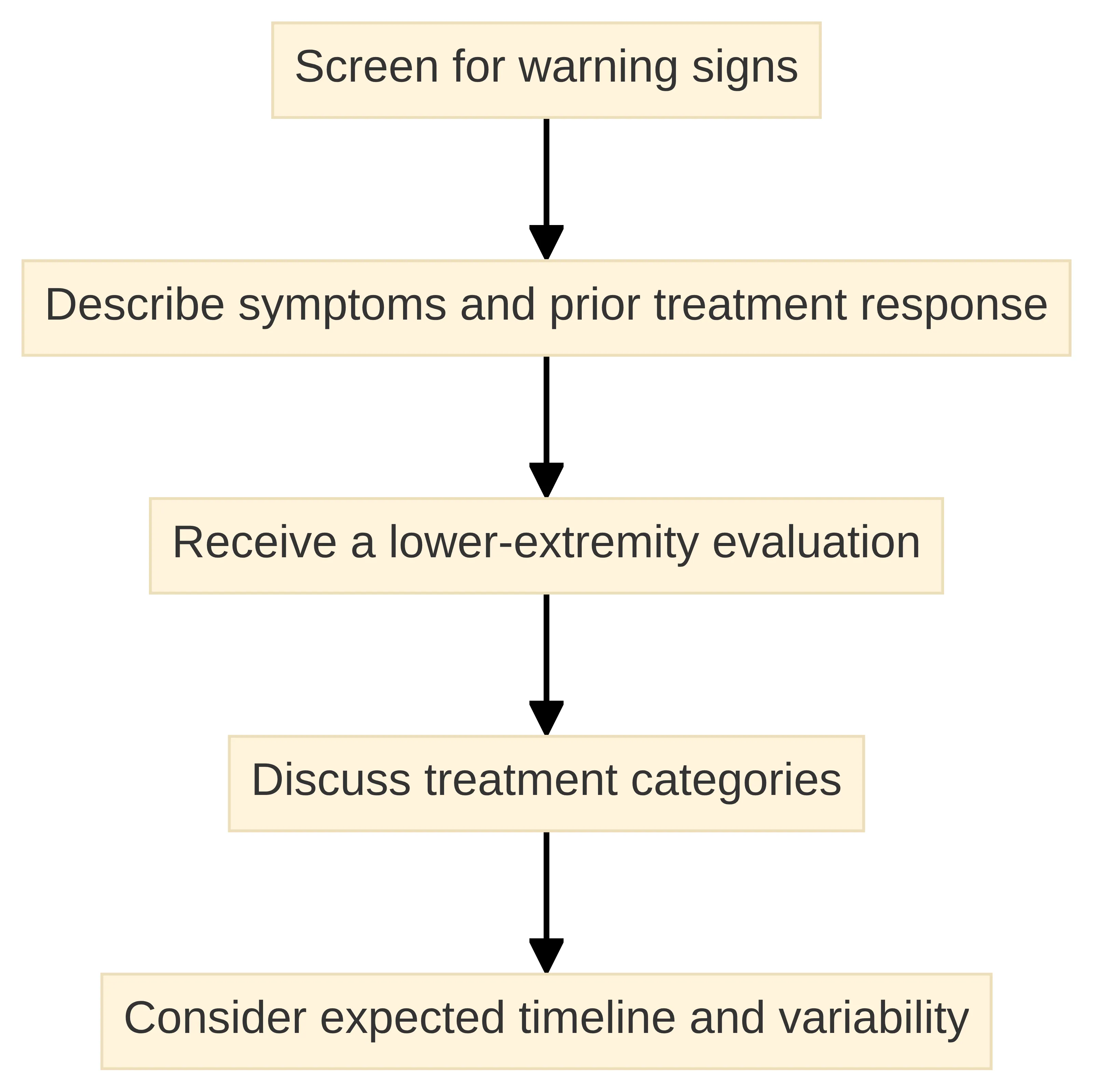
The sequence is straightforward:
- Screen for warning signs that require urgent or emergency care.
- Describe the location, timing, quality, triggers, associated symptoms, and prior treatment response.
- Receive a lower-extremity evaluation that considers possible tendon, joint, nerve, or bone involvement.
- Discuss treatment categories only after the clinical question is clearer.
- Consider the expected timeline and the variability of response before making a treatment decision.
At Regenerative Lower Extremity Institute, we offer full clinical evaluations for foot and ankle concerns when you are seeking regenerative treatment. A thorough lower-extremity examination can help narrow whether symptoms involve tendon, joint, nerve, or bone-related pain before the treatment conversation moves forward. That sequence keeps immediate symptom relief, clinical clarification, and treatment selection as separate decisions.
Read the comfort record before choosing care
Let the comfort record guide the next step:
- Monitor changes when no urgent warning pattern is present and the pain improves after you stop or modify the aggravating activity.
- Arrange a clinical evaluation when pain persists, recurs, or remains unexplained.
- Seek urgent or emergency care for the warning patterns described above. Breathing or chest symptoms call for emergency care.
For ongoing or unexplained foot, ankle, or lower-leg pain without an emergency warning pattern, a qualified professional should decide whether a particular evaluation or treatment is suitable for you. Bring the location, timing, quality, triggers, associated symptoms, medical history, and prior treatment response so the conversation can focus on what remains unclear. We offer full clinical evaluations for foot and ankle problems when regenerative treatment is under consideration.
Request an evaluation when self-care is insufficient
What immediate steps can I take to relieve leg pain?
Start by stopping or modifying any activity that aggravates the pain.
What symptoms indicate that leg pain may be an emergency?
Seek emergency care if leg pain is accompanied by unexplained shortness of breath, chest pain that worsens with breathing, coughing blood, or fainting.
How can I tell if my leg pain requires a clinical evaluation?
Arrange for a clinical evaluation if your leg pain persists, keeps returning, or has no clear explanation, even if it does not appear to require emergency care.
What should I record before seeking medical evaluation for leg pain?
Document the location, onset, duration, quality of pain, any associated symptoms, and what activities preceded the pain. This information will help the clinician assess your condition.
What distinguishes immediate comfort measures from treatment of the underlying cause of leg pain?
Immediate comfort measures, like rest and ice, can help manage pain temporarily but do not address the underlying cause.
What role does regenerative treatment play in managing leg pain?
Regenerative treatment is not an immediate solution for leg pain. It should be discussed after a thorough clinical evaluation has clarified the underlying issues and treatment goals.
Free consultation
Find out whether regenerative treatment is right for you.
Most consultations begin as a telehealth call with a physician specialist, so you can start without travelling to a clinic. No referral needed.