
leg pain treatment
Leg Pain Treatment: How to Choose a Next Step
Leg pain treatment starts with a decision, not a diagnosis
Leg pain treatment should begin with a decision about urgency and uncertainty, not with a treatment label you choose from a search result. Leg pain can come from overuse, a muscle cramp, a sports injury, general wear and tear, or another health condition. The appropriate treatment depends on the underlying cause, so the same symptom can lead to very different next steps. A sore lower leg after increased activity raises a different clinical question from pain that appears every time you walk, pain with numbness, or pain accompanied by swelling.
A useful way to organize your decision is to move through four questions:
- Could waiting create a problem? Sudden, severe, rapidly worsening, or alarming symptoms need prompt medical attention rather than a home-treatment experiment.
- What pattern needs explaining? Location, triggers, walking tolerance, duration, and response to rest help a clinician consider the possible source.
- What has already been tried? Your response to rest, activity changes, therapy, medication, or an injection changes the discussion, even when it does not identify the cause by itself.
- What level of care fits the uncertainty? Conservative care, rehabilitation, injections, surgery, and regenerative approaches should be considered only after the relevant clinical question is clear.
This framework is especially useful when you are in Chicago and have had lower-leg, foot, or ankle pain for long enough that simply repeating the same approach no longer feels reasonable. It gives you a way to move from a symptom to an informed evaluation without diagnosing yourself.
The practical aim is not to identify a treatment category as quickly as possible. It is to match your next action to the information available. A short-lived, mild pattern without warning signs may call for a conservative discussion. A persistent or unclear pattern may call for an evaluation. A dangerous pattern takes priority over any routine treatment conversation. Keeping those decisions separate can prevent a preferred option from distracting you from an unresolved cause.
First decide whether waiting is safe
Some leg-pain patterns should move the question away from self-care and toward immediate medical attention. Some causes of leg pain can require urgent medical or surgical care. Sudden or rapidly worsening symptoms that could relate to peripheral arterial disease also require immediate attention. These possibilities cannot be sorted out from pain intensity alone.
Seek immediate medical attention when leg pain occurs with shortness of breath, chest pain, or dizziness. Leg pain with localized swelling, redness, or warmth can also signal a serious problem, including a possible blood clot or infection. These are warning signs, not diagnoses: red flags raise concern for serious pathology, but clinicians must interpret them alongside the rest of the assessment.
If you have constant, worsening, sudden, severe, or long-lasting leg pain, arrange medical assessment instead of relying only on home care. If none of those warning patterns applies, the next question is not whether a specific treatment is automatically right. The next question is what the pain does, where it appears, and how long it has been present. Keep routine monitoring short and purposeful, and stop waiting if the pattern changes.
Use the warning screen before comparing treatments:
- Prompt medical assessment: constant, severe, persistent, or non-improving pain, especially with localized swelling, redness, or warmth.
This sequence answers how quickly you need help. It does not identify the cause or determine which treatment you should receive.
Use the pattern to identify the clinical question
A clinical evaluation may consider arterial, venous, nerve-related, and musculoskeletal causes of leg pain. Overuse, cramps, sports injuries, wear and tear, and other health conditions can also produce leg symptoms. These categories are starting points for questions, not labels you can confirm at home. The purpose of noticing the pattern is to help you describe it accurately and help the clinician decide what needs to be examined.
Pay attention to the contrasts that a clinician may use during an evaluation:
- Walking and rest: Peripheral arterial disease can cause a painful leg ache during walking that usually eases after a few minutes of rest. A reproducible calf ache brought on by exercise and relieved quickly by rest is a pattern clinicians may consider when evaluating arterial insufficiency, but it does not establish a diagnosis.
- Movement and recovery: Pain related to spinal stenosis or nerve-root compression may occur with movement or at rest and may take longer to settle after exertion.
- Location and tissue: Pain in the calf, thigh, foot, ankle, or another area can point the examination toward different structures, while a sports injury or overuse history may add useful context.
- Change over time: Peripheral arterial disease symptoms often develop slowly, whereas symptoms that appear quickly or suddenly worsen need immediate attention.
A pattern can make the clinical question clearer without answering it. Describe what happens rather than naming the condition you think you have.
Before an appointment, record where the pain begins, what brings it on, whether walking faster or using stairs changes it, what happens when you stand or rest, and how long the symptoms take to settle. Include whether the pain is reproducible or unpredictable. Those details help separate the questions a clinician needs to consider and prevent a broad search term from becoming a premature diagnosis.
Pain quality adds context, but it does not settle the question by itself. A dull ache, sharp pain, cramping, burning, or pain linked to movement may lead to different follow-up questions. The same is true of one-sided and two-sided symptoms, pain that stays in one place, and pain that travels. Note the contrast without treating it as proof. Your description gives the evaluation a starting point; examination and any appropriate testing determine what the pattern means.
Let duration and prior response change the level of care
Duration is part of the treatment decision. A short-lived symptom without warning signs may leave room for a limited period of conservative care, while persistent or worsening pain changes the question to whether you need an assessment. Long-lasting pain should not be managed indefinitely by repeating the same home approach. Have persistent, worsening, or non-improving leg pain evaluated by a medical professional.
Your response to earlier care is useful information, but it is not a diagnosis. Write down what you tried, how long you tried it, what changed, and what did not. A plan that did not provide enough relief may mean that the underlying question remains unresolved, that the treatment was not a fit for the condition, or that a different combination needs discussion. The next choice can be informed by symptoms, medical history, examination findings, and available test results.
Use this practical sequence:
- No warning signs and a recent, mild pattern: ask a clinician or qualified professional what conservative monitoring is reasonable for your situation.
- Persistent, recurrent, or non-improving pain: arrange a routine evaluation and bring your treatment history.
- Sudden, severe, rapidly worsening, or associated warning symptoms: seek immediate medical attention rather than scheduling a routine treatment consultation.
This sequence does not decide which treatment you qualify for. It decides how much uncertainty you should carry before asking for clinical help.
A treatment that helped briefly, failed to change the pattern, or produced a new concern should be recorded rather than treated as a reason to repeat it automatically. Persistence matters because it changes the purpose of the next visit: the discussion may need to move from symptom management toward identifying the cause and comparing alternatives. If symptoms are worsening or accompanied by warning signs, move to the appropriate level of care instead of waiting for a prior plan to work.
Begin with care that protects function while the cause is clarified
When urgent causes are not the immediate concern, treatment often begins with a plan that manages symptoms and keeps the clinical question open. Standard treatment for leg injuries may prioritize rest, ice, compression, elevation, physical therapy, and surgical referrals. Other causes of leg pain may improve with movement, exercise, and lifestyle changes. Because treatment depends on the cause, those options should be matched to your symptoms and examination rather than applied as a universal recipe.
Conservative care can serve several purposes in a treatment discussion:
- reduce symptoms enough for you to participate in ordinary activities;
- preserve or rebuild movement through an appropriate rehabilitation plan;
- show how the pain responds to a carefully chosen change in activity;
- create time to obtain an examination or relevant testing when the cause is uncertain; and
- establish what has already been tried before an injection, surgery, or regenerative option is considered.
The goal is not to prove that a particular diagnosis is present. It is to manage the problem while gathering information that can make the next decision more specific.
Ask what the proposed conservative plan is meant to accomplish, how you will judge whether it is helping, and when the plan should be revisited. Ask how your walking pattern, pain triggers, prior treatment response, and available test results affect the recommendation. A plan that includes rehabilitation or activity guidance should be explained in relation to your condition and goals; do not turn a general exercise suggestion into individualized medical instruction from an article.
Conservative care is not a promise that symptoms will resolve, and it is not a reason to delay evaluation when the pattern is persistent or concerning. Its role depends on the problem being addressed. For some conditions, movement or lifestyle changes may be part of care; for an injury, rest, compression, elevation, physical therapy, or a surgical referral may be considered. The useful question is what the plan is intended to do and what would cause the clinician to change it.
Treat injections as an evidence question, not an automatic escalation
An injection is not automatically the next step simply because rest, medication, or therapy has not solved the problem. Ask what condition the injection is intended to address, what outcome will be measured, and what alternatives remain. For platelet-rich plasma injections in chronic lower-extremity tendinopathies, systematic reviews have found mixed comparative clinical evidence.
The evidence question should be specific to the condition and the proposed outcome. Before discussing an injection, ask:
- What finding makes this option relevant to my symptoms?
- Is the goal temporary symptom relief, improved function, or another defined outcome?
- What comparison or alternative is being used to judge it?
- How much uncertainty comes from differences in patient populations, protocols, or measured outcomes?
- What is the follow-up plan if the result is limited or short-lived?
The review of PRP evidence noted variation in patient populations, comparisons, outcomes, and treatment protocols. That variation matters. A favorable story about an injection for one condition cannot establish that the same option fits your lower-leg pain.
A thoughtful injection discussion should leave room for conservative care, rehabilitation, further evaluation, or another treatment category. It should also make the uncertainty understandable enough for you to weigh the likely purpose against the alternatives. If the proposed injection is PRP for a chronic lower-extremity tendinopathy, treat the mixed evidence as part of the decision rather than as a reason to assume benefit.
Compare an injection with the actual alternatives, not with an empty space. Ask whether the choice changes what you can do, how follow-up will work, and what happens if the intended outcome is not reached. A treatment can be worth discussing without being automatically preferred. Shared decision-making is especially relevant when evidence, protocols, and personal goals point in different directions.
Place surgery and regenerative care after clinical clarification
Surgery belongs in a clinical discussion when the assessment identifies a reason to consider it, not merely because leg pain has lasted a certain number of weeks. For leg injuries, standard treatment may also include surgical referrals as part of the care pathway. Those facts do not make surgery appropriate for unspecified leg pain; they show why the cause and urgency must be clarified first.
Regenerative care should also follow clinical clarification. At Regenerative Lower Extremity Institute, we offer clinical evaluations for patients considering regenerative treatment options for foot and ankle conditions. We provide specialized treatments for plantar fasciitis, Achilles tendonitis, foot and ankle arthritis, sports injuries, ligament sprains and tears, chronic pain conditions, and post-surgical recovery. That scope does not mean every cause of leg pain belongs in a regenerative treatment plan.
Our treatment plans are personalized around each person’s body and lifestyle needs. In practical terms, an evaluation should clarify the condition being considered, the purpose of the proposed treatment, the alternatives, the follow-up plan, and the circumstances that would change the recommendation. Regenerative treatment is not a guaranteed answer to persistent pain. The decision should remain connected to the underlying condition, your goals, and the care that may be needed alongside it.
A treatment discussion should therefore follow this order:
- Clarify whether the symptoms need urgent care.
- Identify the clinical question and the condition being evaluated.
- Discuss established care, rehabilitation, injections, surgery, or regenerative options that relate to that question.
- Set a follow-up point and a way to judge the response.
This order keeps the treatment category downstream of the assessment. It also leaves room for a recommendation that does not involve regenerative care.
Compare regenerative options by purpose, uncertainty, and follow-up
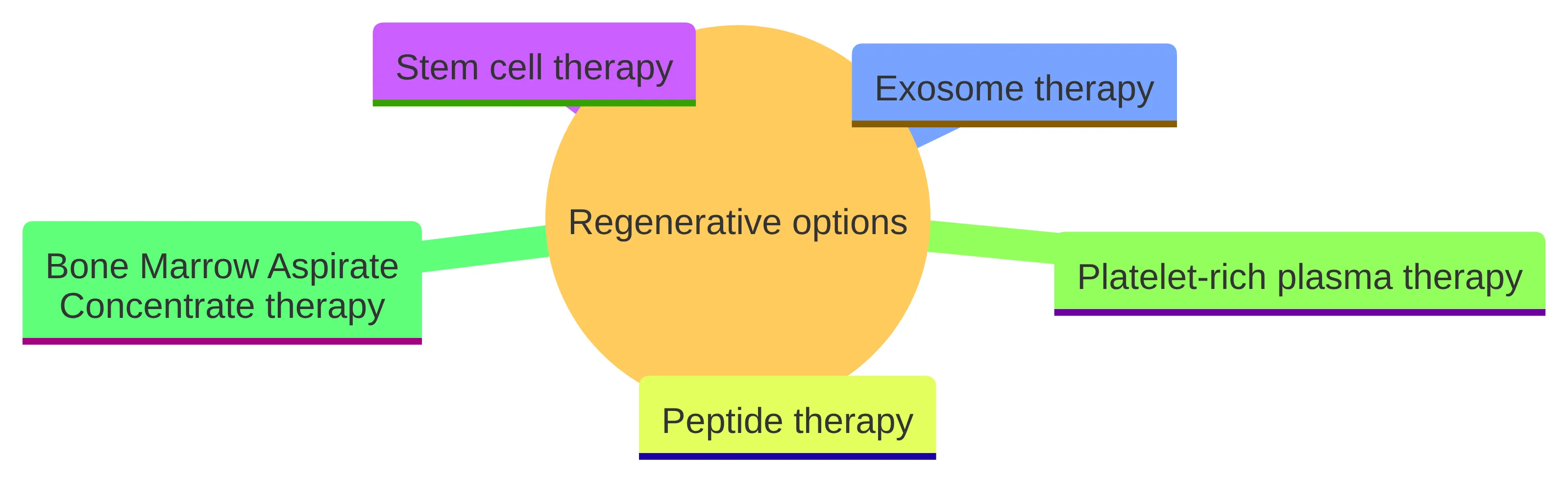
Regenerative options are not one interchangeable category. Our treatment offerings include stem cell therapy, exosome therapy, peptide therapy, platelet-rich plasma therapy, and Bone Marrow Aspirate Concentrate therapy. An offering tells you what can be discussed; it does not decide whether an option fits your condition. Compare each proposed option by the question it is meant to answer, the evidence that applies to that condition, the uncertainty, and the follow-up plan.
| Option under discussion | What to clarify before choosing | Boundary to keep in view |
|---|---|---|
| Stem cell therapy | What condition-specific goal is being proposed, what evidence applies, and how will response be followed? | A general regenerative label does not establish fit for unexplained leg pain. |
| Exosome therapy | What tissue or condition is being discussed, and what is known about the proposed use? | We present exosome therapy as being investigated for its potential to support cell-to-cell communication during the body’s repair process, particularly in tendon and ligament tissue. |
| Peptide therapy | What is the intended purpose, what alternatives were considered, and what outcome will be monitored? | The option should be tied to an identified clinical question rather than a symptom label. |
| Platelet-rich plasma therapy | What evidence applies to your diagnosis, and how does the proposed protocol compare with alternatives? | Evidence for PRP in chronic lower-extremity tendinopathies is mixed and does not show a clear comparative benefit that supports choosing it as a general rule. |
| Bone Marrow Aspirate Concentrate therapy | What is the proposed role in your plan, and what follow-up would determine whether it helped? | The discussion still depends on evaluation, goals, alternatives, and individual circumstances. |
Response and timing should be part of the comparison. We explain that physiological responses to regenerative treatments vary significantly and that biological adaptation tends to follow a gradual timeline. That makes follow-up more than an administrative detail: ask what will be monitored, when the plan will be reviewed, and what decision follows if the response is limited. Do not treat an early symptom change, a marketing promise, or a preferred treatment category as proof of long-term benefit.
For any regenerative option, ask for a plain-language explanation of the proposed purpose and limits. Identify the condition being addressed, the outcome that matters to you, the alternatives that remain, and the point at which the plan will be reassessed. Ask how your body, activity level, tissue concerns, and goals affect the discussion. Personalization changes the question from “Which option sounds promising?” to “What role, if any, could this option have in my evaluated condition?”
Make the treatment choice a shared trade-off discussion
For chronic pain, shared decision-making can help you and a clinician weigh treatment trade-offs over the course of ongoing care. Pain management is often longitudinal and may involve self-management, so the choice is not limited to “Which treatment is strongest?” A more useful question is “Which plan addresses the identified problem, fits my goals, and gives me a clear way to judge what happens next?”
Use these criteria during the discussion:
- Clinical fit: What finding or diagnosis makes this option relevant?
- Purpose: Is the plan intended to reduce symptoms, improve movement or sleep, support daily activity, or address another stated goal?
- Alternatives: What conservative care, rehabilitation, injection, surgical, or regenerative options remain available?
- Trade-offs: What uncertainty, time commitment, monitoring, or potential burden should you weigh?
- Decision point: What result would lead you to continue, adjust, or stop the plan?
Pain-management plans are individualized from symptoms, medical history, examination, and available test results, and they may use one approach or a combination of options. Ask for the reasoning in plain language, especially when two options have different time horizons or evidence limits.
Your goals belong in the decision. You may care most about walking, sleep, work, sport, reducing reliance on repeated care, or understanding why the pain persists. State the activity you want to regain and the uncertainty you are willing to accept. That does not guarantee a result, but it gives the treatment conversation a concrete standard instead of leaving you to choose by reputation, urgency, or a single testimonial.
A clear decision discussion should also address what happens if the first plan does not meet its goal. Ask whether the next step would be more rehabilitation, another evaluation, a different treatment, or continued monitoring. That question matters when care is ongoing and when the available options involve different levels of uncertainty. You do not need to choose every later step in advance, but you should understand how the current plan will be judged.
Bring a treatment timeline to the evaluation
A concise treatment timeline can make an evaluation more useful. Start with the first noticeable symptom and add the changes that followed. Include:
- where the pain is located and whether it spreads;
- when it appears, including walking, stairs, standing, rest, or activity;
- how long each episode lasts and how long the overall problem has continued;
- whether the pattern is reproducible or changes from day to day;
- any swelling, redness, warmth, numbness, weakness, or other associated change; and
- what has already been tried and what happened afterward.
These details reflect the history questions used to consider arterial, venous, nerve-related, and musculoskeletal causes. They help turn “my leg hurts” into a description that can guide examination and further discussion.
Bring the names or descriptions of prior care, such as rest, activity changes, physical therapy, braces, injections, or other treatments, along with the response you noticed. If you have reports or test results that your clinician needs, organize them before the visit. You do not need to arrive with a self-diagnosis. You need a reliable account of the symptom pattern and treatment history.
Write down the questions you want answered:
- What possible cause or causes need to be evaluated first?
- Which warning signs would change how quickly I should seek care?
- What is the purpose of each proposed treatment?
- What alternatives should I compare, and what uncertainty applies to each one?
- How will we follow the response, and when will we revisit the plan?
A treatment timeline keeps the conversation focused on your actual pattern rather than on a treatment category selected before the evaluation.
Keep the timeline factual and specific. “It hurts more” is less useful than noting that pain begins after a certain activity, eases after rest, returns at a repeatable point, or remains present afterward. Include changes in walking, stairs, standing, sleep, work, or sport. If the pattern has shifted, note when it changed. Those details can help the clinician decide which part of the evaluation needs attention first.
Request evaluation when persistent lower-extremity pain remains unresolved
Persistent lower-extremity pain deserves a next step that matches its pattern, duration, prior response, and warning signs. Seek immediate medical attention for sudden, severe, rapidly worsening, or concerning symptoms, especially when leg pain occurs with shortness of breath, chest pain, dizziness, or localized swelling, redness, or warmth. For unresolved foot or ankle pain without those urgent features, at Regenerative Lower Extremity Institute, we offer clinical evaluations for people considering regenerative treatment options and provide specialized treatments for several foot and ankle conditions. A qualified clinician must decide whether any treatment fits your condition and circumstances.
Bring your symptom pattern, treatment timeline, goals, and questions so the evaluation can address the problem you are actually experiencing rather than a label chosen in advance.
What should you ask before a leg pain evaluation?
What should I do if my leg pain is sudden, severe, or worsening?
Seek immediate medical attention for sudden, severe, or rapidly worsening leg pain, especially if accompanied by symptoms like shortness of breath, chest pain, or dizziness.
How can I determine if my leg pain requires urgent care?
Look for warning signs such as localized swelling, redness, or warmth, which may indicate serious conditions like a blood clot or infection. If you experience these symptoms, seek prompt medical evaluation.
What factors should I consider when evaluating my leg pain?
Consider the location, triggers, duration, and response to rest of your pain. These factors can help a clinician determine the possible causes and appropriate next steps.
What are common treatment options for leg pain?
Treatment options vary based on the underlying cause and may include conservative care, rehabilitation, injections, or surgical interventions. It’s important to discuss these options with a healthcare provider.
When should I request a clinical evaluation for my leg pain?
Request a clinical evaluation if your leg pain is persistent, worsening, or does not improve with home care. A qualified clinician can help determine the appropriate treatment based on your symptoms.
What information should I bring to a consultation for leg pain?
Bring a detailed symptom history, including the location and duration of pain, any previous treatments tried, and any associated symptoms. This information will help guide the evaluation.
How does the Regenerative Lower Extremity Institute approach leg pain treatment?
The Regenerative Lower Extremity Institute offers personalized evaluations and treatment plans for various foot and ankle conditions, focusing on the underlying causes of pain rather than just symptoms.
Free consultation
Find out whether regenerative treatment is right for you.
Most consultations begin as a telehealth call with a physician specialist, so you can start without travelling to a clinic. No referral needed.