
regenerative medicine near me
Should You Request Regenerative Medicine for Chronic Foot or Ankle Pain in Chicago?

Use the evaluation to answer a decision question, not to confirm a treatment
Chronic foot or ankle pain does not make regenerative treatment the automatic next step. The more useful question is whether a Chicago evaluation can clarify what is causing your symptoms, which options fit that problem, and what remains uncertain. For chronic foot pain, we consider a regenerative evaluation a worthwhile next step to discuss with a qualified provider. That recommendation is about opening a clinical discussion, not confirming that you qualify for a particular treatment or that treatment will produce a specific result.
An evaluation and a treatment decision serve different purposes. An evaluation gathers your history, examines the affected area, considers available imaging, and frames the options. A treatment decision should then account for potential risks, benefits, alternatives, and consequences so you can make an informed choice. Informed consent is part of that decision process; it is not a promise that an option will work for you.
Your decision can therefore be staged: first decide whether you need a clearer explanation for persistent pain, then decide whether the proposed plan makes sense after you hear the diagnosis, evidence, alternatives, and follow-up expectations. That approach is especially useful when you have tried rest, braces, orthotics, injections, or pain medication and still do not know what to do next. You do not have to choose a procedure simply because you attend a consultation.
A useful evaluation should leave you able to answer three practical questions: what problem is being considered, why a particular treatment is being discussed, and what other choices remain. If the appointment does not resolve those questions, treat that uncertainty as part of the decision rather than filling it with assumptions. The first decision is whether the discussion is clear enough to support a later treatment choice.
Start by identifying what may actually be causing the pain
Heel pain can have causes other than plantar fasciitis. Possible explanations include tendon problems, nerve compression, posterior tibial tendon problems, stress fractures, arthritis, sports injuries, and trauma-related injuries. Achilles tendinopathy can resemble plantar fasciitis because both may hurt in the morning or with activity, while nerve compression may produce burning or tingling. Similar symptoms do not establish the same diagnosis.
Your pain pattern can help organize the clinical question without becoming a diagnosis. Before an evaluation, write down where the pain starts, when it appears, what activity changes it, whether the quality is aching, sharp, burning, or tingling, and whether the problem has changed over time. Note what you have already tried and what happened afterward. A concise record gives the clinician a clearer starting point and helps you notice which questions remain unanswered.
A heel spur does not settle the plantar-fasciitis question by itself. A spur may appear on an X-ray in people with plantar fasciitis and in some people without it, so its presence or absence is not enough to establish or rule out the condition. Ask what the examination and full symptom pattern indicate rather than treating an imaging label as the explanation for every heel symptom.
The first useful outcome of a consultation is a clearer working question: is the pain most consistent with the plantar fascia, a tendon, a joint, a nerve, bone, or another source? Ask what findings support that view and what findings would point elsewhere. If the source remains uncertain, the appropriate boundary is to clarify the diagnosis before choosing a treatment category.
Bring details that can change the conversation: the exact location of pain, the first activity or event you associate with it, whether walking or exercise has changed, and whether symptoms are present at rest or only with movement. Include prior imaging and the names of treatments you tried. These details do not diagnose the problem, but they give the evaluation something specific to examine instead of reducing the visit to a treatment name.
Do not skip conservative care when the pattern may improve without intervention
Plantar fasciitis is often self-limited and commonly resolves within a year, and conservative care is generally tried before more invasive treatment. That natural history changes the decision for some heel-pain patterns: persistent symptoms may deserve assessment, but they do not automatically mean that an injection, biologic treatment, or surgery should follow.
Conservative care can be part of both treatment and decision-making. It may show whether the symptoms follow a pattern that settles with time and noninvasive measures, while continued pain can provide a reason to reassess the diagnosis or plan. The relevant question is not whether you have endured symptoms for a certain number of days; it is whether the condition has been identified accurately and whether the care already tried was appropriate for that condition.
Use your history of prior care as information for the next discussion. Record which measures you tried, how long you used them, whether they changed walking or activity, and whether symptoms returned when your activity increased. Take that record to the consultation instead of treating an unsuccessful attempt as proof that every nonsurgical option has failed. If the symptoms are improving, ask whether continued conservative care remains reasonable; if they are not, ask what the new evaluation adds.
The evidence about a self-limited course and trying conservative care applies specifically to plantar fasciitis. Do not transfer that conclusion automatically to ankle arthritis, a suspected stress fracture, nerve-related pain, or another condition. If the working diagnosis changes, the evidence question and the reasonable next step may change with it.
Use a simple decision split when you review your history:
- If symptoms are improving, ask whether observation or continued conservative care remains appropriate.
- If symptoms are unchanged, ask whether the diagnosis and prior plan need reassessment.
- If symptoms have changed in location, quality, or activity relationship, describe the change rather than assuming the original explanation still applies.
Each branch leads back to clarification before you select a treatment.
Treat the evidence question differently for each condition
The evidence question for plantar fasciitis is not the same as the evidence question for ankle osteoarthritis. For plantar fasciitis, the established practical point is that the condition is often self-limited and that conservative care is generally tried before more invasive treatment. For ankle osteoarthritis, the American Academy of Orthopaedic Surgeons issued its first ankle-osteoarthritis guideline on July 2, 2026; the guideline included only two recommendations and identified gaps in the current research.
Ankle osteoarthritis therefore calls for condition-specific questions rather than broad claims about regenerative care. Ask which recommendation or research applies to your particular joint findings, what the guideline does not resolve, and how the proposed option compares with continued conservative care or other established choices. A gap in research does not prove that an option is ineffective, but it does mean that uncertainty belongs in the conversation.
Tendon, nerve, bone, and joint conditions also require different questions because similar pain locations can arise from different sources. Ask what diagnosis is being considered, which findings support it, what outcome the proposed treatment is intended to affect, and what alternative explanation has been considered. Keep the diagnosis and the treatment evidence connected. Evidence for one condition should not be presented as evidence for another.
A treatment name is not a substitute for a condition-specific evidence discussion. Ask what has actually been studied for your diagnosis, how the proposed outcome will be measured, what the limitations are, and what would lead you to continue, change, or stop the plan. If those questions cannot be answered clearly, pause before treating the option as established care for your problem.
Read uncertainty narrowly. The ankle-osteoarthritis guideline’s research gaps do not answer every question about plantar fasciitis, Achilles tendon problems, or other foot conditions. They do show why a broad statement about regenerative treatment should not replace a condition-specific discussion. Ask for the diagnosis, the relevant evidence, and the limits of that evidence as separate parts of the appointment.
Separate what the Chicago practice offers from what the evidence establishes
Our Chicago practice offers regenerative medicine for foot, ankle, and lower-leg conditions. Our providers use stem cells, exosomes, and peptides to treat these conditions without surgery. That statement identifies the services we offer; it does not establish that every treatment is appropriate for every diagnosis or that a particular result will occur.
The evidence question remains separate from the service question. A consultation should connect the proposed treatment to your specific diagnosis, the evidence for that diagnosis, the alternatives, and the uncertainties. This distinction matters for ankle osteoarthritis, where the guideline issued on July 2, 2026, identified gaps in current research. It also matters when heel pain has not been clearly separated from tendon, nerve, bone, or joint problems.
Stem-cell therapy is presented in our Chicago information as using regenerative cells to support repair of damaged cartilage, tendons, and soft tissue. You should ask how that proposed mechanism relates to your actual diagnosis and what outcome the plan is designed to assess. A biological explanation can help you understand the proposal, but it is not by itself evidence of a predictable clinical result.
We offer clinical evaluations if you are considering regenerative treatment options for foot and ankle conditions. Use that appointment to ask whether the proposed option fits your findings, not to assume that a treatment should be selected because it is available. If the explanation does not connect the service, diagnosis, evidence, risks, and alternatives, keep the decision open.
Keep four statements separate when you compare an option: the practice offers it, the treatment is intended to affect a particular problem, research supports some part of the proposal, and the expected response for you remains uncertain. Those statements can all be discussed in one visit, but they do not mean the same thing. Ask for each part in plain language before treating availability as a reason to proceed.
Use persistent symptoms as a reason to ask questions, not as proof you qualify
Persistent foot or ankle pain can make an evaluation reasonable when rest, orthotics, or other conservative care has not settled the problem. We describe regenerative medicine as potentially relevant to tendon, ligament, cartilage, or joint problems when your pain has not settled with conservative care, including when you want to avoid surgery where possible. Relevance is a reason to discuss an option; it is not proof of candidacy.
Your treatment history should lead to more precise questions. If rest helped only briefly, ask what that pattern means. If an orthotic changed your walking but not the pain, ask whether the working diagnosis still fits. If an injection or medication did not help, ask whether that result changes the diagnosis, the expected benefit, or the alternatives. Do not turn one unsuccessful treatment into a conclusion about every other option.
Wanting to avoid surgery can be part of your goals, but it cannot decide treatment by itself. The Chicago practice states that it discusses regenerative options when they fit and says so when they do not. Let the evaluation determine whether the option is relevant to your findings, and ask what would remain available if it is not.
Ask questions that distinguish relevance from candidacy:
- What finding makes this option worth discussing for my condition?
- What finding could make it a poor fit?
- Which prior treatment results matter to the decision?
- What alternatives should I compare before deciding?
The answers should relate to your history and examination, not only to the fact that your symptoms have lasted a long time.
Make personalization and uncertainty part of the proposed plan
Our treatment plans are personalized around your individual body and lifestyle needs. That means the proposal should connect your symptoms, examination, diagnosis, activity demands, prior care, and treatment goals rather than rely on a generic plan for foot or ankle pain. Ask which parts of the plan are based on your findings and which parts are general features of the treatment.
Physiological responses to regenerative treatments vary significantly, and biological adaptation tends to follow a gradual timeline. You should therefore ask what changes will be monitored, when follow-up will occur, and what would count as meaningful progress. Avoid treating a proposed timeline as a guarantee. A gradual response also means that the plan should explain what you will do while progress is being assessed.
A useful personalized plan answers four separate questions: what problem is being treated, why this option is being considered, how progress will be assessed, and what alternatives remain. Ask how your activity goals affect those answers. If you are an athlete, walk for work, manage diabetes, or have other health considerations, mention that history so the discussion reflects your actual circumstances rather than an abstract condition.
Ask how the plan handles uncertainty before you agree to it. You should know what information will be reviewed at follow-up, what activity guidance or rehabilitation discussion accompanies the plan, and what happens if the expected change does not occur. These questions do not predict your response; they show how the proposed care will be assessed over time.
Bring an evidence-and-risk checklist to the consultation
Informed consent should cover a treatment’s potential risks, benefits, alternatives, and consequences so you can make an informed decision. Turn those categories into direct questions before you attend. Clear answers are more useful than broad reassurance because they show what is known, what is uncertain, and what choices remain available.
Your consultation checklist can include these questions:
- What diagnosis is the proposed treatment intended to address, and what findings support that diagnosis?
- What evidence applies to this condition, and what limits or research gaps should I understand?
- What benefit is the treatment intended to affect, and how will progress be measured?
- What are the material risks and potential consequences for me?
- What alternatives include continued conservative care, another treatment category, or a different clinical opinion?
- What follow-up, activity guidance, or rehabilitation discussion would accompany the plan?
- What would make you change the plan or conclude that this option is not a fit?
Your symptom and treatment record should include the onset and location of pain, changes in activity, prior diagnoses, imaging, medications or injections, orthotics, and the response to each measure. Most of our consultations begin by telehealth, with a physician reviewing your history and imaging before an in-person visit when a joint or tendon needs examination. Sending or having that information available helps the discussion begin with your actual history.
The goal of the checklist is not to force a yes-or-no answer during the appointment. The goal is to leave knowing what is being proposed, why it is being proposed, what uncertainty remains, and which alternative you would choose if the plan does not fit. If you cannot explain those four points in your own words, ask for clarification before deciding.
Keep your questions in four groups so the conversation stays practical:
- Diagnosis: What is causing the symptoms, and what supports that conclusion?
- Treatment: What is being proposed, and what outcome is it intended to affect?
- Risk and alternatives: What could happen, and what other choices remain?
- Follow-up: How will progress be assessed, and what happens if the plan changes?
Write down the answers or bring someone who can help you remember them.
Know what the Chicago evaluation process can and cannot decide
Our Chicago consultation process begins for most people with a telehealth call. A physician reviews your history and imaging, followed by an in-person visit when a joint or tendon needs examination. Our evaluation includes a hands-on examination and review of imaging, and ultrasound guidance may help pinpoint the source of foot, ankle, or lower-leg pain.
You can request an evaluation by calling (833) 734-3648 or submitting our form; no referral is needed. The process gives you a way to discuss your symptoms and history before a treatment decision. It does not turn a phone call or telehealth review into a diagnosis, and it does not make a procedure appropriate before the relevant examination and discussion occur.
The Chicago practice states that if regenerative treatment fits, we discuss options, timing, and cost; if it does not, we say so. That boundary is useful because the evaluation should be able to end with more than a treatment proposal. It may instead clarify that another explanation, another form of care, or continued assessment deserves attention.
An evaluation can organize the decision, but it cannot guarantee a biological response, remove uncertainty from every condition, or replace the choices you need to weigh. Use the visit to ask what has been established about your problem, what remains uncertain, and what action follows from each possible answer. The process is successful when you understand the decision, whether or not regenerative treatment becomes part of it.
Before the call, put your symptom timeline, imaging reports, prior treatment history, current goals, and checklist in one place. During the evaluation, listen for the difference between a finding, an interpretation, and a proposed option. Afterward, you should be able to describe the working diagnosis, the reason for the proposed plan, the alternatives, and the follow-up discussion in your own words.
Because the Chicago pathway may involve two stages, use a two-stage note rather than trying to decide everything during the first call. Before telehealth, list the symptom timeline, prior care, available imaging, activity goals, and three unanswered questions. After the history and imaging review, record the working explanation, what remains unclear, and whether an in-person visit is proposed because a joint or tendon needs examination. At that visit, add the findings discussed, the treatment option being considered, the alternatives, and the follow-up plan. If regenerative treatment is not considered a fit, record the explanation and next option instead. This record separates information gathered from conclusions still being considered; it does not replace the clinician’s assessment or determine candidacy.
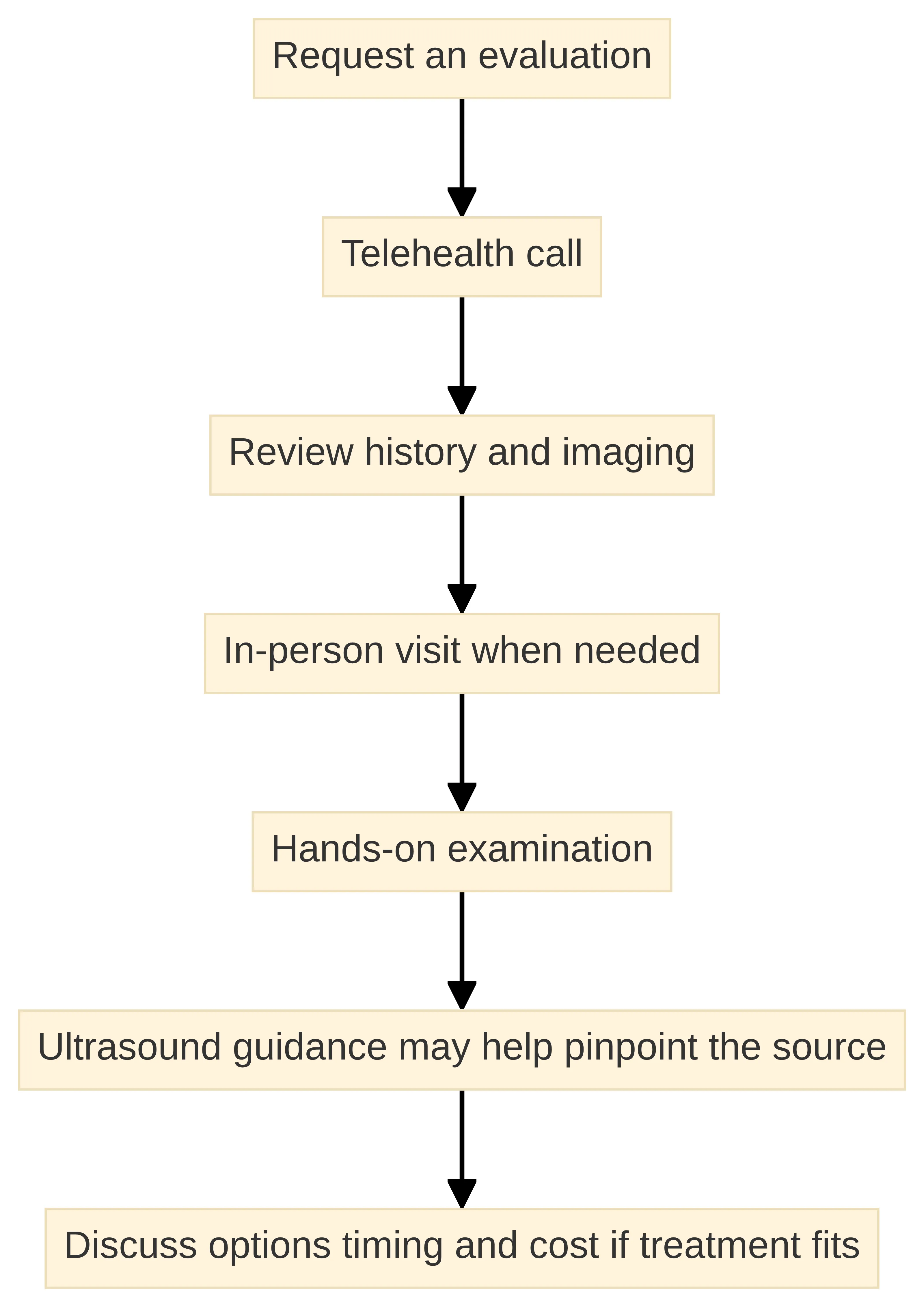
The Chicago consultation process comes before a treatment choice
Chronic foot or ankle pain can justify a focused discussion when symptoms persist after conservative care, but persistence does not establish a diagnosis or guarantee that regenerative treatment will fit. At this stage, the decision is whether to request our Chicago evaluation, not whether to choose a treatment immediately. Individual suitability is a decision for a qualified professional after considering your history and findings.
Bring your symptom record, prior imaging, treatment history, goals, and unanswered questions. Ask for a plain explanation of the proposed option, its evidence, its uncertainties, its alternatives, and how follow-up would work. Our Chicago practice offers clinical evaluations, and our stated process begins with a review of your history and imaging before an in-person examination when needed. Use that conversation to compare options openly rather than arrive committed to one treatment.
What should you ask before discussing regenerative treatment for foot or ankle pain?
How can I prepare for my evaluation at the Chicago clinic?
Prepare by gathering your symptom timeline, imaging reports, prior treatment history, and any unanswered questions. Bring a record of your symptoms, including their onset, location, and any treatments you’ve tried.
What is the role of conservative care before considering regenerative treatments?
Conservative care is generally advised before more invasive treatments. It can help determine if symptoms improve on their own, which may influence the decision to pursue further interventions.
How does the clinic determine if regenerative treatment is appropriate for me?
The clinic evaluates your symptoms, medical history, and examination findings to determine if regenerative treatment fits your specific condition and needs.
What questions should I ask during my consultation?
You should ask about the diagnosis, the evidence supporting the proposed treatment, potential risks and benefits, alternatives to the treatment, and how progress will be monitored.
Free consultation
Find out whether regenerative treatment is right for you.
Most consultations begin as a telehealth call with a physician specialist, so you can start without travelling to a clinic. No referral needed.