
Ankle Pain Treatment
Ankle Pain Treatment: Compare Your Options Before Fusion or Replacement

Make the decision before choosing a treatment
Ankle pain treatment decisions become clearer when you match each option to the question it can answer. The first question is not whether you should choose an injection, regenerative treatment, fusion, or replacement. The first question is what may be driving your pain and what has already been tried.
Ankle osteoarthritis can be disabling and may substantially affect quality of life. Those differences matter when you are weighing a second opinion against another nonsurgical option or a surgical consultation.
A cause-and-purpose match gives you a practical way to compare choices. Use the evaluation to clarify the pain pattern and structural questions, then ask what each pathway is intended to do, how strong its ankle-specific support is, what uncertainty remains, and what action follows. One review recommends attempting initial conservative treatment at any stage of ankle osteoarthritis, while another reports that the scientific evidence for conservative care is limited. That difference calls for a discussion, not an automatic conclusion.
Your decision map can stay simple:
- If the unresolved question is what structure or symptom pattern is involved, arrange an evaluation before choosing a treatment category.
- If the question is whether symptoms can be managed while function is assessed, discuss conservative care and rehabilitation.
- If the question is whether an injection could provide temporary relief, define its purpose and time horizon first.
- If the question is whether regenerative treatment belongs in your options, request an individualized clinical discussion.
- If advanced arthritis or deformity remain after conservative treatments have not worked, ask a clinician to discuss total ankle replacement.
Start with the clinical question an evaluation must answer
An ankle evaluation must first clarify where the symptoms are centered and which associated features travel with them. A clinical pathway separates ankle-pain assessment by location and by features such as instability, numbness or pins and needles, and Achilles or plantar-heel involvement. We offer clinical evaluations for people considering regenerative treatment options for foot and ankle conditions, with the discussion beginning by clarifying the symptom pattern before a treatment category is considered.
Your symptom record should answer the questions that a short appointment may otherwise leave unclear:
- Where is the pain: around the ankle joint, on the inside or outside, near the Achilles area, or beneath the heel?
- When did it begin, and did it follow a sprain, fracture, operation, change in activity, or no clear injury?
- Does the ankle feel unstable, or have you noticed numbness or pins and needles?
- What can you do now that you could not do before, and which activity changes the symptoms?
- What treatments, injections, rehabilitation, braces, or medicines have you already tried, and what happened afterward?
The AMA distinguishes common lateral ankle sprains from high ankle and medial sprains because different ligament groups are involved. Naming the location and injury history gives the clinician a more useful starting point than describing every symptom as general ankle pain.
Duration and prior care belong in the clinical question because they show whether you are dealing with a new problem, a recurring problem, or symptoms that have persisted despite an earlier plan. Ask whether the assessment points toward an ankle-specific conservative plan, an injection discussion, a regenerative evaluation, or a surgical opinion.
A symptom record can organize the visit, but it cannot establish the cause by itself. Arrange assessment promptly rather than self-directing treatment when new instability, numbness or pins and needles, or symptoms centered in a different pathway such as the Achilles or plantar heel change the question. Use the change as a reason to seek clinical clarification, not as proof of a particular diagnosis.
Use conservative care to test function and manage symptoms
Conservative care gives you a way to manage symptoms and observe function while the clinical question is being clarified. One review reports that initial conservative treatment for ankle osteoarthritis should be attempted at any stage, while another review describes the scientific evidence for conservative ankle osteoarthritis treatment as limited and less developed than the evidence for hip and knee osteoarthritis. Both points belong in the conversation: conservative care may be reasonable to discuss, but the expected value and fit still require individual assessment.
Exercise and functional support have different purposes when the history includes an ankle sprain or chronic instability. A clinical review reports evidence for functional support and nonsteroidal anti-inflammatory drugs after ankle sprain; the review also reports that exercise may reduce recurrent sprains and may help manage chronic ankle instability. Ask what level of support, activity, and supervised exercise fits your findings rather than copying a plan designed for a different injury.
Pain medication should be discussed as an individualized part of the plan. An AAFP review identifies acetaminophen and NSAIDs as first-line options for most acute mild-to-moderate pain, while noting that NSAIDs require caution with gastrointestinal bleeding, cardiovascular disease, or chronic renal disease. Discuss your treatment expectations and the anticipated prescription time course with a clinician, especially if you have any of those conditions or take other medicines.
A conservative plan needs a checkpoint, not an indefinite promise. Ask what change in pain, walking, stability, or daily activity would count as useful, when the plan should be reassessed, and what finding would move the discussion toward an injection, regenerative evaluation, or surgical referral. Keep a short record of activity, symptoms, and response so the next decision is based on what happened rather than on memory.
Treat injections as time-limited questions, not automatic solutions
An ankle injection should answer a defined question about symptom management rather than function as an automatic next step. A review reports that NSAIDs and intra-articular injections may provide temporary relief of ankle osteoarthritis symptoms. Temporary relief can be relevant, but it does not by itself establish that the underlying problem has been corrected or that another treatment is unnecessary.
Before discussing an injection, ask:
- What symptom or clinical question is the injection intended to address?
- How will you and the clinician judge whether it helped?
- What time period makes sense for reassessment?
- How does the proposed injection compare with continued rehabilitation, another conservative approach, a regenerative discussion, or a surgical opinion?
- What alternatives remain if relief is temporary or absent?
These questions keep the purpose visible. They also prevent a short-term response from being treated as a complete answer to a complex ankle problem.
Injection evidence for ankle osteoarthritis needs careful interpretation. A review found limited scientific evidence for conservative ankle osteoarthritis treatment and called for further ankle-specific research, including research on injection approaches such as hyaluronic acid, corticosteroid, platelet-rich plasma, and mesenchymal stem-cell injections. That finding does not tell you that an injection is unsuitable; it tells you to ask about the evidence, the intended purpose, and the conditions attached to the recommendation.
Use an injection discussion as a decision checkpoint. If the proposed goal, expected time frame, or follow-up plan is unclear, pause at the clinical question and ask for clarification before choosing the procedure.
Know when structural damage changes the conversation
Structural findings can change the treatment conversation because ankle osteoarthritis may involve chronic instability, deformity, prior surgery, or compromised bone and soft tissue. Ask the clinician to explain which findings are present, which findings are uncertain, and how each one affects conservative care, injections, regenerative treatment, or a surgical opinion. Do not treat an imaging phrase as a treatment decision by itself.
Ankle fusion and ankle replacement are surgical options that a review describes as being considered after conservative-medical treatment fails. A surgical referral is therefore a way to clarify the structural and functional questions, not a declaration that you must have surgery. Ask what the referral is intended to determine and whether a second opinion would add useful information.
Total ankle replacement removes damaged ankle-joint parts and replaces them with prosthetic parts. Cleveland Clinic describes it as a treatment for ankle deformity or advanced arthritis after more conservative treatments have not worked. If replacement enters your discussion, ask which findings make it relevant, what other pathways remain, and how rehabilitation and activity guidance fit the plan.
Seek a surgical opinion when the unresolved question concerns advanced arthritis, deformity, persistent instability, prior surgery, or a proposed operation after conservative care has not answered the problem. Bring your treatment history and response record. That information helps the consultation compare what has already been attempted with what the structural findings may require.
Place regenerative treatment after individualized evaluation
Regenerative treatment can be discussed after an individualized evaluation has clarified the condition, the symptom pattern, and the purpose of the discussion. We offer clinical evaluations for people considering regenerative treatment options for foot and ankle conditions, and we treat foot, ankle, and lower-leg conditions using advanced regenerative approaches. We personalize treatment plans around your individual body and lifestyle needs.
A regenerative consultation should connect the proposed approach to your actual clinical question. Ask:
- What finding makes this approach relevant to your foot or ankle condition?
- What alternatives should you compare before deciding?
- What response would count as meaningful, and over what time frame?
- What rehabilitation or activity guidance would accompany the discussion?
- What risks, limitations, and costs should you understand before proceeding?
These questions keep the conversation centered on fit rather than on the name of a treatment category.
Responses to regenerative treatment can vary, and biological adaptation may follow a gradual timeline. Ask how follow-up will assess your response and what the next option would be if the response is limited.
Exosome therapy is being investigated for its potential role in cell communication during the body’s repair process, particularly in tendon and ligament tissue. If exosome therapy is part of your discussion, ask what evidence applies to your condition and what established alternatives remain available.
Our evaluation discussion is a starting point for comparing foot and ankle regenerative treatment options. It does not determine your eligibility or guarantee pain relief, tissue repair, avoidance of surgery, or a particular recovery outcome. Use the appointment to identify the unresolved clinical question and the next supported action.
Regenerative Lower Extremity Institute lists offices in Westlake, Ohio; Chicago, Illinois; Bayamon, Puerto Rico; Summerville, South Carolina; and Tustin, California. Confirm the current location and service details when scheduling an evaluation.
Read the evidence with its uncertainty intact
Evidence for ankle osteoarthritis treatment is not a single, uniform answer. One review reports that initial conservative treatment should be attempted at any stage, while another reports limited scientific evidence for conservative treatment and calls for more ankle-specific research. The useful conclusion is not that one source cancels the other. The useful conclusion is that your recommendation should identify the treatment purpose, the evidence that applies to your condition, and the point at which the plan will be reassessed.
Ankle osteoarthritis evidence deserves its own discussion rather than an automatic transfer from hip or knee care. A review reports that scientific evidence for conservative ankle osteoarthritis treatment is poorer than for hip and knee osteoarthritis. Ask whether a recommendation is based on ankle-specific research, evidence from another joint, clinical experience, or a combination of those sources.
Use these questions to keep uncertainty useful:
- What is known about this option for my ankle condition?
- What remains uncertain or dependent on individual findings?
- Is the intended outcome symptom management, functional support, structural treatment, or evaluation of another option?
- What would make us change course?
- Which alternatives should be discussed before I decide?
A clear uncertainty statement gives you a decision boundary. It does not make the choice for you.
Use the consultation to compare the real alternatives
A consultation becomes more useful when you compare the pathways against the same questions: purpose, evidence, timing, rehabilitation, and the next decision point. The table below is a discussion aid, not a treatment recommendation.
| Pathway | What it is intended to address | Evidence or limitation to discuss | Direct next question |
|---|---|---|---|
| Conservative care | Symptom management, functional support, and rehabilitation while the condition is assessed | Reviews differ: one recommends attempting initial conservative treatment at any stage, while another reports limited ankle-specific evidence | What plan, activity guidance, and reassessment point fit my findings? |
| Injections | A defined, potentially temporary approach to symptom relief | A review reports that intra-articular injections may provide temporary relief and calls for more ankle-specific research on injection approaches | What is the purpose, time horizon, and alternative if relief is limited? |
| Regenerative evaluation | Discussion of whether a regenerative approach fits your condition and goals | Exosome therapy is being investigated for potential cell communication during repair, and regenerative responses vary | What finding supports this discussion, and how will response and follow-up be assessed? |
| Surgical referral | Clarification of structural options when conservative-medical care has not answered the problem | Reviews describe fusion and replacement as surgical categories; total replacement removes damaged joint parts and uses prosthetic parts | What structural question would the referral answer, and should I seek a second opinion? |
Bring a written question set to the appointment:
- What is the leading explanation for my ankle symptoms, and what remains uncertain?
- How do duration, instability, prior injury or surgery, cartilage or joint findings, and previous treatment response affect the choices under discussion?
- Which option is intended to manage symptoms, support function, investigate a regenerative approach, or address structural damage?
- What alternatives should I compare before deciding?
- What timeline should I use for reassessment, and what rehabilitation or activity guidance belongs with the plan?
- What risks and limitations should I understand?
- What will the full cost include, and which parts should I clarify before proceeding?
The final cost question is deliberately practical. Ask for the factors that make up the total rather than assuming a price, coverage decision, or savings outcome.
Your decision record should end with one unresolved question and one next action. For example, you may still need to clarify whether a structural finding changes the surgical conversation, whether an injection is being offered for temporary symptom relief, or whether a regenerative discussion fits your condition. Write down the answer, the reassessment point, and the alternative that remains available if the plan does not address the problem.
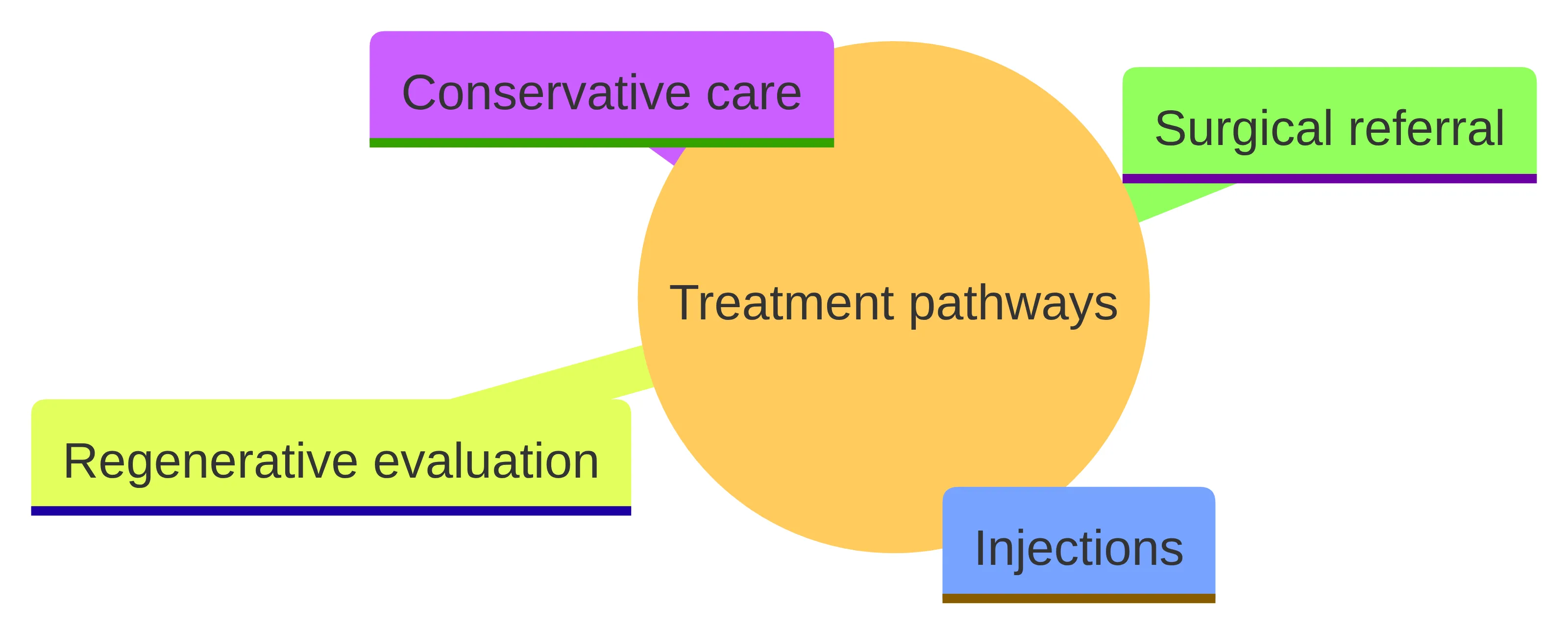
Choose the next action that matches the unresolved question
The right next action depends on what you still need to clarify. If the pain location, instability, numbness or pins and needles, or prior injury history is unclear, arrange a clinical assessment before choosing a treatment. If conservative care has not answered the problem and structural damage or advanced arthritis is part of the discussion, seek a surgical opinion or second opinion. If you want to discuss regenerative treatment, bring your symptom record, previous treatment history, alternatives, rehabilitation questions, risks, timeline, and total-cost questions to an individualized evaluation.
A qualified clinician must decide individual suitability after reviewing your findings and history. Use the consultation to compare options without treating uncertain evidence, temporary symptom relief, or variable regenerative responses as promises. The immediate goal is a clear question, a supported next step, and a plan for reassessment.
What should I ask before an ankle pain evaluation?
What are the common treatment options for ankle pain?
Common treatment options for ankle pain include conservative care, injections, regenerative therapies, and surgical referrals. Each option addresses different aspects of the condition, such as symptom management, functional support, or structural issues.
How can I prepare for a clinical evaluation for ankle pain?
To prepare for a clinical evaluation, keep a symptom record detailing the pain location, duration, prior treatments, and any associated symptoms like instability or numbness. This information will help the clinician assess your condition more effectively.
What should I consider when discussing injections for ankle pain?
When discussing injections, consider the specific symptoms they aim to address, the expected duration of relief, and how they compare to other treatment options like conservative care or regenerative therapies.
When is it appropriate to seek a surgical opinion for ankle pain?
A surgical opinion should be sought if there are unresolved questions about advanced arthritis, deformity, or persistent instability after conservative treatments have been attempted.
What role do regenerative treatments play in ankle pain management?
Regenerative treatments are considered after an individualized evaluation clarifies the condition and symptom pattern.
How does the duration and history of ankle pain affect treatment decisions?
The duration and history of ankle pain can indicate whether the issue is new or recurring, which influences the choice of treatment. Understanding prior responses to treatment helps tailor the next steps.
What questions should I ask during a consultation about ankle pain treatment?
During a consultation, ask about the leading explanation for your symptoms, how previous treatments affect current options, the intended purpose of each treatment, and what risks and costs are associated with the proposed plan.
Free consultation
Find out whether regenerative treatment is right for you.
Most consultations begin as a telehealth call with a physician specialist, so you can start without travelling to a clinic. No referral needed.